







Definition and Purpose of the Ocular Motility Worksheet - Med Navy
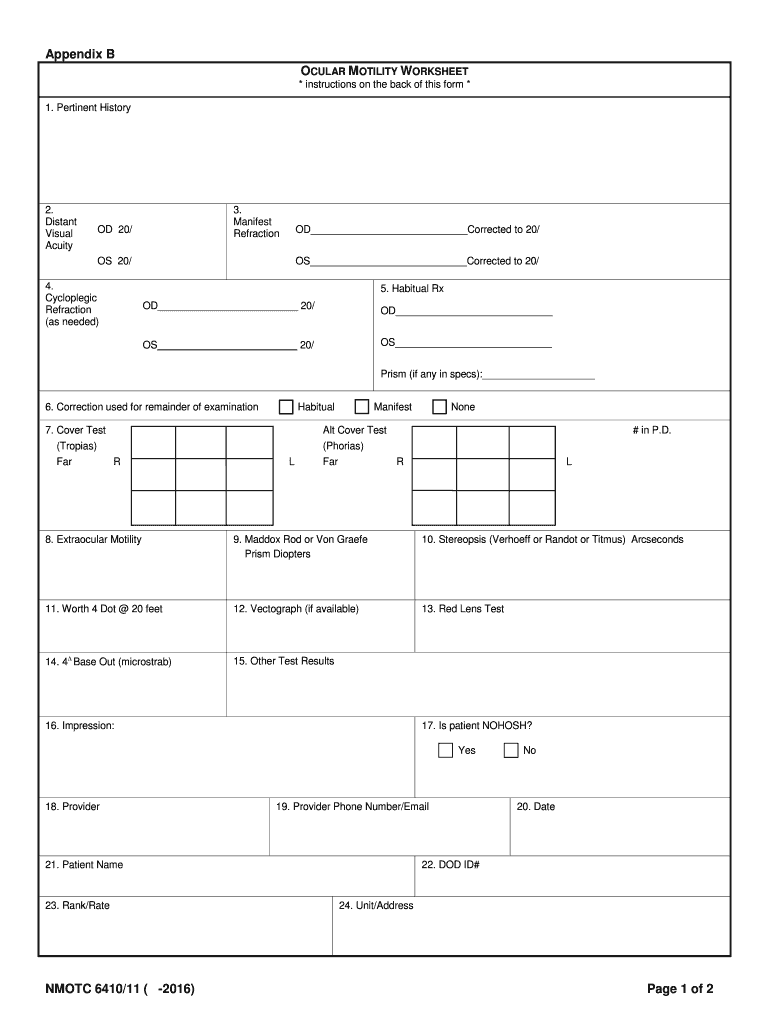
The Ocular Motility Worksheet - Med Navy is a specialized document used to record and assess various elements of a patient’s eye examination, focusing on ocular motility. This worksheet is primarily aimed at military personnel who are applying for aviation roles, given the critical importance of ocular health in fields requiring keen visual acuity and reflexes. This form collects data on different aspects of eye function, including visual acuity, refraction, and extraocular motility. These assessments ensure that the candidate meets the specific vision standards required for their role.
Key Elements of the Ocular Motility Worksheet
The most critical elements recorded on the Ocular Motility Worksheet include several sections devoted to different aspects of an eye examination:
- Visual Acuity: Measures the sharpness of vision, typically using a standard eye chart.
- Refraction Details: Provides information on the correction of refractive errors like myopia, hyperopia, and astigmatism.
- Cover Test Results: Evaluates eye alignment and reveals any deviations or strabismus.
- Extraocular Motility: Assesses the eye movements and identifies any restrictions or anomalies in movement.
Each section is designed to capture comprehensive data essential for an accurate assessment of ocular health, and these data points are crucial for determining the applicant's suitability for sensitive military positions.
Steps to Complete the Ocular Motility Worksheet
Completing the Ocular Motility Worksheet involves several distinct steps to ensure accurate data collection and analysis:
- Patient History: Gather comprehensive background information on the patient's ocular and general health history.
- Visual Acuity Test: Conduct using standardized tools like the Snellen chart to measure the best-corrected vision in both eyes.
- Refraction Assessment: Perform through automated or manual methodologies to document refractive status.
- Cover Test Execution: Utilize both cover-uncover and alternate cover tests to assess and record any misalignments.
- Evaluate Extraocular Motility: Clinically assess eye movements in various gaze positions to detect any limitations.
Following these steps ensures that each aspect of the ocular evaluation is appropriately documented, and the results accurately reflect the candidate's ocular health.
Who Typically Uses the Ocular Motility Worksheet
Primarily, this worksheet is utilized by ophthalmologists, optometrists, and other military medical personnel responsible for evaluating the ocular health of service members. It is particularly essential for candidates applying for aviation or other roles where precise vision is paramount. By maintaining standardized documentation, it enables healthcare providers to make informed decisions regarding the physical readiness of personnel for specific military duties.


Importance of the Ocular Motility Worksheet
The Ocular Motility Worksheet serves an essential role in the context of military readiness and safety. It ensures that individuals who require exemplary vision for their roles can perform their duties without risking personal or mission safety. This form not only helps identify vision-related issues early but also aids in managing and correcting these issues before they become critical impediments.
Legal and Compliance Aspects
While the Ocular Motility Worksheet itself does not impose legal obligations, the data collected can be used to fulfill requirements set by military guidelines and standards. Accurate documentation is crucial as it may support compliance with medical and fitness standards imperative for specific military assignments. Neglecting to appropriately complete this form can lead to non-compliance with military health regulations, which might compromise a candidate's application for certain roles.
Practical Examples of Using the Ocular Motility Worksheet
Consider a military candidate applying for an aviation role. During their assessment, the Ocular Motility Worksheet can reveal minor strabismus that needs addressing. Early detection through thorough examination logged via this worksheet can lead to corrective actions that improve the candidate's chances of acceptance.
In another scenario, a routine ocular assessment using the worksheet could detect visual acuity discrepancies in a service member exposed to environments potentially damaging to sight. This early detection allows for prompt intervention, preserving the service member's health and operational capability.
Format Variations and Digital Integrations
The Ocular Motility Worksheet is available in both paper and digital formats, allowing flexibility in its use. As digital documentation becomes more prevalent, the form integrates seamlessly with various software tools, providing efficient data storage and retrieval. Digital formats enhance accessibility and ensure the secure transmission of sensitive health data, aligning with modern technological standards in healthcare documentation.
Software and Compatibility Considerations
Given the increasing reliance on digital processes, the Ocular Motility Worksheet is compatible with various document management systems like DocHub, allowing for easy annotation, editing, and sharing. These platforms support features such as electronic signatures and secure document exchange, speeding up the workflow and ensuring the accuracy and integrity of the data collected.




