







Definition & Meaning
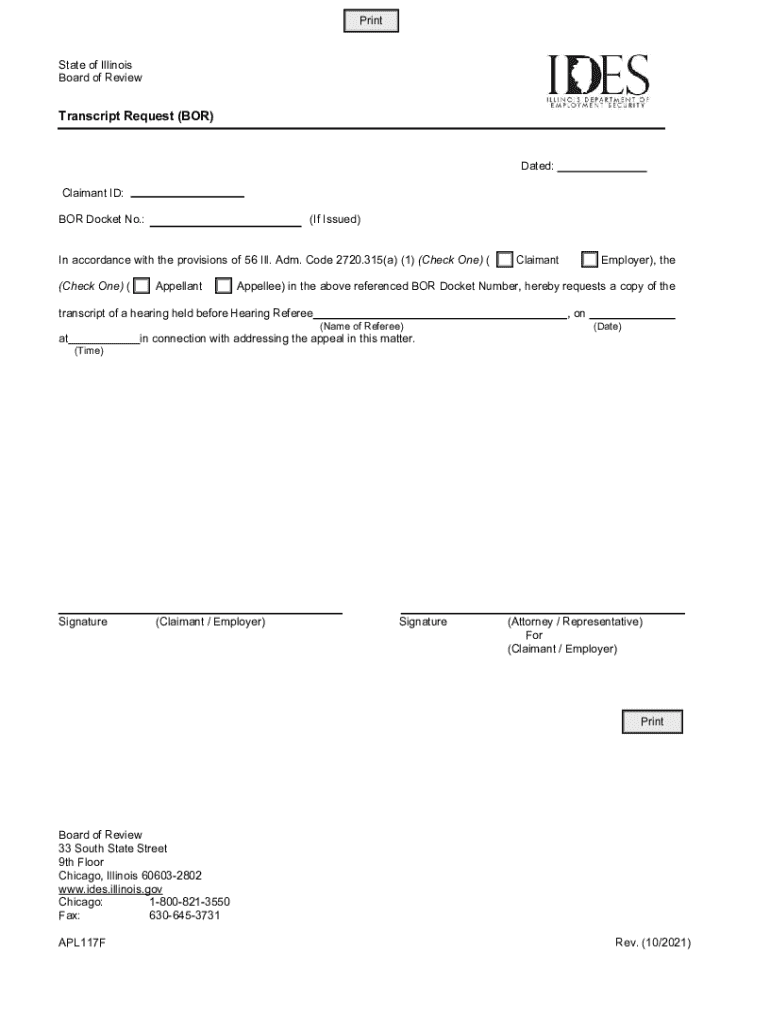
The "Transcript Request (BOR) Illinois Unemployment Insurance Act - IBIS" is a form used to request a copy of a hearing transcript from the State of Illinois Board of Review. This form is often utilized by appellants or appellees involved in an appeal related to unemployment insurance decisions. The document serves as an official means for individuals to obtain detailed records of the verbal proceedings that took place during their appeal hearing.
Important Components
- Claimant Identification: This section includes the appellant's or appellee's identification, ensuring accuracy in processing the request.
- Docket Number: A unique identifier related to the specific appeal case being addressed, crucial for maintaining organized case records.
- Signatures: Required from the requesting party to validate the request and ensure authenticity.
- Contact Information: Details for the Board of Review, usually encompassing address and phone number, to facilitate correspondence.
How to Use the Transcript Request Form
Steps to Utilize the Form
- Complete Identifiable Information: Fill in sections pertaining to your claimant ID and docket number.
- Sign and Date: Ensure your signature is included to authorize the request.
- Submit to the Correct Address: Mail or deliver the form to the Board of Review's designated address as outlined on the form itself.
Practical Scenarios
- Post-Hearing Need: Individuals who wish to appeal further or require a detailed account of the hearing proceedings often file this form.
- Legal Preparation: Lawyers representing claimants may request transcripts to build their case more effectively.
Steps to Complete the Transcript Request Form
Detailed Completion Guide
- Gather Necessary Information: Have your claimant ID and docket number available.
- Provide Personal Details: Fill in your name, address, and contact information.
- Select Preferred Delivery Method: Indicate how you wish to receive the transcript (e.g., mail or electronic).
- Review and Double-Check: Ensure all fields are correctly completed to prevent delays.
- Submit the Form: Upon completion, send it to the specified recipient address.
Common Mistakes to Avoid
- Incomplete Fields: Ensure all mandatory sections are filled out.
- Incorrect Address: Verify the Board of Review's current address to ensure delivery.
Who Typically Uses the Transcript Request Form


Primary Users
- Appellants and Appellees: Individuals involved in unemployment insurance appeals are primary users.
- Legal Professionals: Attorneys may file on behalf of clients to obtain accurate hearing records.
- Government Agencies: May require transcripts to audit or review decision processes.
User Scenarios
- Disputed Claims: Individuals disputing the decisions related to their unemployment benefits.
- Case Review: Professionals reviewing the fairness and accuracy of decisions made during an appeal.
Legal Use of the Transcript Request Form
Compliance Considerations
- Adherence to Privacy Laws: Transcripts contain sensitive information, necessitating careful handling to comply with data protection regulations.
- Authenticity Verification: Signatures and identifiers must be genuine to legally process the request.
Legal Protections
- Secure Document Handling: Implement appropriate measures for secure document exchange to protect personal information.
Required Documents for Submission
Essential Documentation
- Completed Request Form: Must be accurately filled.
- Proof of Identity (if required): Documentation to verify the identity of the requester may be necessary in some instances.
Additional Requirements
- Supporting Information: Any additional documentation that might support the request, such as letters from legal representatives.
Form Submission Methods
Available Methods
- Online Submission: Some jurisdictions might offer an electronic submission option through designated portals.
- Mailing Method: Include the completed form in a secure, postage-paid envelope addressed to the Board of Review.
- In-Person Submission: Delivering in person to a designated office may be possible for individuals preferring direct delivery.
Pros and Cons of Each Method
- Online: Faster processing but may require scanning capabilities.
- Mail: Widely accessible but slower than digital options.
- In-Person: Immediate delivery, but may not be feasible for distant requesters.
Key Elements of the Transcript Request Form
Critical Sections
- Form Identification: Clear labeling of the form’s purpose at the top.
- Requestor Details: Comprehensive fields detailing who is making the request and their relationship to the case.
- Transcript Details: Specifics about which hearing transcript is being sought, including dates and case identifiers.
Importance of Complete Information
- Processing Efficiency: Fully completed forms are processed more efficiently and with fewer delays.
- Accuracy Assurance: Properly filled forms ensure that the correct transcript is sent to the correct individual.




