




01. Edit your form 206 evidence of life online
Type text, add images, blackout confidential details, add comments, highlights and more.

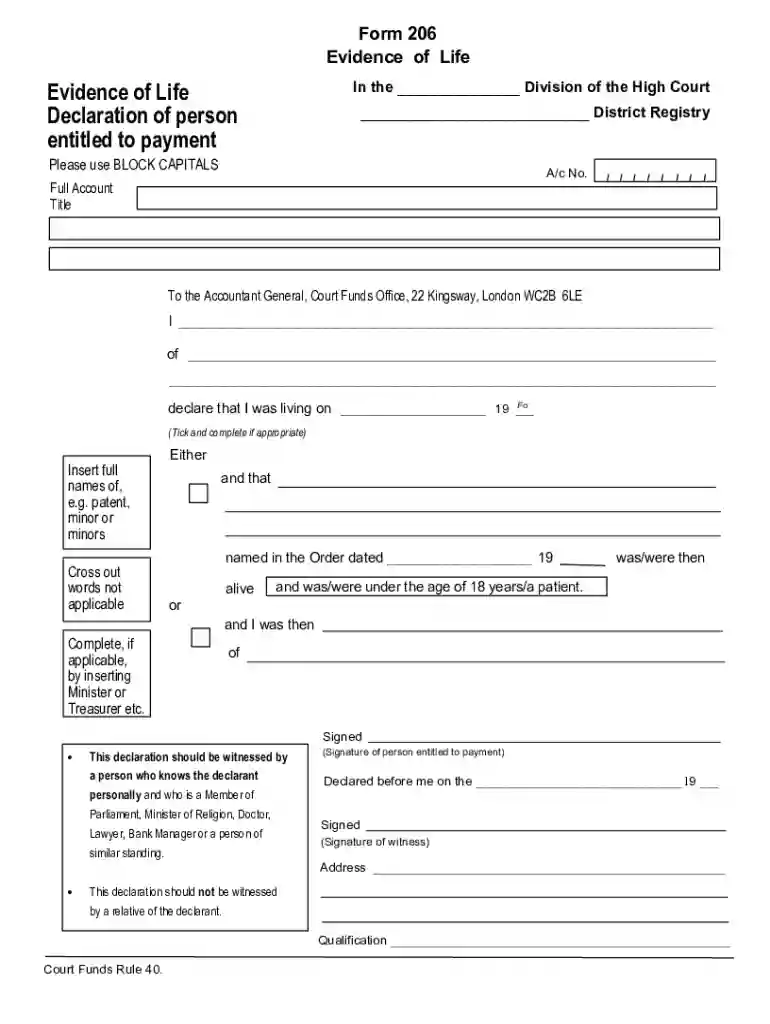
Type text, add images, blackout confidential details, add comments, highlights and more.

Draw your signature, type it, upload its image, or use your mobile device as a signature pad.

Send 206 form via email, link, or fax. You can also download it, export it or print it out.
Form 206, titled "Evidence of Life," is a legal document used primarily in the United Kingdom to confirm the living status of an individual entitled to receive payments from court-held funds. This form is often required by the High Court to ensure that the recipient or beneficiary is still alive and eligible to receive the financial assets in question. It is crucial because it helps prevent fraud and unauthorized access to funds, thereby protecting the interests of both the beneficiaries and the issuing authorities.
Utilizing the Form 206 effectively requires understanding its purpose and completion process. It is predominantly used by individuals or legal representatives who need to confirm the living status of someone entitled to court funds.
Identifying the Need: Determine whether the form is required for your specific situation, typically if you have been instructed to provide evidence of life to receive funds from court deposits.
Completing the Form: Fill out all required fields accurately, ensuring that personal details and declaration statements are comprehensively covered.
Witness Requirement: Ensure a qualified, independent witness is present to sign the form. They must not be a family member to maintain impartiality.
Submitting the Form: Once completed, submit the form as per the instructions provided by the court or the requesting entity, adhering to any specified timelines.
Acquiring this form involves straightforward steps that ensure compliance with court requirements. While the form may not be widely available online due to its specific use within court systems, you can obtain it through several avenues.
Court Websites: Often, the form can be downloaded directly from the official website of the relevant court that requires it.
Legal Representatives: Solicitors or legal advisors can provide the form and assist with its completion, ensuring it meets all legal expectations.
Court Offices: Visit the court office in person to request the form. This can also provide an opportunity to verify if any additional documentation is needed.
Effectively completing Form 206 involves several critical steps, ensuring that all required information is provided accurately and with appropriate authentication.
Read the Instructions: Understand each section of the form to prevent errors that might delay processing.
Provide Accurate Personal Information: Enter all requested personal details accurately to avoid discrepancies.
Fill Out the Declaration Section: Clearly state the date on which you are declaring yourself or another individual as alive, if applicable.
Engage a Qualified Witness: Confirm that a qualified witness, unrelated to the declarant, is available to sign the document.
Review and Sign: Before submission, review the completed form for accuracy, and ensure all parties have correctly signed where required.
Submit in Compliance: Follow submission guidelines, whether online, by mail, or in person, as instructed by the court or entity in charge.
Several critical sections make up Form 206, each serving to verify and document the life status of an individual. Understanding these elements is essential for accurate and authoritative completion.
Declarant Information: This section captures all personal data of the individual whose life status is being verified.
Witness Confirmation: Details of the witness confirming the declarant’s status and their relationship must be included.
Purpose of the Declaration: Clearly states why the evidence of life is being provided, often linked to financial disbursements.
This form primarily serves a legal purpose, helping to verify individuals' eligibility for receiving funds held by or released from the court. The legal use ensures that funds are directed toward legitimate beneficiaries and that legal processes remain transparent and accountable.
Fraud Prevention: Acts as a safeguard against fraudulent claims on court-handled funds.
Court Fund Disbursement: Ensures that only living individuals receive court funds, protecting the estate’s integrity and reducing erroneous payout risks.
The form is typically used by a wide range of individuals and entities that need to establish or verify an individual's living status for legal or financial purposes.
Legal Representatives: Solicitors and barristers may utilize the form to process claims on behalf of clients.
Beneficiaries: Individuals entitled to funds may personally fill out the form to ensure they receive finances from court deposits.
Estate Executors: Those managing estates may require the form to comply with legal duties concerning fund disbursement.


Real-world scenarios provide insight into the practical application of Form 206. Understanding its use can assist in ensuring compliance and verification.
Pension Validation: Individuals receiving pension payments may need to verify their living status to continue receiving benefits.
Court-Ordered Fund Release: Those seeking funds held by the court for family maintenance might use the form to confirm eligibility.
International Scenarios: For individuals living abroad receiving UK-based disbursements, this form ensures continuous legal and financial compliance.
We've got more versions of the form 206 evidence of life form. Select the right form 206 evidence of life version from the list and start editing it straight away!
| Versions | Form popularity | Fillable & printable |
|---|---|---|
| 2013 | 4.4 Satisfied (37 Votes) |
At DocHub, your data security is our priority. We follow HIPAA, SOC2, GDPR, and other standards, so you can work on your documents with confidence.
by JH Langbein Cited by 415 Common Law 206 (A.W.B. Dictionaries and Indexes of English older law the effort to treat the document-preferring best evidence rule as the or- ganizing
short form of a urinary quality of life questionnaire: Identifying and classifying quality of life tools for neurogenic bladder function after spinal cord


