




01. Edit your form 18b online
Type text, add images, blackout confidential details, add comments, highlights and more.

Type text, add images, blackout confidential details, add comments, highlights and more.

Draw your signature, type it, upload its image, or use your mobile device as a signature pad.

Send form 18b notice of intent to defend via email, link, or fax. You can also download it, export it or print it out.
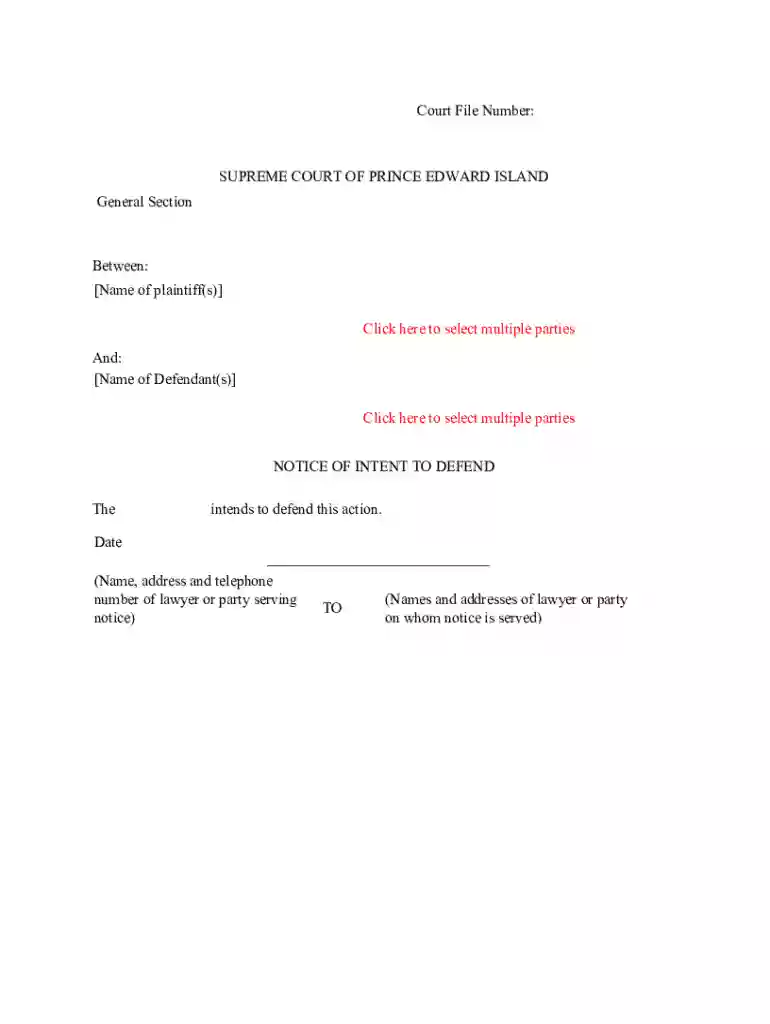
The "f-18b" form serves as a legal notice for individuals or entities indicating their intention to defend against an action in the Supreme Court of Prince Edward Island. It records critical data such as the identities of the parties involved, including the plaintiff(s) and defendant(s), along with the contact information for legal representatives.
Obtaining the f-18b form is an essential first step for parties involved in legal actions in the Supreme Court of Prince Edward Island.
Completing the f-18b form accurately is crucial for legal proceedings. Failure to provide correct details can lead to setbacks or miscommunication in the legal process.
Fill in Plaintiff Information:
Provide Defendant Details:
Identify Legal Representation:
Certify Intent to Defend:
Finalize and Review:
Understanding why the f-18b is crucial can help clarify its role in the legal process.
The f-18b includes several important components that must be completed accurately.
To illustrate the application of the f-18b, consider the following scenarios.
Civil Dispute: In a contract dispute where one party alleges breach and initiates legal action, the defending party would submit the f-18b to announce their defense.
Family Law: During a divorce proceeding, if one spouse disputes claims made by the other, they would use the f-18b to formally defend their position.
Understanding the legal implications of using the f-18b is essential for compliance.
While the f-18b is specific to Prince Edward Island, awareness of jurisdictional differences is beneficial.
We've got more versions of the form 18b form. Select the right form 18b version from the list and start editing it straight away!
At DocHub, your data security is our priority. We follow HIPAA, SOC2, GDPR, and other standards, so you can work on your documents with confidence.
Jul 1, 2025 The F/A-18B and D are dual-seaters. The B model is used primarily for training, current Navy aircraft for attack, tactical air control, while
Oct 4, 2023 The two-seat F/A-18 support aircraft is normally used for photo or video chase. The aircraft is configured to transmit live video back toRead more


