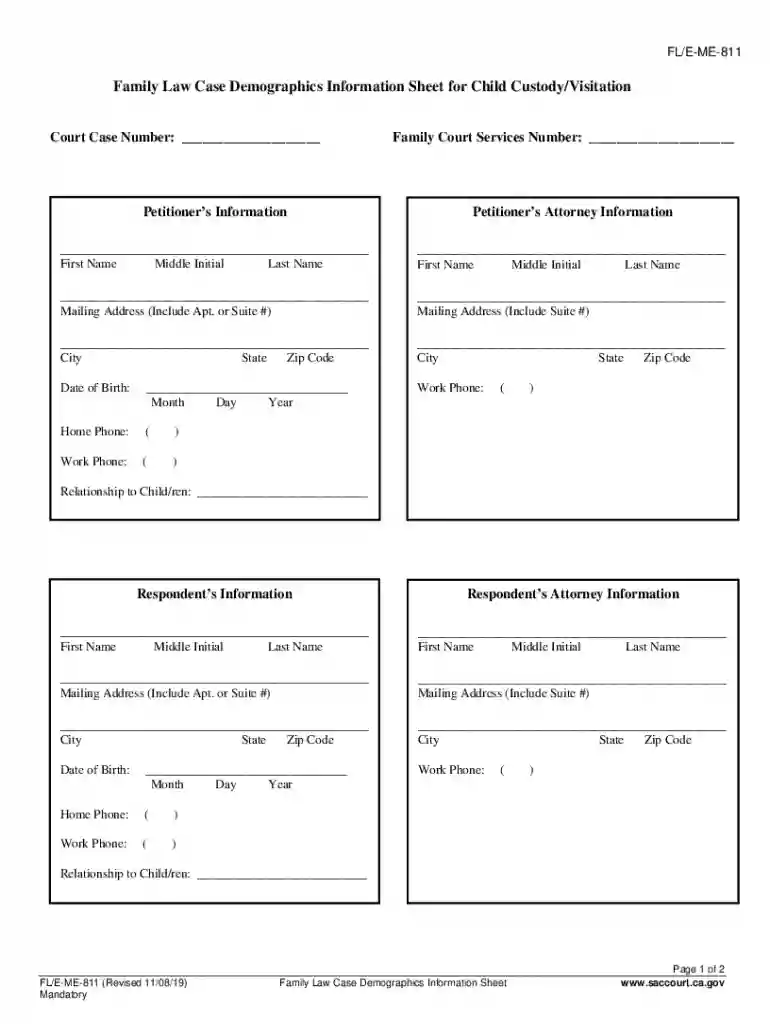
ME-811 FL Case Demographics Information 2026

Get Form
fl e me 811 Preview on Page 1

Here's how it works

01. Edit your fl e me 811 online
Type text, add images, blackout confidential details, add comments, highlights and more.

02. Sign it in a few clicks
Draw your signature, type it, upload its image, or use your mobile device as a signature pad.

03. Share your form with others
Send it via email, link, or fax. You can also download it, export it or print it out.

Definition and Purpose of the ME-811 FL Case Demographics Information

The ME-811 FL Case Demographics Information sheet is an essential document used in family law cases, particularly those involving child custody and visitation. The form serves to gather critical information about all parties involved, including the petitioner, respondent, and any third-party claimants. Information collected includes contact details, relationships to the children in question, and any interpreter needs. This ensures that the court has all necessary personal data to make informed decisions during the proceedings.

How to Use the ME-811 FL Case Demographics Information

To effectively utilize the ME-811 FL form, the respondent should carefully read through each section and provide accurate information. Begin by filling out your contact details, followed by details of other parties involved. It's essential to provide correct relationships between each individual and the children to avoid any legal complications. If interpreter services are required for any party, this must be indicated to ensure proper communication throughout the legal process.

Steps to Complete the ME-811 FL Case Demographics Information

  1. Download the Form: Obtain the ME-811 FL form from the family court’s website or physical courthouse location.
  2. Fill Personal Information: Enter your full name, address, and contact information.
  3. Provide Details of Involved Parties: Include names and contact details of the petitioner, respondent, and third-party claimants.
  4. Specify Relationships: Clearly state the relationship each party has to the children involved in the case.
  5. Note Interpreter Requirements: Indicate if any parties need an interpreter and specify the language required.

Completing these steps accurately ensures that all relevant details are accounted for and submitted to the court efficiently.

Key Elements of the ME-811 FL Case Demographics Information

  • Contact Information: Includes the name, address, and phone numbers of all individuals involved.
  • Relationships to Children: Details the specific relationship each party holds with the children, which is crucial for child custody decisions.
  • Interpreter Needs: Notes any requirement for language assistance to maintain clear communication throughout the case.
  • Mandatory Fields: Emphasizes fields that must be completed to avoid delays in processing your documentation through the court system.

These elements are critical to ensuring that the family court has sufficient and accurate data to base its decisions on.

Who Typically Uses the ME-811 FL Case Demographics Information

The ME-811 FL form is primarily used by individuals involved in family law proceedings, such as child custody and visitation matters. This includes:

  • Petitioners: Individuals initiating the case, often seeking custody or visitation rights.
  • Respondents: Individuals who are the subject of the custody or visitation case.
  • Third-party Claimants: Others who have an interest in the custody or visitation agreements, such as grandparents or extended family.

Attorneys and legal practitioners also utilize this form to assist their clients in accurately providing necessary demographics information.


decoration image ratings of Dochub

Legal Use of the ME-811 FL Case Demographics Information

Utilization of the ME-811 FL form adheres strictly to legal procedures within family court settings. Information provided on the form is used:

  • In Court Proceedings: To aid judges in understanding the familial context and relationships.
  • For Legal Documentation: As an official record of all involved parties’ details and relationships to the children.
  • In Compliance with State Laws: Ensures adherence to family law requirements specific to child custody cases.

Accuracy in filling out this paperwork is paramount to maintaining the legal integrity and efficiency of the court process.

Important Terms Related to the ME-811 FL Case Demographics Information

  • Petitioner: The person initiating the legal proceedings.
  • Respondent: The person responding to the legal action.
  • Third-party Claimant: An individual or entity claiming an interest in the custody or visitation case.
  • Interpreter: A person who translates spoken or sign language in family court settings.

Understanding these terms is fundamental to accurately completing and processing the ME-811 FL form.

State-Specific Rules for the ME-811 FL Case Demographics Information

In different states, the requirements and use of the ME-811 FL form may vary. It is essential to check:

  • State Family Law Codes: Determine if any additional information or documentation is required.
  • Localized Procedure Variations: Some states may have supplementary forms or specific filing instructions.
  • Processing Times: Varies based on the state’s legal system and court schedules.

Familiarity with these state-specific rules ensures comprehensive compliance while completing and submitting the form.

Examples of Using the ME-811 FL Case Demographics Information

Consider a scenario where a parent is seeking custody of their children. The ME-811 FL form will be used to document their contact details and relation to the children. If the other parent (respondent) speaks another language, they would request an interpreter on the form to ensure clarity during court hearings. This practical use of the form highlights the importance of its role in facilitating fair custody arrangements guided by accurate demographic information.

See more ME-811 FL Case Demographics Information versions

We've got more versions of the ME-811 FL Case Demographics Information form. Select the right ME-811 FL Case Demographics Information version from the list and start editing it straight away!
Versions Form popularity Fillable & printable
2019 4.3 Satisfied (25 Votes)
2016 4.8 Satisfied (270 Votes)
2010 4.3 Satisfied (78 Votes)
be ready to get more

Complete this form in 5 minutes or less

Get form

Got questions?

We have answers to the most popular questions from our customers. If you can't find an answer to your question, please contact us.
Contact us
A demographic refers to distinct characteristics of a population. Researchers use demographic analysis to analyze whole societies or just groups of people. Some examples of demographics are age, sex, education, nationality, ethnicity, or religion, to name a few.
Types of Demographic Information The common variables gathered in demographic research include age, sex, income level, race, employment, location, homeownership, and level of education. Demographical information makes certain generalizations about groups to identify customers.
A demographic form is a specialized tool to gather specific details about an individual. It requires users to fill in their names, contact details, and other personal data such as birth date, gender, marital status, ethnicity, and the languages they communicate in.
Demographic Sheet Report displays the demographic information of a patient in a printable form in order to get the signed consent of the patient regarding treatment costs.
Local Forms are forms that are specific only to Yuba County Superior Court. They are adopted as part of the Local Rules of Court. If you do not see the form you are looking for on this page, then your form might be a Judicial Council Form.

Security and compliance

At DocHub, your data security is our priority. We follow HIPAA, SOC2, GDPR, and other standards, so you can work on your documents with confidence.

Learn more
ccpa2
pci-dss
gdpr-compliance
hipaa
soc-compliance

People also ask

What goes on a demographic sheet? Demographic information examples include: age, race, ethnicity, gender, marital status, income, education, and employment.

Related links