CR-251 ORDER FOR TRANSFER Judicial Council forms 2026

Get Form
cr251 Preview on Page 1

Here's how it works

01. Edit your cr251 online
Type text, add images, blackout confidential details, add comments, highlights and more.

02. Sign it in a few clicks
Draw your signature, type it, upload its image, or use your mobile device as a signature pad.

03. Share your form with others
Send cr 251 via email, link, or fax. You can also download it, export it or print it out.

How to use or fill out CR-251 ORDER FOR TRANSFER Judicial Council forms with our platform

Form edit decoration
9.5
Ease of Setup
DocHub User Ratings on G2
9.0
Ease of Use
DocHub User Ratings on G2
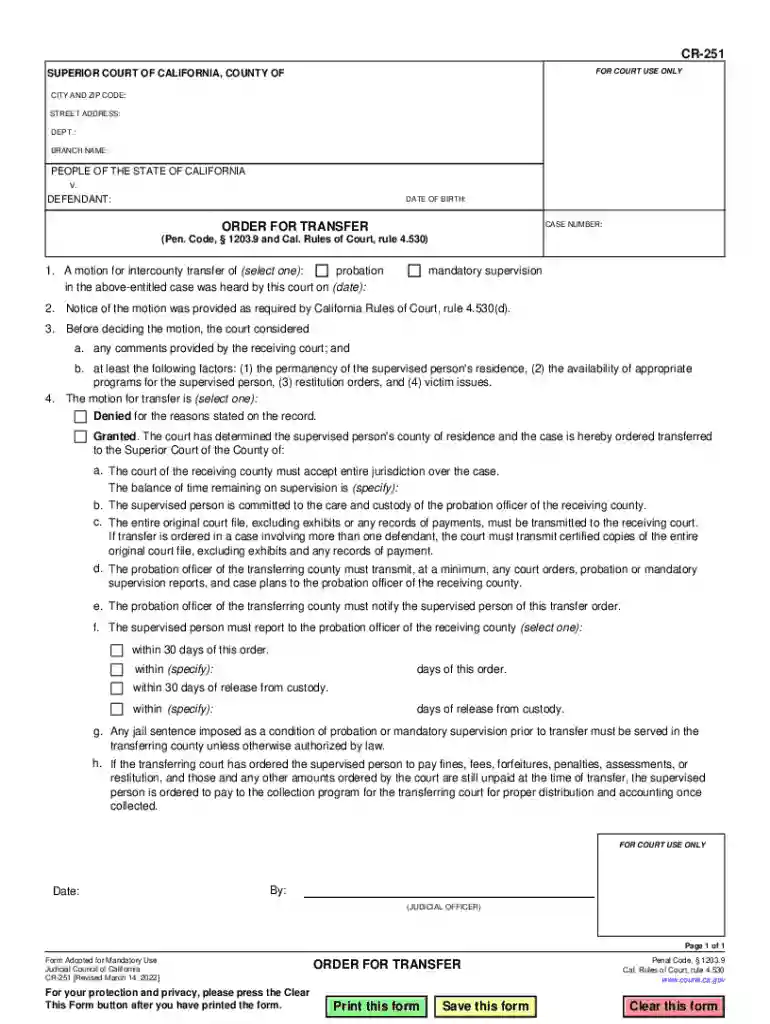
  1. Click ‘Get Form’ to open the CR-251 ORDER FOR TRANSFER in the editor.
  2. Begin by entering the court's information, including the Superior Court of California, County, City and Zip Code, Street Address, Department, and Branch Name.
  3. Fill in the case details: include the Defendant's name, Date of Birth, and Case Number.
  4. Select whether you are transferring probation or mandatory supervision by checking the appropriate box.
  5. Provide the date when the motion for intercounty transfer was heard.
  6. Indicate if notice of the motion was provided as required by California Rules of Court.
  7. Review and select whether the motion for transfer is granted or denied. If granted, specify the receiving county and any additional conditions outlined in sections a-h.
  8. Finally, ensure to sign and date the form at the bottom where indicated for court use only.

Start using our platform today to easily complete your CR-251 ORDER FOR TRANSFER form online for free!

See more CR-251 ORDER FOR TRANSFER Judicial Council forms versions

We've got more versions of the CR-251 ORDER FOR TRANSFER Judicial Council forms form. Select the right CR-251 ORDER FOR TRANSFER Judicial Council forms version from the list and start editing it straight away!
Versions Form popularity Fillable & printable
2022 4.4 Satisfied (28 Votes)
2021 4.8 Satisfied (74 Votes)
2012 4.3 Satisfied (76 Votes)
be ready to get more

Complete this form in 5 minutes or less

Get form

Got questions?

We have answers to the most popular questions from our customers. If you can't find an answer to your question, please contact us.
Contact us
For a case transfer, you must first file a motion for a change of venue with the court where the case is currently filed. Change of venue for a court case involves understanding the legal intricacies. The best way to navigate the process is with the help of a family law attorney in California.
Civil cases arise from disputes involving the Constitution, federal laws, or treaties. They also can be brought in district court if the parties are citizens of different states or countries and the amount in controversy exceeds a certain amount of money.
In the US legal system, transfer generally refers to the act of changing a lawsuits venue from one US federal district court to another US federal district court.
To bring a state law claim in federal court, all of the plaintiffs must be located in different states than all of the defendants, and the amount in controversy must be more than $75,000.
The Judicial Council is the policymaking body of the California courts, the largest court system in the nation.

Security and compliance

At DocHub, your data security is our priority. We follow HIPAA, SOC2, GDPR, and other standards, so you can work on your documents with confidence.

Learn more
ccpa2
pci-dss
gdpr-compliance
hipaa
soc-compliance

People also ask

Upon the defendants motion, the court may transfer the proceeding, or one or more counts, against that defendant to another district for the convenience of the parties, any victim, and the witnesses, and in the interest of justice.
Transfer to defendants local court Claims will continue to be transferred automatically to the defendants local court where: the claim is not a specialist claim. the claim is for a specific sum (typically debt claims) the defendant is a private individual.
A common pleas court has legal authority over adult felony criminal cases, bigger civil cases, and all other cases not handled by another, more specialized court.

Related links