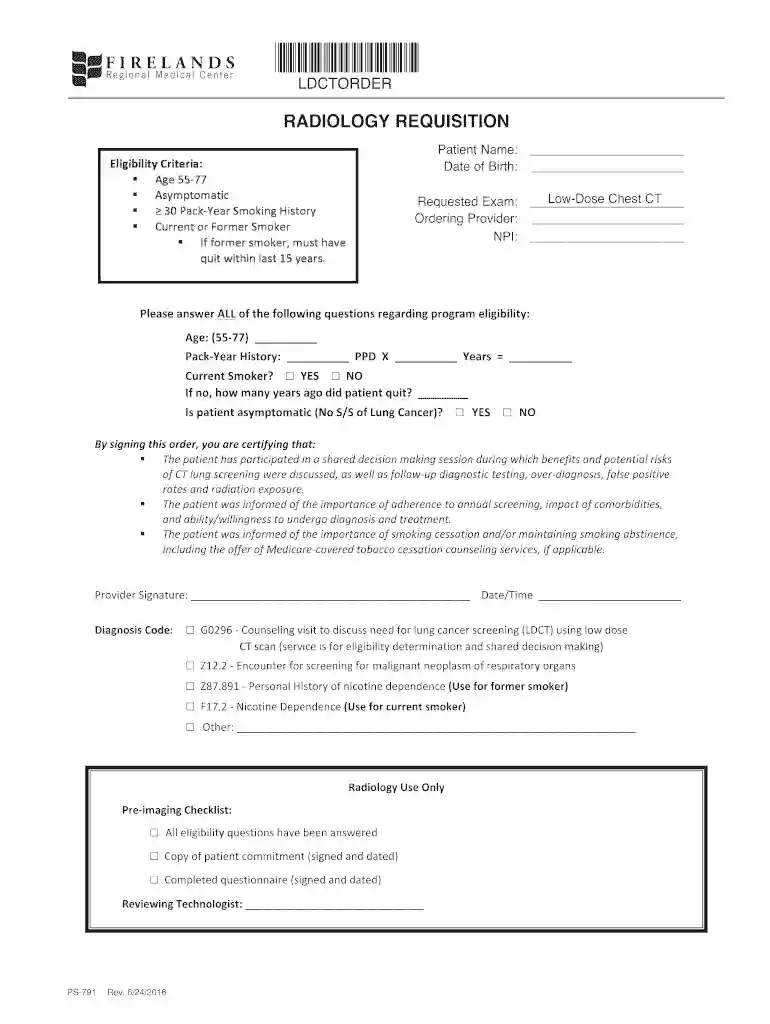
RADIOLOGY REQUISITION 2026

Get Form
RADIOLOGY REQUISITION Preview on Page 1

Here's how it works

01. Edit your form online
Type text, add images, blackout confidential details, add comments, highlights and more.

02. Sign it in a few clicks
Draw your signature, type it, upload its image, or use your mobile device as a signature pad.

03. Share your form with others
Send it via email, link, or fax. You can also download it, export it or print it out.

Definition and Meaning of Radiology Requisition

A radiology requisition is a formal document utilized within medical settings to request imaging services for a patient. This form acts as a communication tool between the referring healthcare provider and the radiology department, ensuring that the necessary imaging studies are conducted accurately and promptly. The document typically includes essential details such as the patient's personal information, the type of radiology exam required, the clinical indication for the examination, and any specific instructions for the radiology team. It serves as a critical component of patient care, facilitating accurate diagnosis and treatment planning.

Key Elements of the Radiology Requisition

A radiology requisition form comprises several components to convey necessary information effectively:

  • Patient Information: Includes the patient's full name, date of birth, and identification number to ensure accurate record-keeping and identification.
  • Referring Healthcare Provider Details: Provides the name, contact information, and signature of the doctor or medical professional who is requesting the radiology service.
  • Clinical Indication: Specifies the medical reason or symptoms that justify the radiology examination, guiding the radiologist in performing the appropriate imaging study.
  • Type of Imaging Exam: Details the specific type of radiology procedure needed, such as an X-ray, CT scan, MRI, or ultrasound.
  • Special Instructions: Any additional notes or requirements for the radiology staff, such as patient preparation instructions or requests for add-on imaging sequences.

How to Use the Radiology Requisition

Utilizing a radiology requisition form involves a systematic process that ensures all required information is provided accurately. Here's how it is typically used:

  1. Patient Assessment: The healthcare provider evaluates the patient and determines the necessity for a radiological exam.
  2. Form Completion: The referring provider fills out the radiology requisition form, entering all relevant patient details, clinical indications, and requested imaging procedures.
  3. Submission to Radiology: The completed form is submitted to the radiology department, either electronically or via physical delivery, to schedule and conduct the examination.
  4. Coordination with the Patient: The radiology department coordinates with the patient to arrange a convenient time for the imaging procedure and provides any specific preparation instructions.

Practical Examples

  • For a patient experiencing chronic headaches, a healthcare provider may fill out a radiology requisition for a brain MRI to rule out potential causes like a tumor or aneurysm.
  • In the case of chest pain, a requisition may be issued for a low-dose chest CT scan to check for lung issues or cardiac anomalies.

Steps to Complete the Radiology Requisition

Completing a radiology requisition involves the following steps to ensure accuracy and completeness:

  1. Gather Patient Information: Collect personal and medical details, ensuring correct spelling and information.
  2. Identify Need for Imaging: Determine the type of imaging necessary based on the patient's symptoms and clinical indications.
  3. Complete the Requisition Form:
    • Accurately fill in patient demographics.
    • Clearly state the clinical indications for the imaging study.
    • Specify the type of radiology exam required.
    • Include any special instructions or notes.
  4. Review for Accuracy: Double-check the information for any errors or omissions.
  5. Submit the Form: Deliver the completed form to the radiology department for processing.

Importance of a Radiology Requisition

Radiology requisitions are crucial as they facilitate effective communication between medical staff, aiding in patient diagnosis and treatment. They ensure that the imaging studies requested are aligned with the patient's clinical needs, avoiding unnecessary procedures and expedites the diagnostic process.

Who Typically Uses the Radiology Requisition

Radiology requisition forms are predominantly used by:

  • Healthcare Providers: Physicians, nurse practitioners, and other medical professionals who identify the need for diagnostic imaging.
  • Radiology Departments: Use the form to organize and schedule imaging studies, interpreting the information to deliver precise imaging services.
  • Medical Staff: Administrative staff use requisitions to manage patient records and billing processes.
decoration image ratings of Dochub

Legal Use of the Radiology Requisition

Radiology requisition forms must comply with legal and regulatory standards to maintain confidentiality and accuracy. In the United States, they must adhere to HIPAA guidelines to protect patient information. Additionally, the forms act as legal documentation of the medical necessity for imaging procedures, which is significant for insurance reimbursement and claims processing.

Software Compatibility and Digital vs. Paper Versions

Radiology requisitions can be digital or paper-based, depending on the facility's infrastructure. Modern healthcare systems often utilize digital forms to streamline the process:

  • Compatibility with Medical Software: Electronic health record (EHR) systems integrate with digital requisition forms for efficient management.
  • Digital Advantages: Allow for easier tracking, reduced paperwork, and quicker communication between departments.
  • Paper Versions: Used in settings where digital infrastructure is unavailable, requiring manual submission processes.

Practical Scenarios for Radiology Requisitions

Radiology requisition forms are versatile and used in diverse medical scenarios such as:

  • Pre-Surgical Evaluation: Requesting specific imaging to plan surgeries like joint replacement or spinal surgery.
  • Acute Situations: Issuing rapid requisitions for emergency cases, such as trauma victims requiring CT scans.
  • Routine Monitoring: Scheduling regular imaging studies for chronic conditions like cancer or cardiovascular disease management.

Each scenario reflects the requisition form's role in maintaining high standards of patient care and optimizing diagnostic accuracy.

See more RADIOLOGY REQUISITION versions

We've got more versions of the RADIOLOGY REQUISITION form. Select the right RADIOLOGY REQUISITION version from the list and start editing it straight away!
Versions Form popularity Fillable & printable
2022 4.8 Satisfied (44 Votes)
2016 4 Satisfied (55 Votes)
be ready to get more

Complete this form in 5 minutes or less

Get form

Got questions?

We have answers to the most popular questions from our customers. If you can't find an answer to your question, please contact us.
Contact us
An X-ray order is typically valid for 30 to 90 days, depending on the healthcare setting and specific institutional policies. This period ensures the imaging is relevant to the patients health. Verifying the specific validify period with the healthcare facility or referring physician is essential. How Long Are X-Ray Orders Valid? - Maven Imaging Maven Imaging blog how-long-are- Maven Imaging blog how-long-are-
Radiology request form (RRF) is a medical referral to a radiologist requesting input concerning the diagnosis, treatment, follow-up of patients, and intervention where necessary.
A radiology requisition is a formal document completed by a healthcare provider that orders a specific radiological exam and provides essential details about the patients condition and medical history. Do You Need a Requisition for an X-Ray? - Maven Imaging Maven Imaging blog do-you-need-r Maven Imaging blog do-you-need-r
A radiology requisition is a formal document completed by a healthcare provider that orders a specific radiological exam and provides essential details about the patients condition and medical history.
One approach is the ten day rule, which states that whenever possible, one should confine the radiological examination of the lower abdomen and pelvis to the 10-day interval following the onset of .

Security and compliance

At DocHub, your data security is our priority. We follow HIPAA, SOC2, GDPR, and other standards, so you can work on your documents with confidence.

Learn more
ccpa2
pci-dss
gdpr-compliance
hipaa
soc-compliance

People also ask

Radiologists can help your doctor diagnose and treat a wide variety of health conditions. So, your doctor will call on a radiologist when they need help with imaging or certain specialized treatments. Radiologists - What They Do Why You Might Need One - WebMD WebMD cancer-what-radiologist WebMD cancer-what-radiologist
If youve been in a car accident or experienced another type of trauma, you must see a radiologist as soon as possible. X-ray imaging can determine whether you have broken or fractured bones, while an MRI or CT scan can determine whether you have internal injuries to your soft tissues or internal bleeding. 6 Reasons Why You Should See a Radiologist - EMU Health EMU Health blog 1237327-6-reasons EMU Health blog 1237327-6-reasons

Related links