




01. Edit your jv form 667 online
Type text, add images, blackout confidential details, add comments, highlights and more.

Type text, add images, blackout confidential details, add comments, highlights and more.

Draw your signature, type it, upload its image, or use your mobile device as a signature pad.

Send jv 667 via email, link, or fax. You can also download it, export it or print it out.
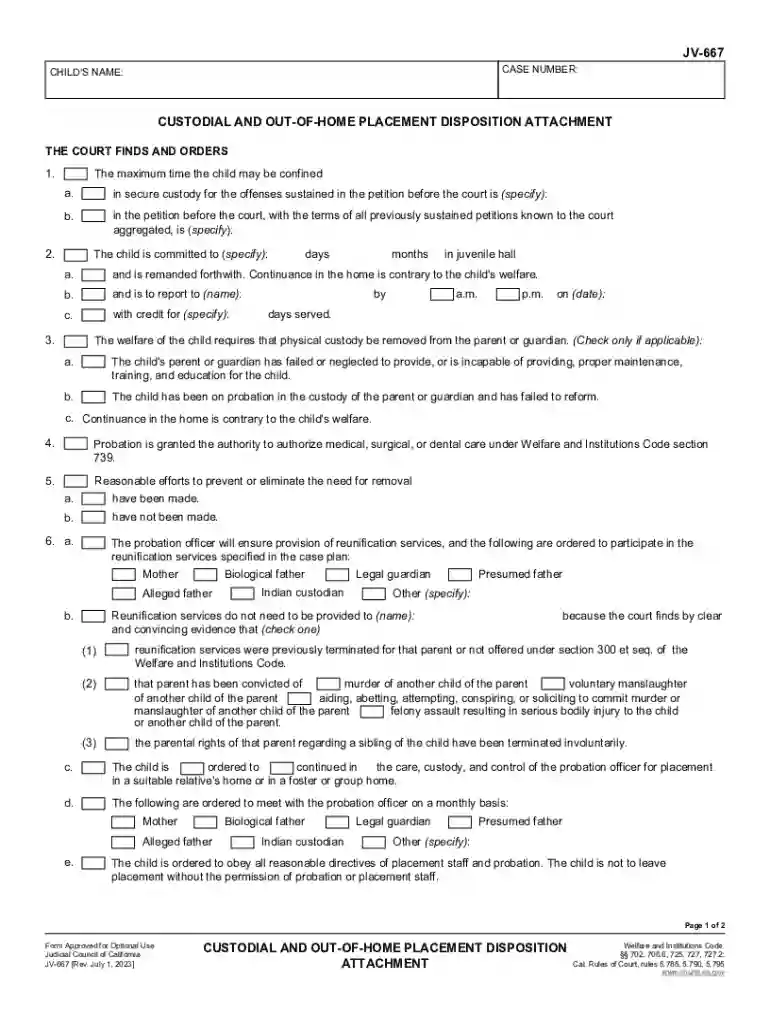
The JV-667 Custodial and Out of Home Placement Disposition Attachment is a legal document used in family court proceedings to detail the decisions regarding a child's custodial and out-of-home placement. This form specifies the court's findings and orders concerning the care and placement of a child who cannot remain with their parents. It covers a range of considerations, such as the duration of secure custody, the rationale for removing a child from parental care, and the types of facilities considered suitable for the child's placement. The document outlines parental responsibilities, such as cooperation requirements and limitations on certain rights like educational decision-making.
The JV-667 form can be obtained from the court handling the family law matter or from the official website of the judicial branch governing family court proceedings. Typically, these documents are available for download in PDF format, which allows for convenient access and printing. It's important for individuals to ensure they are accessing the most current version of the form, as legal documents can be subject to updates. If available, courts may also offer physical copies at the clerk's office or provide guidance on how to download the form electronically.
Familiarize with the Form: Begin by reading the entire form to understand every section. This will provide an overview of the information required.
Gather Required Information: Collect all necessary details such as the child's personal information, parental contact details, and specifics about current custody arrangements.
Provide Court Details: Fill in the section related to the court's name and location, the case number, and any judges or magistrates involved.
Outline Placement Orders: Clearly specify the orders about the child's placement, detailing the type of facility or care home if an out-of-home placement is ordered.
Include Reunification Services: If applicable, describe any court-ordered services aimed at facilitating reunification with the child's family.
Review and Sign: Ensure all required fields are complete and then sign the document. Submit it to the appropriate court office for official processing.
The legal use of the JV-667 form is to formally document the court's directives regarding a child's placement and care when they cannot reside with their parents. This ensures that all parties involved are aware of and comply with the court's conditions, facilitating the child's well-being and legal protection. The form also serves as an official record of the court’s decisions, which can be referenced in future proceedings or appeals.
Different states may have specific regulations or supplementary requirements that affect how the JV-667 form is completed and processed. For example, some states may dictate additional steps if a child is to be placed in an out-of-state facility. Likewise, state laws can influence the involvement of local social services organizations in the placement and decision-making process. It is crucial to consult local guidelines or seek legal counsel to ensure compliance with state-specific provisions and requirements.
In practice, the JV-667 form is utilized in various scenarios, such as when a court determines a child must temporarily reside in a foster home while their parents work on court-mandated improvement plans. Another example involves a child with special medical needs, where the form might specify a healthcare facility specializing in their care as the appropriate placement. These instances highlight the form's role in ensuring that placements serve the child's best interests while adhering to legal standards.
We've got more versions of the jv form 667 form. Select the right jv form 667 version from the list and start editing it straight away!
At DocHub, your data security is our priority. We follow HIPAA, SOC2, GDPR, and other standards, so you can work on your documents with confidence.
Disposition Attachment (JV-667) States the courts additional decisions (orders) made at a disposition hearing when the child is ordered to juvenile hall or a
Feb 15, 2022 Abuse, Neglect, Dependency, and Termination of Parental Rights Proceedings. Multiethnic Placement Act (MEPA-IEP) Permanent custodians and


