







Definition & Meaning
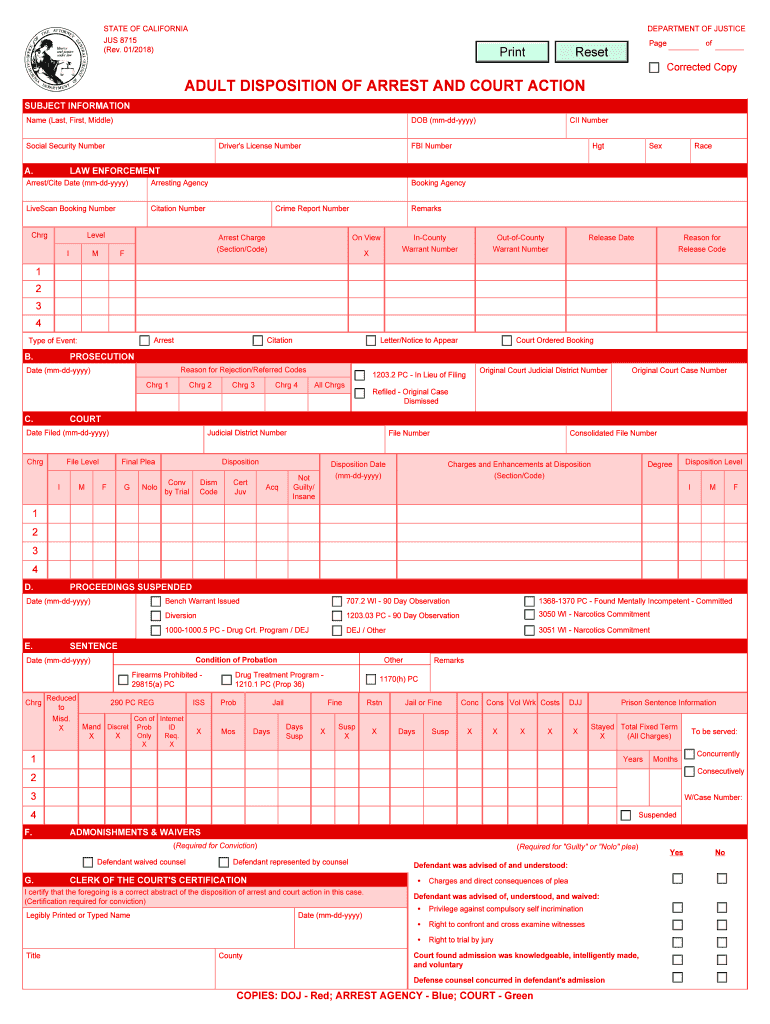
The JUS 8715 form is utilized by the California Department of Justice as an official record to capture the adult disposition of arrest and court actions. This form tracks various stages of the criminal justice process, including information about arrests, charges, court outcomes, and any subsequent actions taken. It serves a critical role in maintaining accurate records for tracking criminal cases from the initial arrest through final disposition. This ensures that all pertinent details regarding a criminal case are recorded and accessible for reference by law enforcement agencies, the courts, and other authorized entities.
Key Elements of the JUS 8715
The JUS 8715 form comprises several essential elements that document the comprehensive journey of a criminal case. These elements typically include:
- Arrest Details: Information about the arrest, such as the date, location, and arresting agency, forms the foundational part of the form.
- Charges Filed: Detailed enumeration of the charges brought against the individual.
- Court Outcomes: Records of any court decisions or judgments, including conviction or acquittal.
- Sentencing Information: Details regarding the sentencing phase, if applicable.
- Subsequent Actions: Any further legal actions post-sentencing, such as appeals, revocations, or modifications of the sentence.
Each section plays a pivotal role in ensuring the form captures the full scope of criminal proceedings.
How to Use the JUS 8715
Utilizing the JUS 8715 form involves a detailed process to ensure all relevant information is accurately captured. Users should follow these steps:
- Gather Necessary Information: Before completing the form, collect all relevant details, including arrest and court records.
- Complete Each Section Carefully: Input the data pertaining to arrest, charges, court decisions, and sentencing accurately into the respective fields.
- Review and Verify: Cross-check the input data for accuracy and completion.
- Submit the Form: Ensure submission to the correct authority within the stipulated timeframe.
This process aids in maintaining comprehensive and reliable criminal justice records.
Steps to Complete the JUS 8715
Completing the JUS 8715 form involves several precise steps to ensure complete data accuracy:
- Begin with Personal Information: Insert personal identification details of the arrested individual.
- Enter Arrest and Charge Details: Fill in specifics such as the nature and date of the arrest, along with the list of charges.
- Record Court Proceedings: Document outcomes of any court proceedings, such as verdicts, and attach supporting documentation if necessary.
- Add Sentencing Details: If applicable, accurately record sentencing information including duration and terms.
- Verify Completeness: Revisit each section to ensure no details are omitted and all data aligns with official reports.
Completing these steps correctly is crucial for the validity of the record.
Who Typically Uses the JUS 8715
The JUS 8715 form is primarily used by law enforcement agencies, court officials, and legal professionals involved in the criminal justice process. The form provides a uniform method for these entities to document and track the procedural details of a criminal case.
- Law Enforcement Agencies: Utilize it to ensure they have a complete record of arrest and processing.
- Court Officials: Use it to document proceedings, outcomes, and ensure that the legal process is tracked accurately.
- Legal Professionals: Depend on it to reference client cases, prepare for hearings, or resolve disputes regarding case history.
The form's widespread use underscores its importance in the judicial system.


Legal Use of the JUS 8715
The JUS 8715 form carries legal significance in the state of California, as it provides an official account of criminal proceedings. Its utilization ensures transparency and accountability in criminal justice administration. Legal professionals and law enforcement entities use the form to validate procedural accuracy and accountability:
- Evidence in Court: The form may be used as an official document to support court proceedings.
- Tracking Criminal Histories: Ensures accurate documentation and assists in background checks or investigations.
Understanding its legal use is essential for proper case management.
State-Specific Rules for the JUS 8715
California imposes specific regulations and procedures regarding the use of the JUS 8715 form. These rules are designed to standardize the documentation process across the state's diverse legal and law enforcement agencies:
- Compliance with California State Law: The form must be used in accordance with state laws governing arrest and court record documentation.
- Mandated Use in Certain Cases: Ensures uniform reporting in scenarios dictated by state legislation.
Awareness of these state-specific rules ensures the form's validity and compliance across jurisdictions.
Penalties for Non-Compliance
Failure to comply with the proper use and submission of the JUS 8715 form can result in significant legal consequences. Understanding these penalties is critical for entities responsible for handling such documents:
- Legal Repercussions: Non-compliance may lead to legal actions, including fines or penalties, against the responsible party.
- Impact on Case Proceedings: Errors or omissions in documentation can affect the outcome and management of criminal cases.
- Administrative Sanctions: State authorities may impose sanctions on agencies or individuals bypassing mandatory documentation protocols.
Maintaining compliance ensures the integrity and accuracy of the criminal justice process.
Digital vs. Paper Version
The JUS 8715 form can be completed either digitally or in paper format, each offering distinct advantages:
- Digital Version: Allows for easier sharing and storage, and often features automated entry capabilities to reduce errors.
- Paper Version: Preferred in certain legal scenarios where digital submission is impractical or not allowed.
Understanding the respective benefits can guide users in selecting the best approach for their specific needs.
Form Submission Methods (Online / Mail / In-Person)
The JUS 8715 form can be submitted through multiple channels, accommodating different preferences and situations:
- Online Submission: Offers convenience and speed, enabling quick delivery to the relevant authorities.
- Mail Submission: Provides a tangible trail, useful when a physical record is required.
- In-Person Submission: Ensures direct delivery and allows for immediate confirmation of receipt.
Choosing the appropriate submission method depends on entity protocols and the urgency of the process.




