




01. Edit your form online
Type text, add images, blackout confidential details, add comments, highlights and more.

Type text, add images, blackout confidential details, add comments, highlights and more.

Draw your signature, type it, upload its image, or use your mobile device as a signature pad.

Send it via email, link, or fax. You can also download it, export it or print it out.
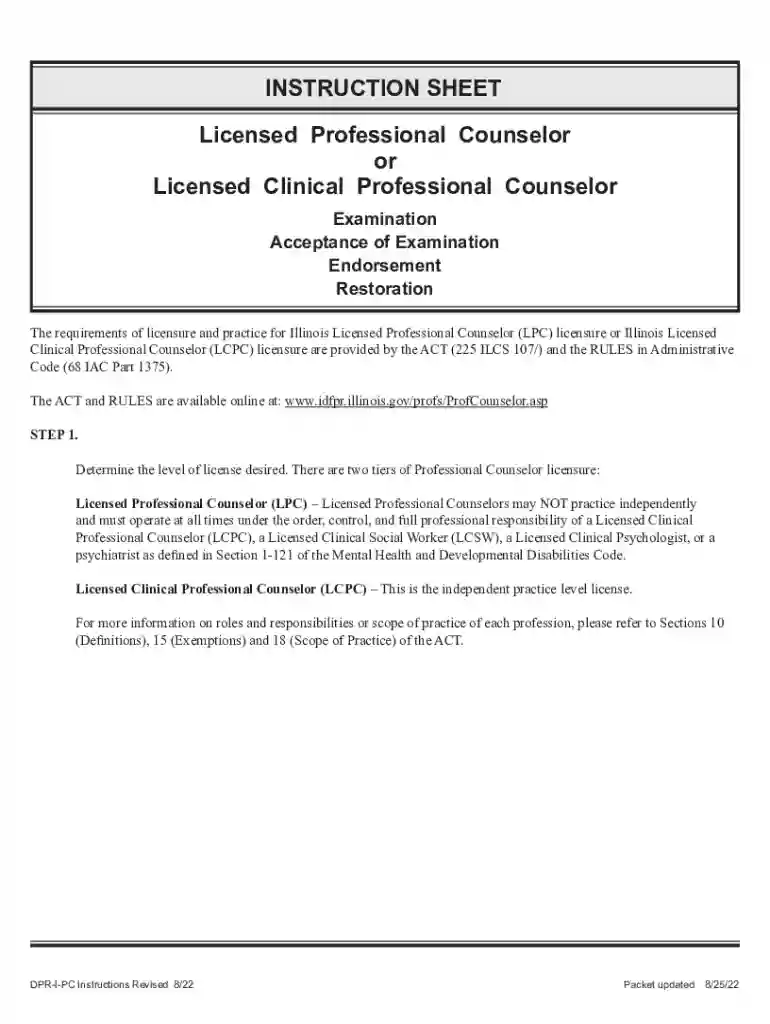
The "INSTRUCTION SHEET - Professional Counselor" serves as a comprehensive guide designed to assist individuals through the process of becoming a Licensed Professional Counselor (LPC) or Licensed Clinical Professional Counselor (LCPC) in Illinois. It details the necessary steps, requirements, and legal obligations involved in attaining licensure. The document's primary aim is to ensure applicants have a clear understanding of the procedures and compliance standards required for professional recognition in the counseling field.
This instructional guide should be utilized as a step-by-step reference throughout the licensure process. It is essential for applicants to familiarize themselves with the outlined pathways to licensure and accompanying requirements. The instruction sheet aids in preparing necessary documents, understanding application protocols, and meeting all predefined criteria.
This document encompasses several critical elements tailored to support applicants in becoming licensed professional counselors. These include:
Following the steps outlined in the instruction sheet is crucial to ensure a seamless application process. Below is a general framework:
This instruction sheet is designed within the context of Illinois state requirements and legal standards. Using the information provided ensures legal compliance when applying for counseling licensure.
Given the focus on Illinois, this instruction document includes specific regulations pertinent to the state. Applicants must adhere to these rules to ensure their application is not delayed or rejected due to non-compliance.
Applicants must gather several documents as instructed in the sheet. These documents prove crucial in supporting and validating the application. Examples include:
Submitting the application as per the instruction sheet is a critical final step. Various methods are specified to ensure a streamlined process.
We've got more versions of the INSTRUCTION SHEET - Professional Counselor form. Select the right INSTRUCTION SHEET - Professional Counselor version from the list and start editing it straight away!
At DocHub, your data security is our priority. We follow HIPAA, SOC2, GDPR, and other standards, so you can work on your documents with confidence.


