



01. Edit your form online
Type text, add images, blackout confidential details, add comments, highlights and more.

Type text, add images, blackout confidential details, add comments, highlights and more.

Draw your signature, type it, upload its image, or use your mobile device as a signature pad.

Send it via email, link, or fax. You can also download it, export it or print it out.
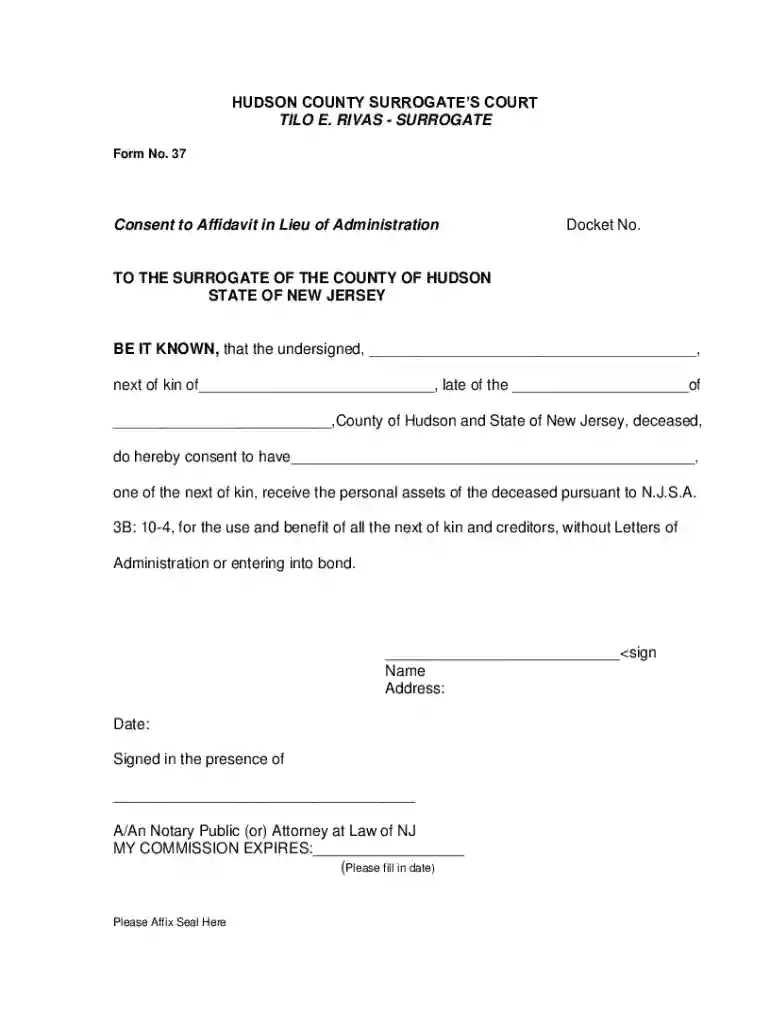
The Hudson County Surrogate's Court form is a legal document utilized to facilitate the transfer of personal assets from a deceased individual to their next of kin without the need for formal probate proceedings. This form essentially bypasses the requirement for Letters of Administration, allowing a more streamlined transfer of assets. It is an important tool in estate management, especially when the deceased person did not leave behind a will or when the estate is straightforward enough that formal administration would be unnecessarily complex or costly.
To effectively use this form, one must understand its primary purpose and application in legal contexts. Typically, the form is filled out by the next of kin who is applying to obtain the deceased individual's assets. It requires comprehensive data entry regarding the deceased's personal and financial information. Users should ensure accuracy when entering asset details and relationship information to avoid delays in processing. Furthermore, the form must be co-signed by a notary public or attorney to validate the transfer legally.
Collect Personal Information: Gather all necessary information about the deceased, such as full name, date of death, and any specific asset details.
Complete the Form: Fill in all required sections thoroughly, being mindful of accuracy to avoid potential legal complications.
Authentication: Ensure the form is signed in the presence of a notary or attorney to validate its authenticity and your identity as the next of kin.
Accessing the Hudson County Surrogate's Court form can be accomplished through several methods, primarily depending on your preference for digital or paper versions.
In-Person at the Courthouse: Visit the Hudson County courthouse to obtain a physical copy and receive guidance on filing procedures.
Online Download: The form might be available for download on the Hudson County Surrogate's Court official website. Ensure to check for the most recent version to comply with current legal standards.
Completing the form requires attention to detail and a clear understanding of the required fields.
Enter Personal Details: Input the deceased's personal information accurately, including date of death and social security number.
Detail Asset Information: List all known assets, including bank accounts, real estate, and other substantial properties. This information will determine what will be distributed to the next of kin.
Attach Required Documentation: Compile necessary documents like death certificates or proof of relationship which may need to accompany the form.
Review and Sign: Double-check for errors before signing. The form must be signed by a notary public to ensure its validity.
Submit the Form: Depending on your choice, submit the form either online, through mail, or personally at the courthouse.
Understanding key terminology is crucial for correctly filling out the form.
Next of Kin: Refers to the closest living blood relative legally entitled to inherit the deceased's assets.
Letters of Administration: Official court documents granting a person, usually the next of kin, authority to administer the deceased's estate.
Notary Public: A legal officer authorized to witness signatures on documents for verification purposes.
Several elements within the form are integral to its proper execution:
Identity Verification: Necessary to establish the identity of the deceased and the claimant.
Legal Consents: Requires consent from all parties involved, ensuring that assets are distributed according to lawful agreements.
Signatures and Notarization: Valid signatures and notary seal are mandatory to authenticate the form.
New Jersey state law governs the usage of this form, and its specific rules include:
Jurisdiction Requirements: The decedent must have been a resident of Hudson County for the court to process this form.
Threshold Values: Estates exceeding a certain value may not be applicable for this simplified process and might require formal probate.
This form serves critical legal functions, specifically in estate management and asset distribution following an individual's death. It’s recognized within the state of New Jersey for facilitating smoother transitions of personal property, thus minimizing potential disputes regarding inheritance.
Proper Filing: Ensures legal recognition of the form, granting enforceable rights to the claimant.
Consequence of Misuse: Inaccurate or fraudulent information can lead to legal sanctions, including revocation of rights to the estate.
We've got more versions of the HUDSON COUNTY SURROGATES COURT form. Select the right HUDSON COUNTY SURROGATES COURT version from the list and start editing it straight away!
At DocHub, your data security is our priority. We follow HIPAA, SOC2, GDPR, and other standards, so you can work on your documents with confidence.
Superior Court of New Jersey, Hudson County, Honrable Martha D. Lynes. Jersey City, NJ. Surrogates Court of Westchester County, Honorable Brandon R. Sall (2Read more
Office of Research and Development, National Risk. Hudson. 2007. The complete ISRM suggested methods for rock characterization, testing and monitoring: 1974-


