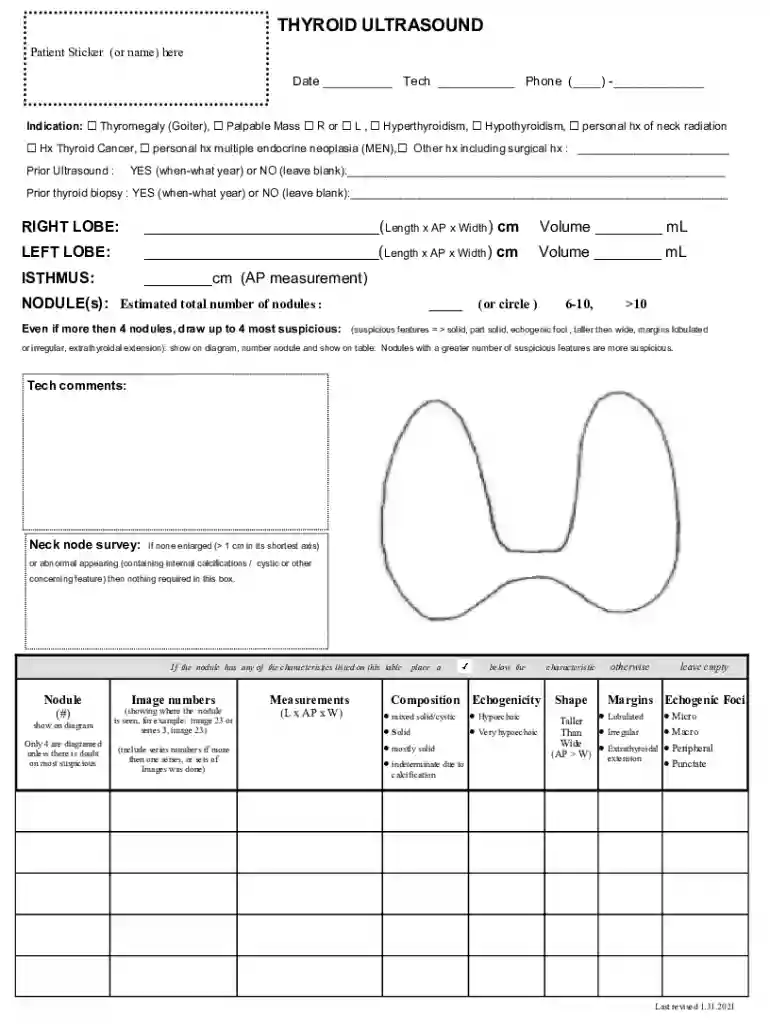
Definition and Purpose of the Thyroid Worksheet Ultrasound Radiology of Indiana
The Thyroid Worksheet Ultrasound Radiology of Indiana is a specialized document designed to compile and present essential information related to thyroid ultrasounds. This form serves a critical role in the diagnostic process, providing healthcare professionals with a structured format to document findings, patient history, and other pertinent data. Key components of the worksheet include:
- Patient Information: This section captures essential details about the patient, such as name, date of birth, and medical record number, which helps ensure proper identification.
- Indications for Ultrasound: Here, the referring physician outlines the medical reasons for the ultrasound, which could range from thyroid dysfunction symptoms to monitoring existing conditions.
- Medical History: A comprehensive review of the patient’s prior medical conditions and any relevant thyroid-related history provides context for the ultrasound findings.
This worksheet is essential for consistent documentation practices and facilitates effective communication among healthcare providers involved in a patient's care.
Steps to Complete the Thyroid Worksheet Ultrasound Radiology of Indiana
Completing the Thyroid Worksheet Ultrasound Radiology of Indiana involves several methodical steps to ensure thorough documentation and accurate diagnostics. The following process outlines how to effectively complete the form:
- Gather Patient Information: Collect all relevant details, including name, contact information, and identification numbers.
- Document Indications: Clearly outline the clinical reasons prompting the ultrasound course, referencing concerns like nodules, masses, or abnormal laboratory findings.
- Review Medical History: Include any previous thyroid treatments or surgeries, along with family history of thyroid disease.
- Measurements and Observations: Accurately document the measurements of the thyroid lobes, isthmus, and any nodules, providing precise millimeter readings.
- Report Additional Findings: Note any observations about enlarged lymph nodes or other anatomical structures surrounding the thyroid.
- Technician Comments: Utilize this section to capture impressions or observations made during the ultrasound, which may be relevant for diagnostic interpretation.
Following these steps ensures that all necessary information is recorded systematically, aiding in comprehensive patient assessment.
Important Terms Related to the Thyroid Worksheet Ultrasound Radiology of Indiana
Understanding specific terminology associated with the Thyroid Worksheet Ultrasound Radiology of Indiana is crucial for accurate documentation and communication within medical contexts. Key terms include:
- Thyroid Lobes: The thyroid gland consists of two lobes (right and left) and an isthmus. Measurements of these lobes are essential in assessing gland size and any abnormalities.
- Nodules: These are abnormal lumps within the thyroid that may require monitoring or further examination, such as a biopsy, if an ultrasound indicates potential malignancy.
- Sonography: A technique utilizing high-frequency sound waves to create images of the thyroid, providing real-time feedback during examination.
- Cystic vs. Solid Nodules: Nodules can either be fluid-filled (cystic) or solid; distinguishing between these types can impact management decisions.
- Hypoechoic and Hyperechoic Areas: These terms refer to the echogenicity of nodules on ultrasound. Hypoechoic areas appear darker and may be more concerning than hyperechoic areas, which look brighter.
Grasping these terms helps healthcare professionals deliver precise reports and facilitates better understanding among teams involved in patient care.
Legal Use of the Thyroid Worksheet Ultrasound Radiology of Indiana
The legal use of the Thyroid Worksheet Ultrasound Radiology of Indiana encompasses several crucial aspects, ensuring compliance with healthcare regulations and maintaining patient safety. Key points include:
- Patient Privacy: The worksheet must adhere to the Health Insurance Portability and Accountability Act (HIPAA) guidelines, which protect the confidentiality of patient information.
- Record Keeping: Proper documentation is vital for legal purposes, especially in potential malpractice cases where thorough records can demonstrate adherence to standard care protocols.
- Insurance Compliance: Submitting accurately completed worksheets may be necessary for insurance reimbursement purposes, ensuring that all diagnostic services are accounted for.
- Scope of Practice: Healthcare professionals using this worksheet must operate within their defined scope of practice, adhering to state laws governing ultrasound interpretation and diagnosis.
Understanding the legal implications associated with the Thyroid Worksheet Ultrasound Radiology of Indiana protects healthcare providers and supports optimal patient care.
Examples of Using the Thyroid Worksheet Ultrasound Radiology of Indiana
Several real-world scenarios illustrate the application of the Thyroid Worksheet Ultrasound Radiology of Indiana in clinical practice. Examples include:
- Monitoring Existing Conditions: A patient with a known history of thyroid nodules presents for routine surveillance. The worksheet helps the technician document any changes in size or appearance, guiding further evaluation or management.
- Initial Diagnosis: For patients exhibiting symptoms such as swelling or difficulty swallowing, the ultrasound findings recorded on the worksheet can be crucial in diagnosing thyroid disorders, linking symptoms to the ultrasound results.
- Specialist Referrals: After a radiologist completes the worksheet, it can be shared with endocrinologists for interpretation and treatment planning, ensuring all relevant clinical data is accessible for specialized care.
These scenarios demonstrate the worksheet's utility in a variety of clinical contexts, fostering effective patient management and interdisciplinary collaboration.