Carecana retraction 2026

Get Form
carevest mortgage investment corporation retraction request Preview on Page 1

Here's how it works

01. Edit your carevest mortgage investment corporation retraction request online
Type text, add images, blackout confidential details, add comments, highlights and more.
02. Sign it in a few clicks
Draw your signature, type it, upload its image, or use your mobile device as a signature pad.
03. Share your form with others
Send it via email, link, or fax. You can also download it, export it or print it out.

How to use or fill out carecana retraction with our platform

Form edit decoration
9.5
Ease of Setup
DocHub User Ratings on G2
9.0
Ease of Use
DocHub User Ratings on G2
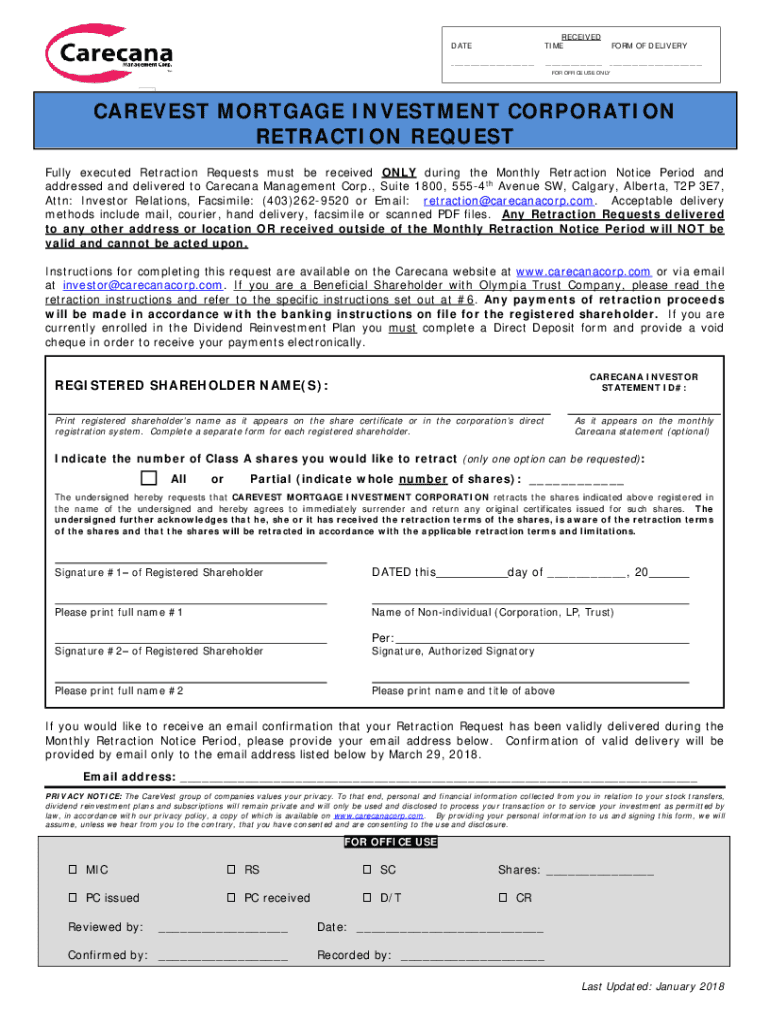
  1. Click ‘Get Form’ to open the carecana retraction request in the editor.
  2. Begin by entering the exact name of the Registered Shareholder in the designated field. Ensure that this matches the records held by CareVest.
  3. Indicate whether you are requesting all shares for retraction or a specific whole number of shares. For partial requests, clearly denote the exact number without using dollar values or fractions.
  4. Each Registered Shareholder must sign and print their name in the appropriate section. If shares are held through an intermediary, ensure that they are involved in this process.
  5. If applicable, attach any physical share certificates to your request. Remember, these must be original documents.
  6. Submit your completed form during the Monthly Retraction Notice Period via mail, courier, or email as specified in the instructions.

Start filling out your carecana retraction request today for free on our platform!

See more carecana retraction versions

We've got more versions of the carecana retraction form. Select the right carecana retraction version from the list and start editing it straight away!
Versions Form popularity Fillable & printable
2018 4.6 Satisfied (22 Votes)
be ready to get more

Complete this form in 5 minutes or less

Get form

Got questions?

We have answers to the most popular questions from our customers. If you can't find an answer to your question, please contact us.
Contact us
Retraction is a mechanism for correcting the literature and alerting readers to articles that have such seriously flawed or erroneous content or data that their findings and conclusions cannot be relied upon. Unreliable content or data can result from honest error, naive mistakes, or research or publication misconduct.
Retractions are a sign that someone is working hard to breathe. The areas below the ribs, between the ribs, and in the neck sink in with each attempt to inhale. Normally, when you take a breath, your diaphragm and the muscles around your ribs create a vacuum that pulls air into your lungs.
Retractions are typically accompanied by a retraction notice written by the editors or authors explaining the reason for the retraction. Such notices may also include a note from the authors with apologies for the previous error and/or expressions of gratitude to persons who disclosed the error to the author.
Among the causes of retraction, plagiarism is the most common one. A rise in plagiarism detection can be attributed to widespread access to plagiarism software and the pressure for authors to publish.
Lid retraction repair surgery is performed to return the lower eyelid to its natural position hugging the eyeball and returning the natural almond shape of the eye.

Security and compliance

At DocHub, your data security is our priority. We follow HIPAA, SOC2, GDPR, and other standards, so you can work on your documents with confidence.

Learn more
ccpa2
pci-dss
gdpr-compliance
hipaa
soc-compliance

People also ask

Reasons for Paper Retraction The two main reasons that papers are retracted have to do with intention. If a researchers intention was honest and ethical, but its realized that there was an error in the conclusion, for example, the researcher may decide to self-retract.
Background: Laparoscopic bariatric surgery requires retraction of the left lobe of the liver to provide adequate operative view and working space. Conventional approaches utilize a mechanical retractor and require additional incision(s), and at times an assistant.

Related links