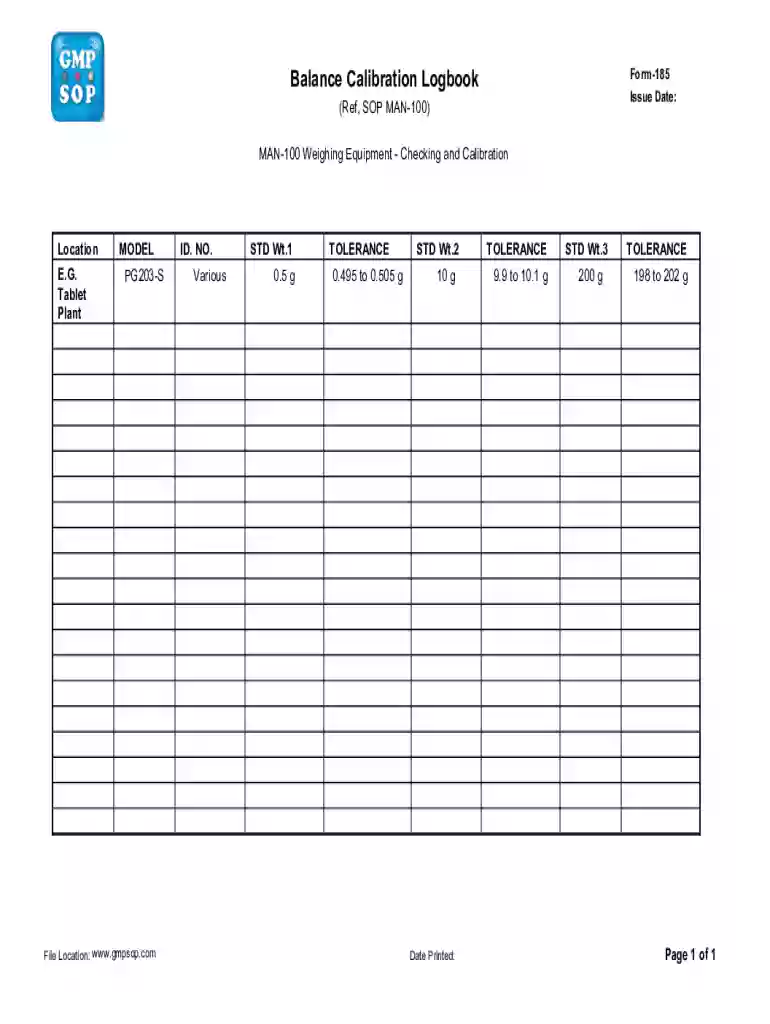
Balance Calibration Logbook Balance Calibration Logbook 2026

Get Form
Balance Calibration Logbook Balance Calibration Logbook Preview on Page 1

Here's how it works

01. Edit your form online
Type text, add images, blackout confidential details, add comments, highlights and more.

02. Sign it in a few clicks
Draw your signature, type it, upload its image, or use your mobile device as a signature pad.

03. Share your form with others
Send it via email, link, or fax. You can also download it, export it or print it out.

How to use or fill out Balance Calibration Logbook with our platform

Form edit decoration
9.5
Ease of Setup
DocHub User Ratings on G2
9.0
Ease of Use
DocHub User Ratings on G2
  1. Click ‘Get Form’ to open the Balance Calibration Logbook in the editor.
  2. Begin by entering the 'Location' where the calibration is taking place. This helps in tracking and accountability.
  3. Fill in the 'MODEL' field with the specific model of the weighing equipment, such as PG203-S, to ensure accurate records.
  4. For each standard weight (STD Wt.1, STD Wt.2, STD Wt.3), input the weight value and its corresponding tolerance range. For example, for STD Wt.1, enter '0.5 g' and ensure that it falls within '0.495 to 0.505 g'.
  5. Repeat step 4 for additional standard weights as necessary, ensuring all data is accurate and complete.
  6. Once all fields are filled out, review your entries for accuracy before saving or exporting your logbook.

Start using our platform today to streamline your Balance Calibration Logbook process for free!

See more Balance Calibration Logbook Balance Calibration Logbook versions

We've got more versions of the Balance Calibration Logbook Balance Calibration Logbook form. Select the right Balance Calibration Logbook Balance Calibration Logbook version from the list and start editing it straight away!
Versions Form popularity Fillable & printable
2024 4.1 Satisfied (57 Votes)
be ready to get more

Complete this form in 5 minutes or less

Get form

Got questions?

We have answers to the most popular questions from our customers. If you can't find an answer to your question, please contact us.
Contact us
Generally, calibrations are recommended every 6 months to a year. However, some balances may require more frequent adjustments.
In simple terms, calibration is a quantitative comparison. To check the reading of a balance or scale, a reference weight is placed on the pan. The error is defined as the difference between the measured value (the reading) and the true value (the reference weight).
If the standard deviation obtained is less than formed using a balance that is calibrated over the operat- 0.41d, where d is the scale interval, replace this standard ing range and meets the requirements defined for deviation with 0.41d. In this case, repeatability is satisfac- repeatability and accuracy.
The checking process is fairly straightforward: If equipped activate the internal calibration feature. Apply the certified weight and note the displayed reading. Compare the displayed reading against the measured value of the weight stated on the certificate and note the difference.
0:03 1:34 Again add your 10 back on. And make sure it still reads 10. Add another 10 till it reads.MoreAgain add your 10 back on. And make sure it still reads 10. Add another 10 till it reads.

Security and compliance

At DocHub, your data security is our priority. We follow HIPAA, SOC2, GDPR, and other standards, so you can work on your documents with confidence.

Learn more
ccpa2
pci-dss
gdpr-compliance
hipaa
soc-compliance
be ready to get more

Complete this form in 5 minutes or less

Get form