(ts149) quality control for field-placed concrete - technical 2026

Get Form
(ts149) quality control for field-placed concrete - technical Preview on Page 1

Here's how it works

01. Edit your form online
Type text, add images, blackout confidential details, add comments, highlights and more.

02. Sign it in a few clicks
Draw your signature, type it, upload its image, or use your mobile device as a signature pad.

03. Share your form with others
Send it via email, link, or fax. You can also download it, export it or print it out.

How to use or fill out (ts149) quality control for field-placed concrete - technical with our platform

Form edit decoration
9.5
Ease of Setup
DocHub User Ratings on G2
9.0
Ease of Use
DocHub User Ratings on G2
  1. Click ‘Get Form’ to open it in the editor.
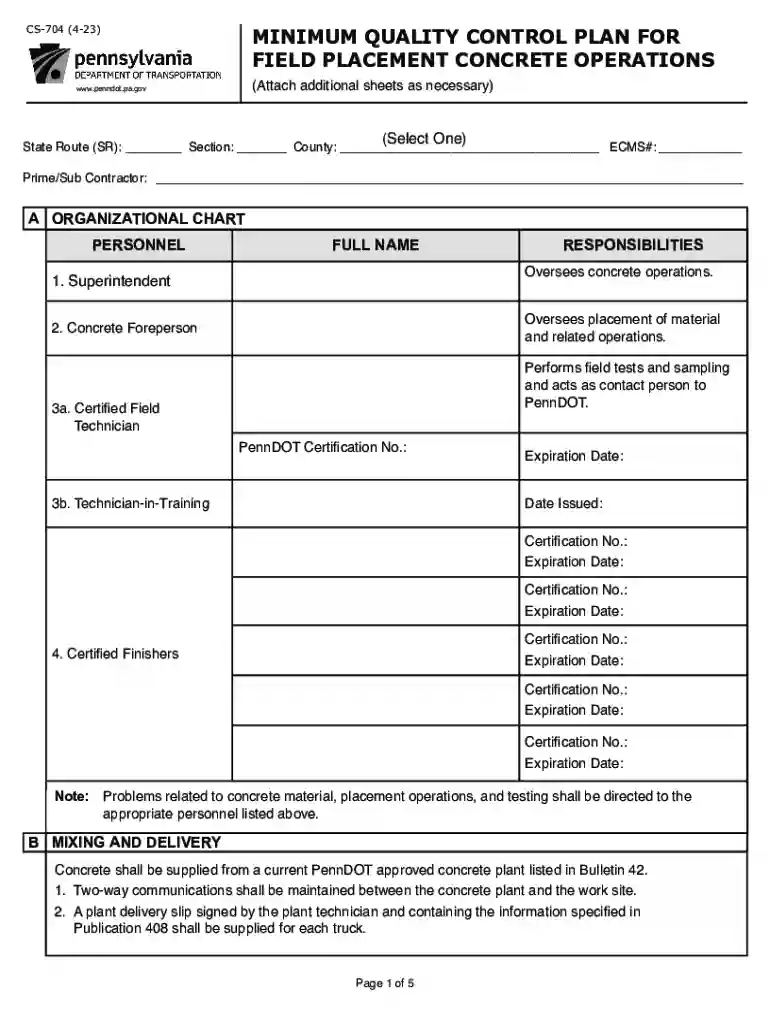
  2. Begin by filling in the State Route, Section, County, and ECMS# at the top of the form. This information is crucial for identifying the specific project.
  3. In Section A, create an organizational chart by listing personnel names and their responsibilities. Ensure that all roles are clearly defined to facilitate communication.
  4. For Section B, provide details about mixing and delivery. Include the name of the concrete supplier and ensure that two-way communication is established between the plant and work site.
  5. In Section C, document material control measures. List designs and slump requirements while ensuring that testing requirements for temperature, slump, and air content are met as specified.
  6. Section D requires you to specify the number of concrete cylinders needed for various strength tests. Clearly outline curing methods for both initial and post-curing periods.
  7. Finally, complete Section E by detailing your workforce and equipment used for placement operations.

Start using our platform today to streamline your document editing process for free!

See more (ts149) quality control for field-placed concrete - technical versions

We've got more versions of the (ts149) quality control for field-placed concrete - technical form. Select the right (ts149) quality control for field-placed concrete - technical version from the list and start editing it straight away!
Versions Form popularity Fillable & printable
2023 4.7 Satisfied (32 Votes)
2021 4.9 Satisfied (58 Votes)
2019 4.4 Satisfied (84 Votes)
2018 4.4 Satisfied (119 Votes)
2012 3.9 Satisfied (29 Votes)
be ready to get more

Complete this form in 5 minutes or less

Get form

Got questions?

We have answers to the most popular questions from our customers. If you can't find an answer to your question, please contact us.
Contact us
Quality Test of Concrete Materials Cement should be tested before being added to the concrete mix. Following that, the cement should be checked every two months. Moisture should be kept away from cement. If cement is stored for an extended period of time, it should be retested every three months.
When it comes to concrete, the two main tests are the tests for compressive strength on the hardened concrete in the laboratory and slump tests on the wet concrete on-site. Compressive strength tests indicate the capacity of the concrete to support the load of the building or structure.
Key tests on fresh concrete include slump and compacting factor tests, while tests on hardened concrete include compression, tensile strength, and flexural strength tests to evaluate the quality and strength of the concrete.
Slump Test A concrete slump test is conducted in-field on fresh concrete mix. It helps to determine if the, soon to be poured, concrete will meet its specified standard.
The most common cement tests include compressive strength, setting time, soundness, and fineness. These tests are important to ensure that the Cement being used in construction meets the necessary standards and is able to perform its intended function.

Security and compliance

At DocHub, your data security is our priority. We follow HIPAA, SOC2, GDPR, and other standards, so you can work on your documents with confidence.

Learn more
ccpa2
pci-dss
gdpr-compliance
hipaa
soc-compliance

People also ask

PSI ratings for concrete are determined through standardized ASTM C39 testing procedures, which test cylindrical specimens of concrete under controlled conditions to determine how much force can act on the surface. In these tests, the concrete cores must meet specific criteria to pass.
During Concrete Placement Adjust the water content as necessary, but be cautious not to exceed the water-to-cement ratio specified in the mix design. Compact Thoroughly: Use vibrators to compact the concrete properly in the forms, eliminating air pockets and ensuring full contact with the reinforcement and formwork.

Related links