




01. Edit your 8840 closer connection form 2018 online
Type text, add images, blackout confidential details, add comments, highlights and more.

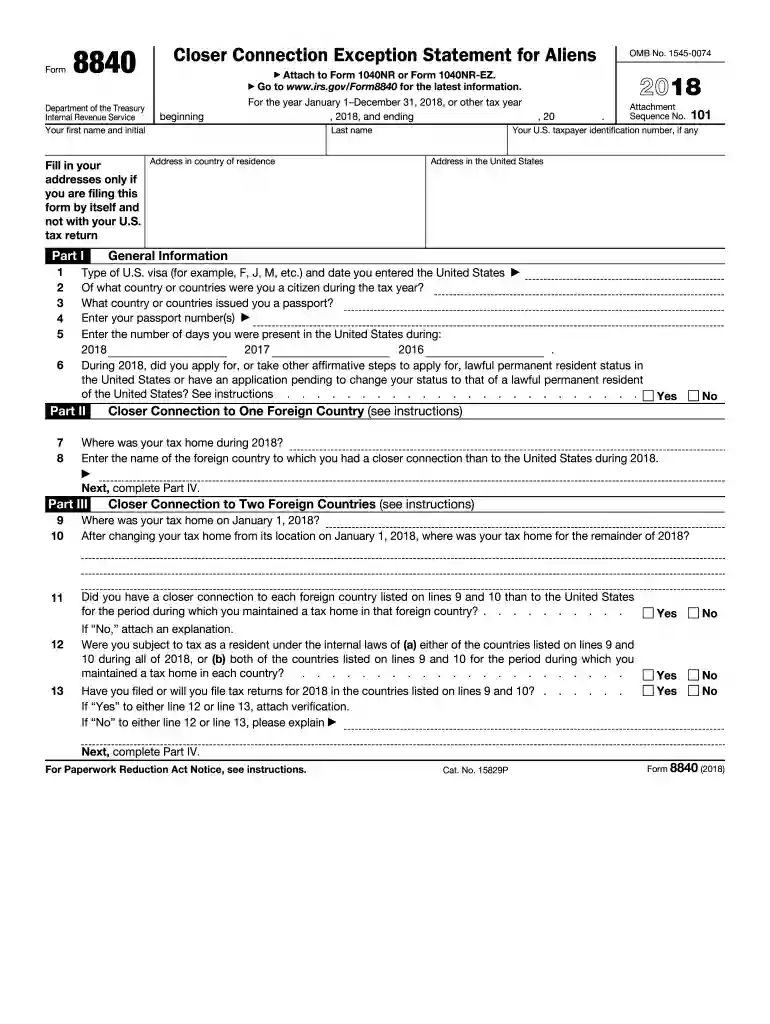
Type text, add images, blackout confidential details, add comments, highlights and more.

Draw your signature, type it, upload its image, or use your mobile device as a signature pad.

Send closer connection form 2018 via email, link, or fax. You can also download it, export it or print it out.
The Form 8840, also known as the Closer Connection Exception Statement for Aliens, is a document used by nonresident aliens in the United States to declare their closer connection to another country. By filing this form, individuals can demonstrate that they are more closely connected to another country than the U.S., even if they meet the criteria for the substantial presence test. This distinction is essential for tax purposes, as it allows individuals to maintain their nonresident status if they qualify.
The substantial presence test is a criterion used to determine if an individual is considered a resident for tax purposes. Nonresident aliens who are within the U.S. for 183 days or more during a three-year period may meet this test, but filing Form 8840 can help establish a closer connection elsewhere, affecting tax obligations.
Obtaining Form 8840 is a straightforward process. It is available through the Internal Revenue Service (IRS) website, where individuals can download the form in PDF format, ensuring it is accessible for electronic filling and submission. Additionally, it can be picked up from IRS offices or requested through mail.
Filling out Form 8840 requires precision to effectively claim the closer connection exception. Here’s a step-by-step guide:
Personal Information:
Visa Status:
Physical Presence:
Tax Home Country:
Closer Connection:
Signature:
Form 8840 is predominantly used by nonresident aliens who have substantial ties to a foreign country despite significant time spent in the U.S. These individuals may include:


Following IRS guidelines is crucial for filing Form 8840 accurately. The IRS provides comprehensive instructions available with the form to assist individuals in understanding the requirements and the context of reporting.
Understanding the critical filing deadlines for Form 8840 helps ensure compliance with IRS requirements:
Several key documents are necessary to support your Form 8840 submission:
Failure to file Form 8840 properly can result in severe consequences, such as:
Form 8840 can be completed in both digital and paper formats, each with its own set of implications:
We've got more versions of the 8840 closer connection form 2018 form. Select the right 8840 closer connection form 2018 version from the list and start editing it straight away!
| Versions | Form popularity | Fillable & printable |
|---|---|---|
| 2025 | 4.2 Satisfied (51 Votes) | |
| 2024 | 4.9 Satisfied (35 Votes) | |
| 2023 | 4.3 Satisfied (22 Votes) | |
| 2022 | 4.8 Satisfied (42 Votes) | |
| 2021 | 4.8 Satisfied (30 Votes) | |
| 2020 | 4.2 Satisfied (71 Votes) | |
| 2019 | 4.3 Satisfied (63 Votes) | |
| 2018 | 4.4 Satisfied (180 Votes) | |
| 2017 | 4.3 Satisfied (140 Votes) | |
| 2016 | 4.4 Satisfied (771 Votes) | |
| 2015 | 4.4 Satisfied (600 Votes) | |
| 2014 | 4 Satisfied (24 Votes) | |
| 2013 | 4.3 Satisfied (32 Votes) | |
| 2012 | 4.2 Satisfied (71 Votes) | |
| 2011 | 4 Satisfied (41 Votes) |
At DocHub, your data security is our priority. We follow HIPAA, SOC2, GDPR, and other standards, so you can work on your documents with confidence.





◼Immigration status and tax status are related, but NOT the same! ◼You can hold a nonimmigrant visa and still be a resident for tax purposes.Read more
On December 22, 2017, the U.S. government enacted comprehensive tax legislation commonly referred to as the Tax Cuts and Jobs Act (the Tax Act). The TaxRead more
If you are filing a 2017 Form 1040NR or. Form 1040NR-EZ, attach Form 8840 to it. Mail your tax return by the due date. (including extensions) to the address.Read more


