







Definition & Meaning
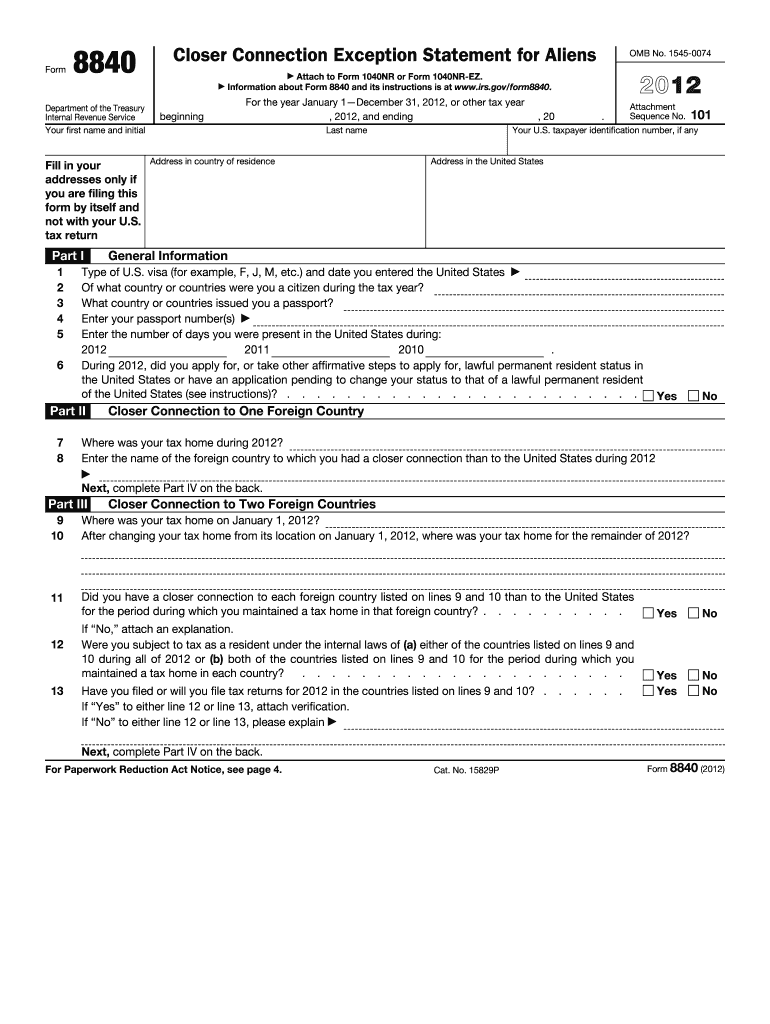
The 2 form, known as the Closer Connection Exception Statement for Aliens, is used by nonresident aliens to demonstrate a closer connection to a foreign country rather than the United States for tax purposes. This form helps establish eligibility for nonresident status under the substantial presence test by detailing significant contacts with foreign countries. Nonresidents must fill out this form to ensure they meet specific criteria that could exempt them from being taxed as U.S. residents.
Steps to Complete the 2 Form
-
Personal Information: Start with your full name, address, and taxpayer identification number. Ensure accuracy, as these details are crucial for identity verification.
-
U.S. Tax Residency Information: Include details of the tax year for which you're filing and document your days of presence in the U.S. for the current and past two years. This is essential to establish your residency status.
-
Closer Connection Statement: Provide a comprehensive description of your ties to a foreign country, such as ownership of property, other family members living abroad, economic interests, and social engagements.
-
Supporting Details and Attachments: Attach any necessary documentation that supports your claims of stronger ties to another country, such as records of property or business ownership.
-
Declaration and Signature: Carefully read the declaration, then sign and date the form to verify the information's accuracy.
Eligibility Criteria
To be eligible to file the 2 form, one must:
- Be a nonresident alien for tax purposes.
- Have exceeded 182 days in the U.S. over a three-year period but wish to claim a closer connection to another country.
- Provide substantive evidence to support their closer connection claim.
Meeting these criteria involves understanding the substantial presence test and demonstrating sufficient foreign ties.


Required Documents
- Proof of foreign residency, such as a lease or property deed.
- Passport copies showing travel itineraries.
- Documentation of family ties, including marriage or birth certificates.
- Bank statements or investment records indicating financial ties to another country.
These documents help reinforce your claim of a closer connection elsewhere.
IRS Guidelines
Adhering to IRS guidelines is essential for those using Form 8840. These include:
- Understanding the substantial presence test.
- Comprehending legal residency definitions.
- Recognizing tax implications for choosing nonresident status.
These guidelines provide clarity and assist filers in ensuring compliance with tax laws.
Filing Deadlines / Important Dates
- Filing Deadline: Typically, the form must be filed by June 15 following the end of the tax year if you're outside the U.S., or April 15 if you reside in the U.S. during the filing season.
- Extensions: Extensions may be available, but requests must be submitted timely to avoid penalties.
Timely filing is crucial for effectively managing tax liabilities and maintaining good standing with the IRS.
Key Elements of the 2 Form
The 2 form consists of:
- Personal Details: Identifying information and taxpayer number.
- Residency Information: Days spent in the U.S. and proof of foreign ties.
- Closer Connection Explanation: Detailed narrative of non-U.S. ties.
- Signature and Date: Acknowledgment of information's truthfulness.
Each element is vital for the accurate submission and processing of the form.
Penalties for Non-Compliance
Failing to comply with filing requirements may result in:
- Fines: Financial penalties for late or fraudulent submission.
- Tax Implications: If residency status isn't adequately declared, you might owe taxes as a U.S. resident.
- Audit Risks: Increased risk of an audit for non-compliance.
Understanding these penalties ensures meticulous adherence to tax obligations.
Digital vs. Paper Version
The 2 form can be submitted in both digital and paper formats. While paper submission requires mailing the completed form, electronic filing simplifies the process with benefits like faster processing, instant feedback for errors, and secure document management.
Software Compatibility
Filing can be performed using popular tax software like TurboTax or QuickBooks for additional convenience. These platforms often include guides to assist with accurate completion and submission, making the process efficient and user-friendly.




