
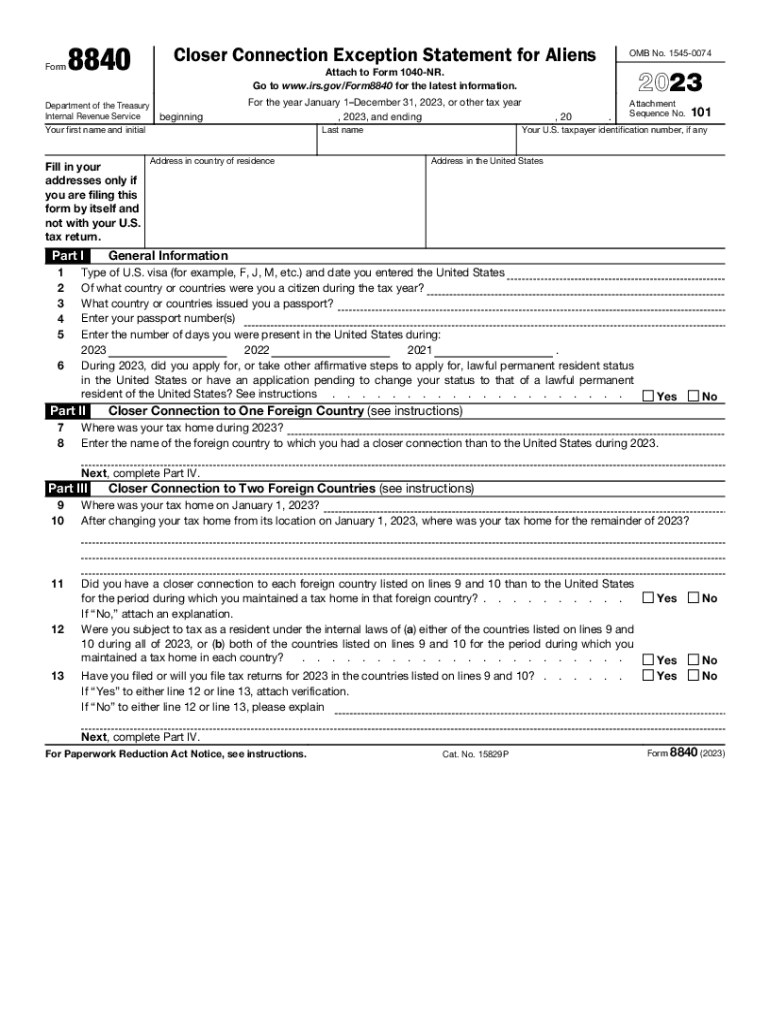







Definition and Purpose of Form 8840
Form 8840, the Closer Connection Exception Statement for Aliens, is utilized by individuals who wish to declare a closer connection to a foreign country for tax reasons. Nonresident aliens often use this form to exempt themselves from being taxed as U.S. residents, even if they meet the substantial presence test. The purpose of this form is to provide documented evidence that the individual maintains significant connections to another country, which could include personal, familial, economic, or social ties.
Steps to Complete Form 8840
-
Personal Information:
- Begin by entering your full name, current U.S. and foreign addresses, and taxpayer identification number.
- Clearly state your visa status and the nature of your stay in the U.S.
-
Substantial Presence Test:
- Calculate the number of days you have been present in the U.S. over the last three years, ensuring you provide a detailed count for the current, previous, and year before last.
-
Closer Connection to Foreign Country:
- Demonstrate your substantial ties to a foreign country, such as your principal residence, family ties, and economic interests.
- Include evidence like property ownership, voting registration, and government documentation.
-
Signature and Submission:
- Ensure all information is accurate before signing.
- Submit the completed form by attaching it to your income tax return or sending it directly to the IRS if you are not required to file a return.
Eligibility Criteria
To qualify for the Closer Connection Exception, individuals must meet the following conditions:
- Presence in the U.S. for less than 183 days during the current year.
- Existence of a tax home in a foreign country throughout the year.
- Establishment of a closer connection to that foreign country per IRS guidelines.
Documentation such as banking details, property leases, and records of memberships or affiliations in organizations abroad can support your claim.


Important Terms and Concepts
- Substantial Presence Test: Determines if an individual is considered a U.S. tax resident based on days physically present in the U.S.
- Tax Home: The individual's principal place of business or employment.
- Nonresident Alien: An individual who is not a U.S. citizen and does not pass the Green Card or substantial presence test.
Required Documents
Collecting and organizing supporting documentation is crucial:
- Proof of residence in a foreign country.
- Visa and travel documents.
- Financial records reflecting foreign income or investments.
- Any correspondence with foreign entities such as banks, employers, or social services.
Ensuring these documents are up-to-date can prevent potential disputes.
Submission Methods
- Online: Use file upload services compatible with IRS systems.
- Mail: Send completed forms via certified mail for tracking.
- In-Person: Visit an IRS office, though typically not required for this form.
Each submission method has its benefits and drawbacks, requiring individuals to choose based on convenience and verification needs.
IRS Guidelines and Compliance
The IRS provides specific guidelines on how to claim a closer connection exception and the evidence required to support the claim. Following these guidelines is critical to avoid penalties. Misrepresentation or inadequate documentation can lead to the denial of the request and possibly incurring the full resident tax liability.
Penalties for Non-Compliance
Failing to file Form 8840, or doing so incorrectly, can have significant consequences. The IRS may assess fines, interest on unpaid taxes, or revocation of deemed nonresident status. It is important to understand these risks to prevent unwanted financial consequences and compliance issues.
Digital vs. Paper Versions
While both formats are acceptable, opting for digital submissions enhances speed and efficiency. Platforms like DocHub, compatible with various document formats, allow for easy digital completion and submission, ensuring secure encryption and storage.




