Pcl 5 fillable 2026

Get Form
pcl 5 pdf Preview on Page 1

Here's how it works

01. Edit your pcl 5 pdf online
Type text, add images, blackout confidential details, add comments, highlights and more.

02. Sign it in a few clicks
Draw your signature, type it, upload its image, or use your mobile device as a signature pad.

03. Share your form with others
Send pcl5 pdf via email, link, or fax. You can also download it, export it or print it out.

Definition and Meaning of PCL 5 Fillable

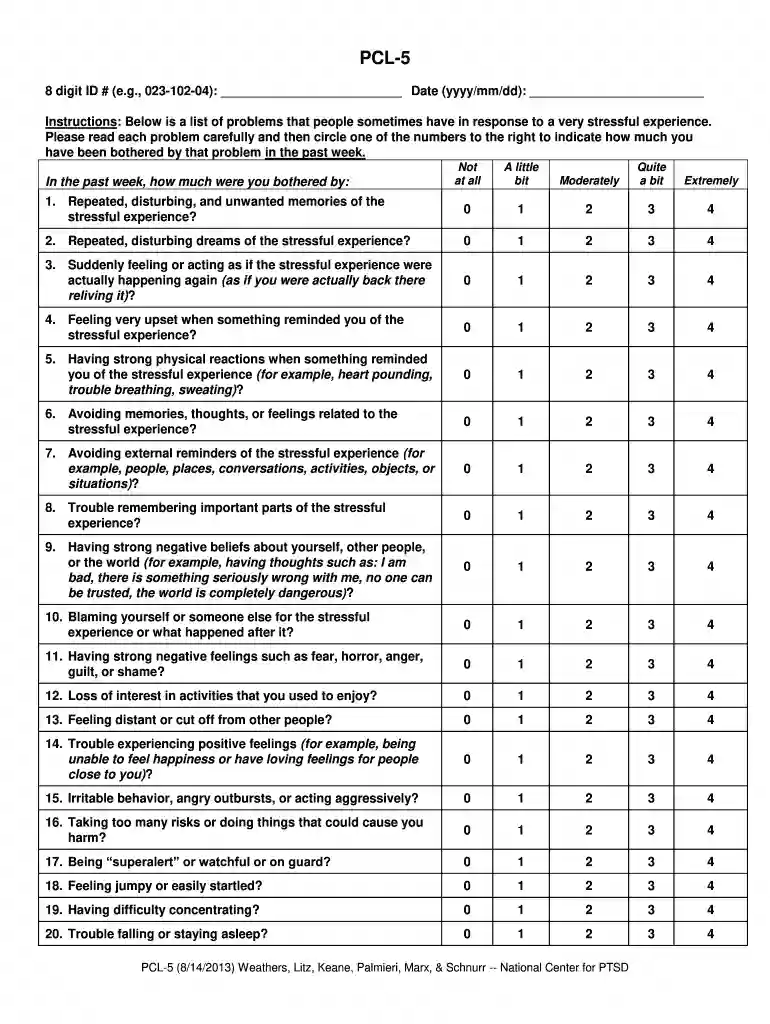
The PCL-5 (Posttraumatic Stress Disorder Checklist for DSM-5) is a standardized self-report questionnaire developed to assess the presence and severity of PTSD symptoms according to the criteria set forth in the Diagnostic and Statistical Manual of Mental Disorders, Fifth Edition (DSM-5). The fillable version of the PCL-5 allows users to complete the assessment electronically, making it convenient for both individual and clinical use. This tool consists of 20 items that explore symptoms experienced in the past month, such as intrusive thoughts, avoidance behaviors, negative alterations in mood and cognition, and alterations in arousal and reactivity. Scoring is straightforward, with higher total scores indicating greater symptom severity.

How to Use the PCL 5 Fillable

Using the PCL-5 fillable form is simple, particularly due to its user-friendly electronic format. Users can access the form online, fill in their responses directly, and submit it without printing or scanning. Here is a step-by-step guide to utilizing the fillable PCL-5:

  1. Access the Form: Locate the PCL-5 fillable form online.
  2. Read Instructions: Familiarize yourself with the instructions on how to complete the questionnaire.
  3. Respond to Each Item: For each of the 20 items, indicate the severity of your symptoms over the past month on a scale from zero (not at all) to four (extremely).
  4. Review Responses: After completing the questionnaire, review all your answers to ensure accuracy.
  5. Save or Submit: Depending on the platform, either save your filled form for personal records or submit it to a healthcare provider.

This process not only facilitates self-assessment but also aids mental health professionals in tracking symptoms across intervals, providing critical data for diagnosis and treatment planning.

Steps to Complete the PCL 5 Fillable

Completing the PCL-5 fillable form requires attention to detail for accurate self-assessment. Follow these steps to effectively fill out the questionnaire:

  1. Initial Setup: Open the PCL-5 fillable through a compatible device, ensuring you have a stable internet connection.
  2. Understand the Questions: Each item relates to specific PTSD symptoms. It is important to read through each question carefully.
  3. Rate the Severity: Assign a score based on your symptoms. Score each item by considering how much distress you have felt in the past month.
  4. Use Guidelines: Utilize the scale provided to aid in scoring. For instance, if you experienced a symptom "moderately," select a two.
  5. Final Review: Double-check your responses before saving or submitting to ensure that they reflect your true experience.

By following these steps, users can ensure that their assessments yield reliable information that can contribute to understanding their mental health status.

Why You Should Use the PCL 5 Fillable

There are several reasons to utilize the PCL-5 fillable form for assessing PTSD symptoms:

  • Accessibility: The electronic nature of the fillable form allows users to complete it from anywhere, at any time, without needing physical resources.
  • Time-Efficient: Digital completion saves time as users can quickly navigate through questions and submit results.
  • Comprehensive Feedback: The structured scoring system offers clear insights into symptom severity, facilitating better discussions with healthcare providers.
  • Confidentiality: Completing the form online can be more private than traditional methods, making it easier for individuals to engage in self-assessment.
  • Encouragement for Follow-Up: By accurately capturing symptoms, users are better equipped to seek professional help if needed.

Using the PCL-5 fillable can empower individuals to take proactive steps in managing their mental health.

Important Terms Related to PCL 5 Fillable

Familiarizing yourself with key terminology associated with the PCL-5 fillable can enhance your understanding of the assessment process. Key terms include:

  • PTSD: Post-Traumatic Stress Disorder, a mental health condition triggered by experiencing or witnessing traumatic events.
  • DSM-5: The Diagnostic and Statistical Manual of Mental Disorders, Fifth Edition, which provides the criteria for diagnosing mental disorders, including PTSD.
  • Fillable Form: An electronic document that allows users to enter information directly, streamlining the completion process.
  • Intrusive Symptoms: Symptoms that involve re-experiencing traumatic memories, such as flashbacks or nightmares.
  • Avoidance Symptoms: Actions or thoughts taken to avoid reminders of the trauma, leading to emotional numbness or detachment.

Understanding these terms provides clarity on what the PCL-5 measures and helps users articulate their mental health experiences.

Legal Use of the PCL 5 Fillable

The PCL-5 fillable form is widely accepted within the therapeutic and clinical environments as a reliable screening tool for PTSD. It is important to recognize that while the PCL-5 provides valuable insights, it does not constitute a formal diagnosis. Licensed mental health professionals utilize the results alongside diagnostic criteria outlined in the DSM-5. Additionally, when submitted for clinical evaluation or insurance purposes, it is essential to preserve confidentiality and follow any relevant legal regulations regarding mental health records.

  • Confidentiality Requirements: All user data should be handled in compliance with HIPAA regulations to protect individual privacy.
  • Evidence in Therapeutic Settings: Results from the PCL-5 can support treatment planning and the measurement of progress through clinical therapy.

Legal considerations ensure that the application of the PCL-5 fillable aligns with health regulations and ethical practices in mental health care.

Examples of Using the PCL 5 Fillable

There are various contexts in which the PCL-5 fillable may be employed effectively:

  • Individual Self-Assessment: A person seeking to understand if they exhibit symptoms of PTSD after experiencing trauma can complete the PCL-5 fillable independently.
  • Clinical Settings: Mental health professionals often use the PCL-5 during intake assessments to gauge symptom severity and inform treatment plans.
  • Research Purposes: Clinical trials involving PTSD may incorporate the PCL-5 to track changes in symptom severity over time among participants.
  • Support Groups: Facilitators might provide the PCL-5 to group members to help identify collective needs and areas for growth.

These examples illustrate the versatility of the PCL-5 fillable form in diverse settings, making it an invaluable tool for assessment and dialogue around PTSD.

See more pcl 5 fillable versions

We've got more versions of the pcl 5 fillable form. Select the right pcl 5 fillable version from the list and start editing it straight away!
Versions Form popularity Fillable & printable
2018 4.2 Satisfied (58 Votes)
2013 4 Satisfied (33 Votes)
be ready to get more

Complete this form in 5 minutes or less

Get form

Got questions?

We have answers to the most popular questions from our customers. If you can't find an answer to your question, please contact us.
Contact us

A lot of software solutions are available on the market for document editing and signing. DocHub is one of the most widely used online solutions that comply with all data protection and compliance standards and guarantees your eSigned paperwork is legally enforceable. All you need to give it a try is to create an account, upload your pcl5 questionnaire, provide the required details, and click Sign. Create your electronic signature by typing, drawing it, uploading its image to your form, or scanning a unique QR code.

With DocHub, there are several convenient ways to edit your pcl 5 form online. You can drag and drop the form and modify it straight at the DocHub website or use our browser extension to fill out your form right away. Additionally, you can modify your PDF on your smartphone, as DocHub is compatible with all the available mobile platforms.

A total. score of 44 is considered to be PTSD positive for the general population while a total. score of 50 is considered to be PTSD positive in military populations.
A PCL-5 cut-point of 33 appears to be a reasonable value to use for provisional PTSD diagnosis. diagnosis of PTSD. maximize the detection of possible cases needing additional services or treatment. A higher cutoff score should be considered when attempting to minimize false positives.
PTSD Checklist for. DSM-5 (PCL-5) Version date: 11 April 2018. Reference: Weathers, F. W., Litz, B. T., Keane, T. M., ... PCL-5 (11 April 2018) National Center for PTSD. PCL-5. Instructions: Below is a list of problems that people sometimes have in response to a very stressful experience.

Security and compliance

At DocHub, your data security is our priority. We follow HIPAA, SOC2, GDPR, and other standards, so you can work on your documents with confidence.

Learn more
ccpa2
pci-dss
gdpr-compliance
hipaa
soc-compliance

People also ask

Initial research suggests that a PCL-5 cutoff score between 31-33 is indicative of probable PTSD across samples.
A PCL-5 cut-point of 33 appears to be a reasonable value to use for provisional PTSD diagnosis. diagnosis of PTSD. maximize the detection of possible cases needing additional services or treatment. A higher cutoff score should be considered when attempting to minimize false positives.
Initial research suggests that a PCL-5 cutoff score between 31-33 is indicative of probable PTSD across samples. However, additional research is needed.
The PCL-5 is a 20-item self-report measure that assesses the 20 DSM-5 symptoms of PTSD. The PCL-5 has a variety of purposes, including: Monitoring symptom change during and after treatment. Screening individuals for PTSD. Making a provisional PTSD diagnosis.
The PCL is a standardized self-report rating scale for PTSD comprising 17 items that correspond to the key symptoms of PTSD. Two versions of the PCL exist: 1) PCL-M is specific to PTSD caused by military experiences and 2) PCL-C is applied generally to any traumatic event.

pcl 5 weekly pdf