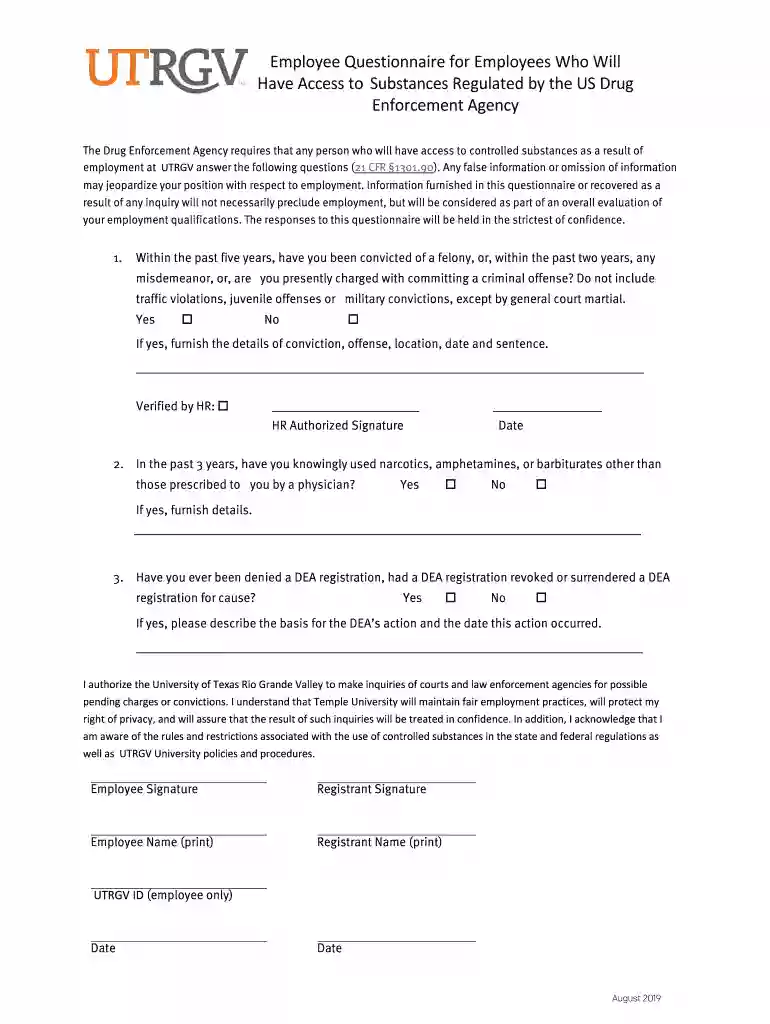
Michigan for Employees Who Will Have Access to Substances 2026

Get Form
Michigan for Employees Who Will Have Access to Substances Preview on Page 1

Here's how it works

01. Edit your form online
Type text, add images, blackout confidential details, add comments, highlights and more.

02. Sign it in a few clicks
Draw your signature, type it, upload its image, or use your mobile device as a signature pad.

03. Share your form with others
Send it via email, link, or fax. You can also download it, export it or print it out.

The fastest way to redact Michigan for Employees Who Will Have Access to Substances online

Form edit decoration
9.5
Ease of Setup
DocHub User Ratings on G2
9.0
Ease of Use
DocHub User Ratings on G2

Dochub is a perfect editor for changing your paperwork online. Adhere to this straightforward instruction to redact Michigan for Employees Who Will Have Access to Substances in PDF format online free of charge:

  1. Sign up and log in. Register for a free account, set a strong password, and go through email verification to start working on your forms.
  2. Add a document. Click on New Document and choose the file importing option: add Michigan for Employees Who Will Have Access to Substances from your device, the cloud, or a protected URL.
  3. Make changes to the sample. Take advantage of the upper and left-side panel tools to change Michigan for Employees Who Will Have Access to Substances. Add and customize text, images, and fillable areas, whiteout unneeded details, highlight the significant ones, and provide comments on your updates.
  4. Get your documentation accomplished. Send the form to other people via email, create a link for faster file sharing, export the sample to the cloud, or save it on your device in the current version or with Audit Trail included.

Discover all the benefits of our editor right now!

See more Michigan for Employees Who Will Have Access to Substances versions

We've got more versions of the Michigan for Employees Who Will Have Access to Substances form. Select the right Michigan for Employees Who Will Have Access to Substances version from the list and start editing it straight away!
Versions Form popularity Fillable & printable
2019 4.8 Satisfied (231 Votes)
be ready to get more

Complete this form in 5 minutes or less

Get form

Got questions?

We have answers to the most popular questions from our customers. If you can't find an answer to your question, please contact us.
Contact us
Safety-sensitive employees are subject to drug or alcohol testing in the following situations: Pre-employment. Reasonable Suspicion/Cause. Random.
A prescription is required to legally purchase Adderall. Without a prescription, possession of Adderall carries a maximum two-year prison sentence and a $2,000 fine in Michigan. Without a license, administering Adderall is a felony, and depending on how much is in possession, there may be fines and jail time.
The Michigan Lifer Law, or 650 Lifer Law as it was once referred to, meant that individuals who were convicted of serious drug crimes would receive a mandatory sentence of life in prison. While sentencing is not as harsh today as it once was, it is still severe.
Under Michigan drug laws, Possession of Ecstasy (MDMA, or Molly) or Meth in any amount has a penalty of up to 10 years in prison and $15,000 in fines. Under Michigan drug laws, Possession of Marijuana in any amount has a maximum penalty of up to 1 year in prison and $2,000 in fines.
Consistent with the Drug-free Workplace Act of 1988, all Employer employees are prohibited from engaging in the unlawful manufacture, distribution, dispensing, possession, or use of prohibited substances in the workplace including transit system premises and transit vehicles.

Security and compliance

At DocHub, your data security is our priority. We follow HIPAA, SOC2, GDPR, and other standards, so you can work on your documents with confidence.

Learn more
ccpa2
pci-dss
gdpr-compliance
hipaa
soc-compliance

People also ask

Controlled Substance Violations in Michigan These substances include narcotics and prescription drugs, and they are categorized into five schedules. Schedule I and II drugs are considered to have a high potential for abuse and no medically accepted value.
(1) A person shall not knowingly or intentionally possess a controlled substance, a controlled substance analogue, or a prescription form unless the controlled substance, controlled substance analogue, or prescription form was obtained directly from, or pursuant to, a valid prescription or order of a practitioner while
The Controlled Substances Act (CSA) places all substances which were in some manner regulated under existing federal law into one of five schedules. This placement is based upon the substances medical use, potential for abuse, and safety or dependence liability.

Related links