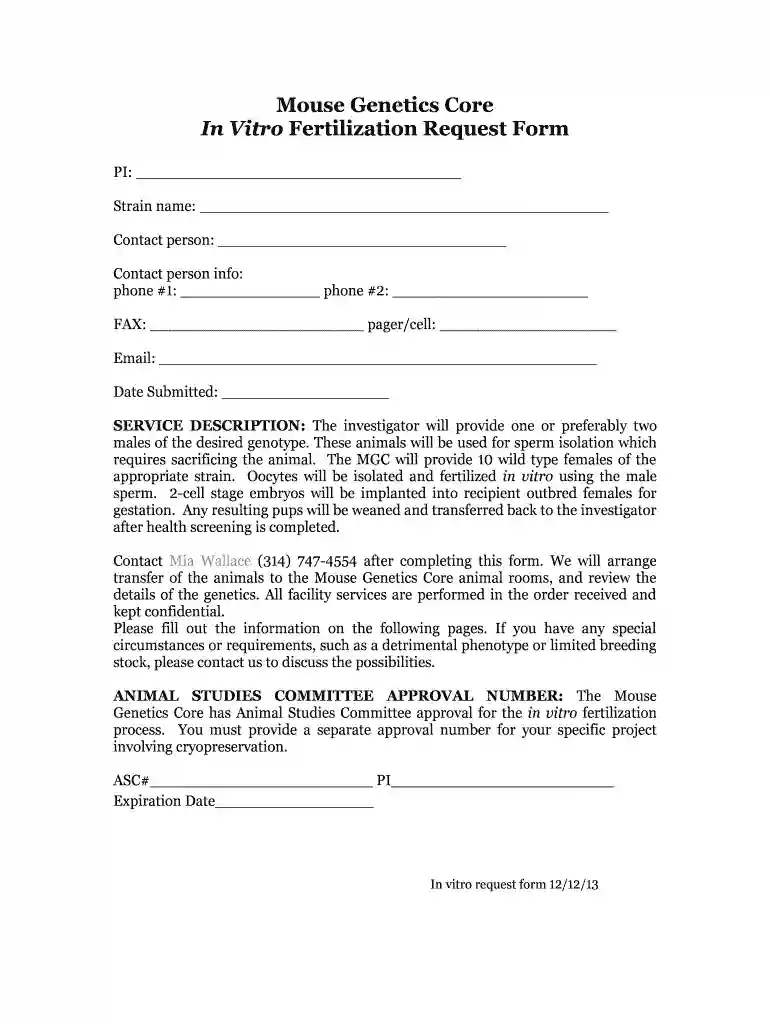
Mouse Genetics Core In Vitro Fertilization Request Form 2026

Get Form
Mouse Genetics Core In Vitro Fertilization Request Form Preview on Page 1

Here's how it works

01. Edit your form online
Type text, add images, blackout confidential details, add comments, highlights and more.

02. Sign it in a few clicks
Draw your signature, type it, upload its image, or use your mobile device as a signature pad.

03. Share your form with others
Send it via email, link, or fax. You can also download it, export it or print it out.

How to use or fill out Mouse Genetics Core In Vitro Fertilization Request Form with our platform

Form edit decoration
9.5
Ease of Setup
DocHub User Ratings on G2
9.0
Ease of Use
DocHub User Ratings on G2
  1. Click ‘Get Form’ to open the Mouse Genetics Core In Vitro Fertilization Request Form in the editor.
  2. Begin by filling in the Principal Investigator (PI) name and strain name at the top of the form. This information is crucial for identifying your request.
  3. Provide contact details for the person responsible, including phone numbers, FAX, pager/cell, and email. Ensure accuracy for effective communication.
  4. In the SERVICE DESCRIPTION section, review the requirements for providing males of the desired genotype. Note any special circumstances that may apply to your project.
  5. Complete the ANIMAL STUDIES COMMITTEE APPROVAL NUMBER section with your specific project approval number and expiration date.
  6. Fill out the BACKGROUND and BREEDING SCHEME sections with relevant genetic information and specify which females will be used for embryo production.
  7. List all animals to be transferred, including their sex, genotype, and age in the designated area.
  8. Finally, complete the BILLING INFORMATION section with your department details and ensure you sign at the bottom before submission.

Start using our platform today to streamline your form completion process effortlessly!

See more Mouse Genetics Core In Vitro Fertilization Request Form versions

We've got more versions of the Mouse Genetics Core In Vitro Fertilization Request Form form. Select the right Mouse Genetics Core In Vitro Fertilization Request Form version from the list and start editing it straight away!
Versions Form popularity Fillable & printable
2013 4.8 Satisfied (123 Votes)
be ready to get more

Complete this form in 5 minutes or less

Get form

Got questions?

We have answers to the most popular questions from our customers. If you can't find an answer to your question, please contact us.
Contact us

If you regularly work with documents stored in your Google Drive, DocHub is a perfect option for you to easily and quickly fill out, edit, and approve them. This editor integrates properly with Google apps, so you can export your Mouse Genetics Core In Vitro Fertilization Request Form from your Google Drive to the editor without downloading and re-uploading it. Right-click on your file, choose Open With → DocHub PDF Sign and Edit. In our editor, add and assign Signature Fields for all parties involved, then click on the Menu button above → Send → select how you want to share your paperwork.

If you need to edit your Mouse Genetics Core In Vitro Fertilization Request Form online quickly, it does not matter what browser you employ. DocHub’s simple editing tools are accessible using any internet browser. Simply open the appropriate tab in the editor, add your file, and fill it out without stress.

In vitro fertilization, also called IVF, is a complex series of procedures that can lead to a pregnancy. Its a treatment for infertility, a condition in which you cant get pregnant after at least a year of trying for most couples. IVF also can be used to prevent passing on genetic problems to a child.
Mice should be acclimated at your facility for at least 7 days before immunization. Inject mice with antigen emulsified in CFA subcutaneously at two sites on the back, injecting 0.05 to 0.1 mL at each site (total of 0.1 to 0.2 mL per mouse).
In mice this process takes 4-5 days. The egg has a protective membrane, the zona pellucida, which stops it from implanting in the oviduct wall. By the time it docHubes the the egg has undergone many cell divisions to form a blastocyst, which hatches from the zona to implant into the uterine wall.

Security and compliance

At DocHub, your data security is our priority. We follow HIPAA, SOC2, GDPR, and other standards, so you can work on your documents with confidence.

Learn more
ccpa2
pci-dss
gdpr-compliance
hipaa
soc-compliance

People also ask

In Vitro fertilization (IVF) Fresh or frozen from a transgenic male is used to fertilize oocytes obtained from superovulated female mice. IVF rederivations generally yield a larger number of pups compared to thawing one or two straws of embryos for rederivation.
Mouse IVF Using 40-50L of Cryopreserved This protocol is for IVF using a cryostraw or cryovial containing 40-50 L of cryopreserved . Oocytes are collected and pre-incubated in IVF medium containing GSH for 30-70 min and are thawed and pre- incubated in MBCD medium for 30-40 min before insemination.

Related links