




01. Edit your form 1120 instructions 2018 online
Type text, add images, blackout confidential details, add comments, highlights and more.

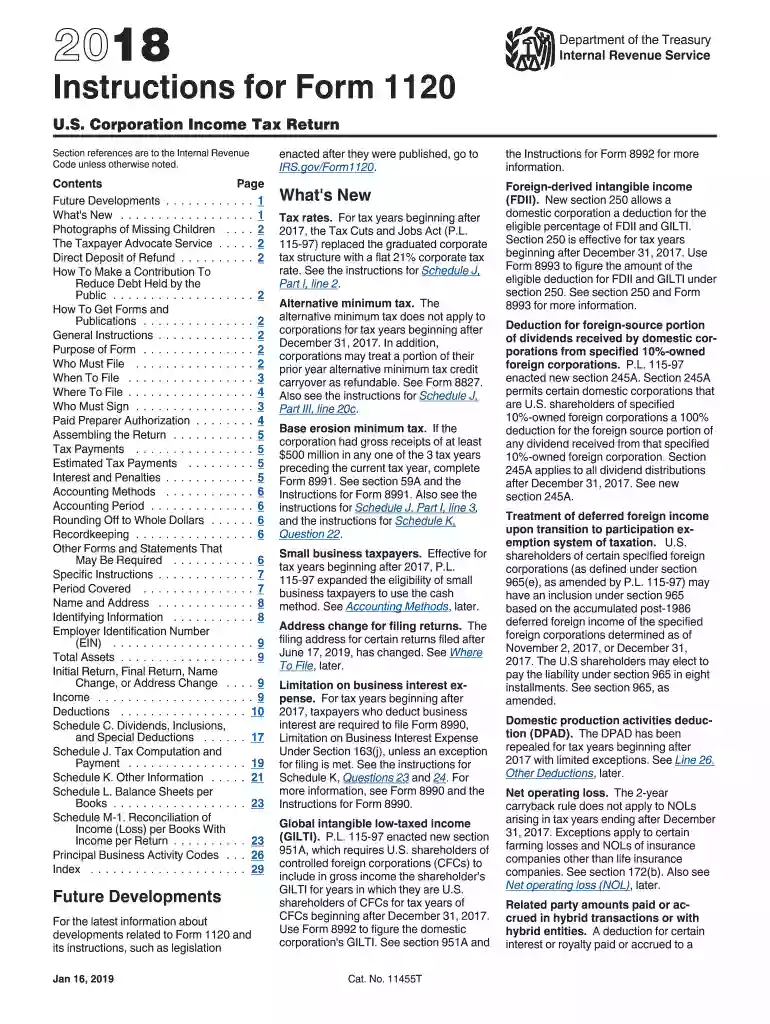
Type text, add images, blackout confidential details, add comments, highlights and more.

Draw your signature, type it, upload its image, or use your mobile device as a signature pad.

Send 2018 form 1120 instructions via email, link, or fax. You can also download it, export it or print it out.
Form 1120, also known as the U.S. Corporation Income Tax Return, is a critical document used by corporations operating in the United States to report their annual income, gains, losses, deductions, credits, and to calculate their tax liability. The 2016 instructions provide a comprehensive guide for accurately completing the form for that tax year, ensuring compliance with the Internal Revenue Service's (IRS) regulations.
Corporations should utilize the 2016 Form 1120 instructions to understand the requirements for each section of the form. These instructions outline how to properly report income figures, apply deductions, and compute taxes. Key sections include income reporting, deductions, and computation of the tax, making the instructions essential for accurate tax filing.
Review Income Reporting Requirements:
Apply Deductions:
Compute Tax Obligations:
Understanding the terminology used in the Form 1120 instructions is crucial for compliance. The following key terms are highlighted throughout the instructions:
Completing Form 1120 requires meticulous attention to detail, guided by the instructions. Here’s how to approach the process:
Gather Financial Documents:
Follow Detailed Section Guidelines:
Check Calculations:
For corporations following a calendar year, the Form 1120 must be filed by April 15th of the following year. Key dates also include deadlines for estimated tax payments, which typically occur quarterly on the 15th of April, June, September, and December.
Failure to comply with Form 1120 submission guidelines can result in significant penalties. These may include fines for late filing, inaccuracies, or underpaid taxes. Interest on unpaid amounts begins accruing immediately after the due date, emphasizing the importance of timely and precise filing.
Corporations have several submission options for Form 1120:
The form is predominantly used by domestic corporations, including C corporations, to fulfill their federal tax reporting obligations. It is crucial for tax professionals and accountants who assist corporations in tax preparation and compliance.


The IRS provides these instructions to assist corporations in meeting their federal tax obligations. These guidelines ensure that corporations correctly report their financial activities in order to comply with federal tax laws.
We've got more versions of the form 1120 instructions 2018 form. Select the right form 1120 instructions 2018 version from the list and start editing it straight away!
| Versions | Form popularity | Fillable & printable |
|---|---|---|
| 2024 | 4.6 Satisfied (53 Votes) | |
| 2022 | 4.9 Satisfied (52 Votes) | |
| 2021 | 4.8 Satisfied (56 Votes) | |
| 2020 | 4.2 Satisfied (35 Votes) | |
| 2019 | 4.3 Satisfied (48 Votes) | |
| 2018 | 4.1 Satisfied (67 Votes) | |
| 2017 | 4.4 Satisfied (54 Votes) | |
| 2016 | 4.4 Satisfied (290 Votes) | |
| 2015 | 4.2 Satisfied (57 Votes) | |
| 2014 | 4 Satisfied (55 Votes) | |
| 2013 | 3.9 Satisfied (49 Votes) | |
| 2011 | 4 Satisfied (45 Votes) |
At DocHub, your data security is our priority. We follow HIPAA, SOC2, GDPR, and other standards, so you can work on your documents with confidence.
Enter the six-digit NAICS code for this taxpayer from your federal return (form 1120, Schedule K, line 2a; 1120S, box B;. 1165, box C; or corresponding lineRead more
Jan 6, 2017 Use Form 1120, U.S. Corporation Income. Tax Return, to report the income, gains, losses, deductions, credits, and to figure the income taxRead more
May 14, 2021 Only submit original (no copies needed). All corporations required to file an income tax return other than Form 990-T (including 1120-C filers),Read more


