



01. Edit your 2017 form 1120 instructions online
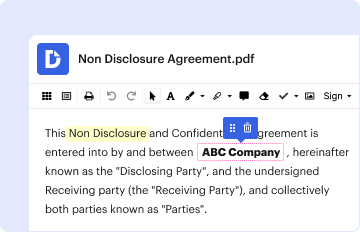
Type text, add images, blackout confidential details, add comments, highlights and more.

Type text, add images, blackout confidential details, add comments, highlights and more.
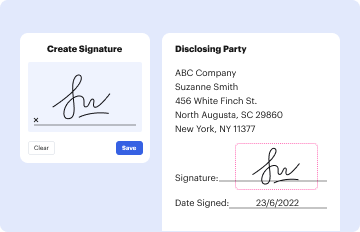
Draw your signature, type it, upload its image, or use your mobile device as a signature pad.

Send 1120 instructions 2017 via email, link, or fax. You can also download it, export it or print it out.
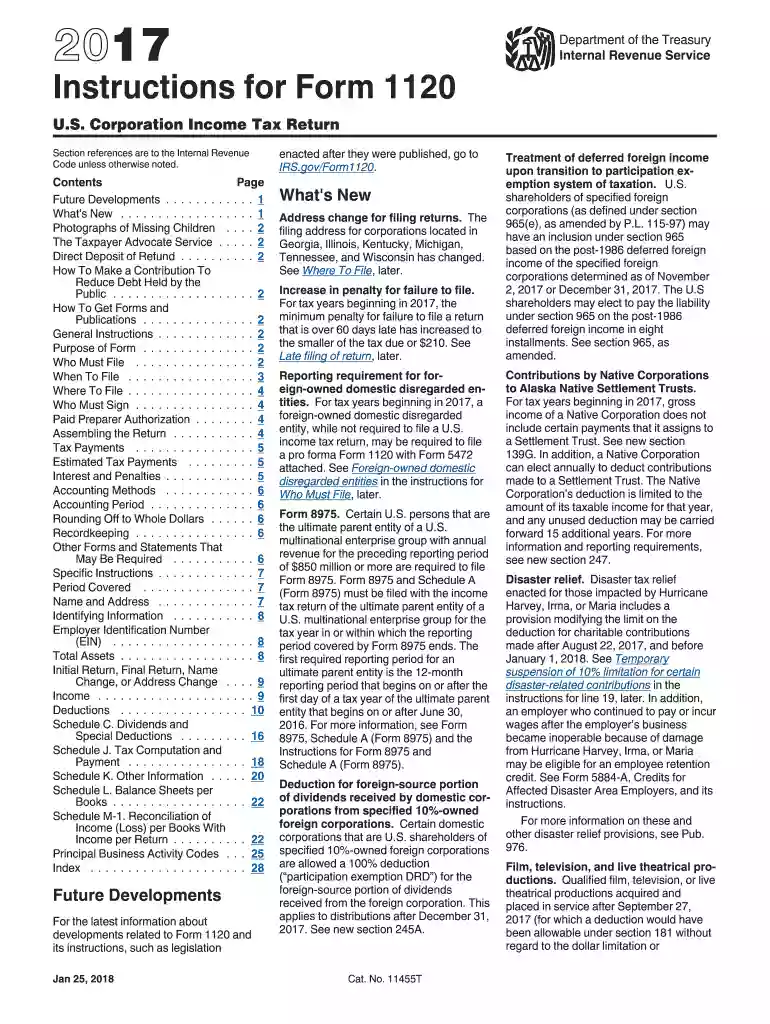
The IRS Form 1120 is the U.S. Corporation Income Tax Return. The instructions for this form serve as a crucial guide to completing the return accurately for the tax year 2017. These guidelines detail who is required to file the form, what information must be included, and how to compute taxes owed. Corporations, including those undergoing liquidation, generally need to utilize Form 1120 unless they qualify to use specialized corporate forms like 1120S for S corporations.
Filing Form 1120 entails a step-by-step process to ensure accuracy and compliance with IRS regulations.
The deadline for Form 1120 is typically the 15th day of the fourth month after the end of the corporation's tax year. For those whose fiscal year coincides with the calendar year, the due date is April 15. Extensions can be requested to avoid late filing penalties but must be submitted before the original due date.
Corporations that conduct business, process income, and have taxable obligations in the U.S. are required to file Form 1120. This includes most C corporations. Determining eligibility includes evaluating whether the corporation meets specific thresholds in income and employee numbers.


For electronic filing, software compatibility is vital. Many tax preparation platforms, including TurboTax and QuickBooks, support Form 1120 filings, offering guided assistance to reduce errors and streamline the e-filing process.
While Form 1120 is a federal requirement, corporations should also account for state-specific tax obligations. This may include additional filings or adjustments for state-specific deductions and credits.
Corporations have multiple methods for submitting IRS Form 1120:
These instructions provide comprehensive support to navigate the complexities of corporate tax requirements, ensuring that all financial obligations are met in a timely and accurate manner.
We've got more versions of the 2017 form 1120 instructions form. Select the right 2017 form 1120 instructions version from the list and start editing it straight away!
| Versions | Form popularity | Fillable & printable |
|---|---|---|
| 2024 | 4.6 Satisfied (53 Votes) | |
| 2022 | 4.9 Satisfied (52 Votes) | |
| 2021 | 4.8 Satisfied (56 Votes) | |
| 2020 | 4.2 Satisfied (35 Votes) | |
| 2019 | 4.3 Satisfied (48 Votes) | |
| 2018 | 4.1 Satisfied (67 Votes) | |
| 2017 | 4.4 Satisfied (54 Votes) | |
| 2016 | 4.4 Satisfied (290 Votes) | |
| 2015 | 4.2 Satisfied (57 Votes) | |
| 2014 | 4 Satisfied (55 Votes) | |
| 2013 | 3.9 Satisfied (49 Votes) | |
| 2011 | 4 Satisfied (45 Votes) |
At DocHub, your data security is our priority. We follow HIPAA, SOC2, GDPR, and other standards, so you can work on your documents with confidence.
Apr 12, 2018 Use Form 1120, U.S. Corporation Income. Tax Return, to report the income, gains, losses, deductions, credits, and to figure the income taxRead more
Effective July 1, 2017, the Illinois income tax rate for individuals, trusts, and estates increased from. 3.75% to 4.95%. The corporate rate (excluding SRead more
See instructions . . . . . . . . 2. 3. Carryforward of credits for qualified tax credit bonds and build America bonds to 2017 (see instructions) .Read more


