
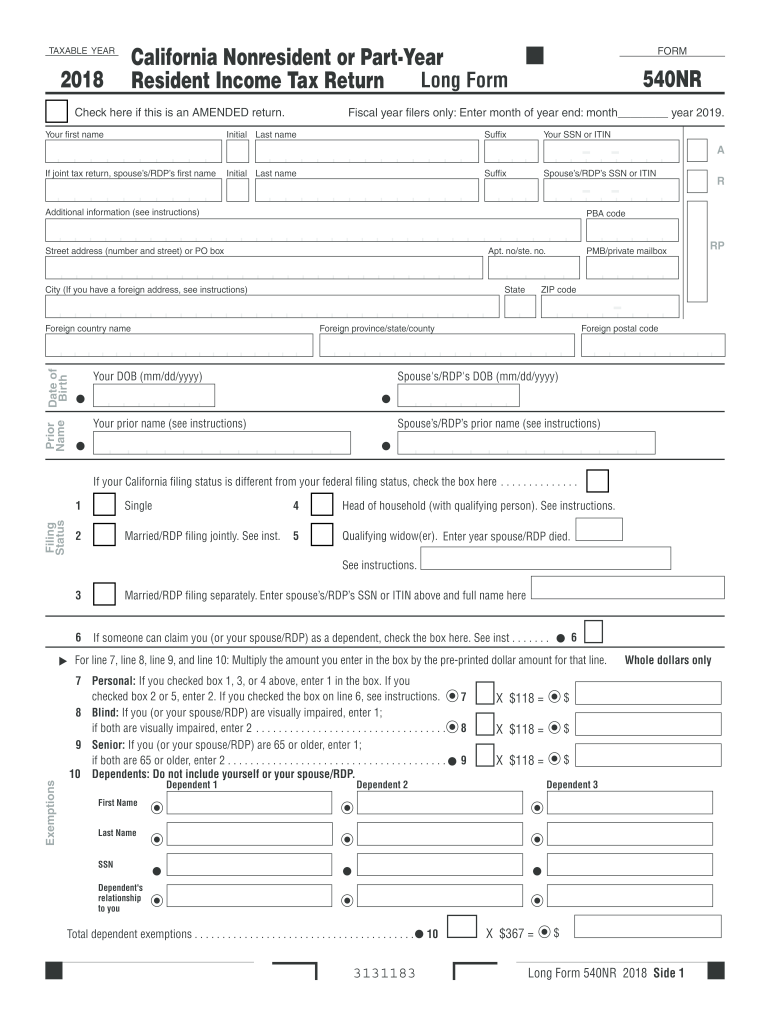







Definition and Purpose of Form 540NR
Form 540NR, officially known as the California Nonresident or Part-Year Resident Income Tax Return, is designed for individuals who meet specific residency and income criteria in California. This form is essential for those who earned income in California but did not reside there for the entire tax year. It helps to determine the tax owed to California based on various income sources and residency status. Nonresidents and part-year residents use this form to report adjusted gross income, deductions, and credits applicable to their situation in California.
Categories of Individuals Using Form 540NR
- Nonresidents: Individuals residing outside California for the entire year but with income from California sources.
- Part-Year Residents: Those who moved into or out of California during the tax year with income earned while a resident.
Understanding the primary use of Form 540NR helps taxpayers accurately file their returns and comply with California's tax regulations.
How to Obtain Form 540NR
Securing the Form 540NR is a straightforward process. Taxpayers have various methods to choose from, depending on their preference for digital or paper formats.
-
Downloadable Format:
- The form is readily available on the official website of the California Franchise Tax Board (FTB). Taxpayers can download and print the form for manual completion.
-
Mail Request:
- Individuals can request a paper version via mail by contacting the California Franchise Tax Board directly.
-
Tax Software Platforms:
- Form 540NR is also integrated into numerous tax preparation software, simplifying the process for those who prefer electronic filing.
Choose the method that best aligns with your preference and ensure to obtain the latest edition of the form.
Steps to Complete Form 540NR
Completing the Form 540NR requires attention to detail to ensure accuracy and compliance. Below are the general steps involved:
-
Personal Information:
- Enter basic data, including name, address, and Social Security Number. Ensure all information matches your federal tax return to avoid discrepancies.
-
Residency Status:
- Specify your residency status (nonresident or part-year resident) and provide the dates of residency in California.
-
Income Reporting:
- Report all sources of California income, including wages, rental income, and dividends.
- Only include income earned during your time as a California resident or from California sources.
-
Adjustments and Deductions:
- List qualifying deductions and adjustments applicable to California state law.
-
Calculating Tax Liability:
- Use provided worksheets to calculate your total tax liability, credits, and amounts due or refundable.
-
Final Review:
- Review all sections for accuracy, ensuring all calculations are correct before submission.
-
Signature:
- Sign and date the form to validate its authenticity.
Complete each section accurately to avoid errors that could lead to processing delays or penalties.
Required Documents for Form 540NR
When preparing to fill out the Form 540NR, gather relevant documents to ensure a smooth filing process.
- Previous Year Tax Returns: Needed for comparison and verification, ensuring accuracy in reporting.
- W-2 and 1099 Forms: Essential for reporting wages and other sources of income.
- Property Tax Receipts: Useful for claiming deductions associated with property taxes paid.
- Proof of Residency: Documents like rental agreements or utility bills that establish residency status during the tax year.
Having these documents on hand will simplify the filing process and help avoid errors.
Legal Implications and Use of Form 540NR
Filing Form 540NR is a legal requirement for individuals with California income who meet the nonresident or part-year resident criteria. Understanding its legal implications helps maintain compliance with state tax laws.
Compliance Requirements
- Accurate Reporting: All income and deductions must be reported correctly according to California tax laws.
- Timely Filing: Submit by the deadline to avoid penalties for late filing.
- Verification of Residency Status: Proper documentation supporting residency period and nonresident status is crucial.
Failure to comply can result in penalties, interest charges, and potential audits.
Key Elements and Structure of Form 540NR
Form 540NR is structured to capture essential information that determines the taxpayer's liability.
-
Personal Information Section
- Collects basic identity and contact details.
-
Residency Section
- Captures detailed residency information necessary to categorize taxpayer as nonresident or part-year resident.
-
Income Section
- Includes categories for reporting various income types with relevance to California.
-
Deductions and Credits
- Allows taxpayers to list applicable deductions to reduce tax burden legally.
-
Calculation Worksheets
- Provides structured worksheets for calculating total tax liability and potential refunds.
Understanding each section helps users efficiently navigate and complete the form.
Important Submission Details
Submitting Form 540NR correctly helps ensure your taxes are processed without issues.
Submission Method Options
- Electronic Filing: Utilizing e-file systems through tax software ensures quick and secure submission.
- Mail Submission: For traditional submissions, send to the address listed on the form instructions. Ensure it is postmarked by the deadline.
Critical Deadlines
- Filing Deadline: Aligns with the federal deadline of April 15, unless otherwise adjusted for weekends or holidays.
- Extensions: Available upon request, typically granting additional time to file, though payments are still due by the original deadline.
Staying informed about submission methods and deadlines prevents penalties and keeps taxpayers in good standing with California tax authorities.
Penalties for Non-Compliance
Failure to file or accurately complete Form 540NR can lead to significant consequences.
Types of Penalties
- Late Filing Penalty: A percentage of the unpaid tax due, assessed if the return is filed past the deadline without a valid extension.
- Accuracy-Related Penalty: Imposed for errors and inaccuracies in reported amounts.
- Fraud Penalty: Severe penalties apply for intentional attempts to evade tax duties.
To avoid these, ensure complete and timely submissions with verified accuracy in all entries. Promptly address any notifications from tax authorities to rectify potential issues immediately.




