Definition & Meaning
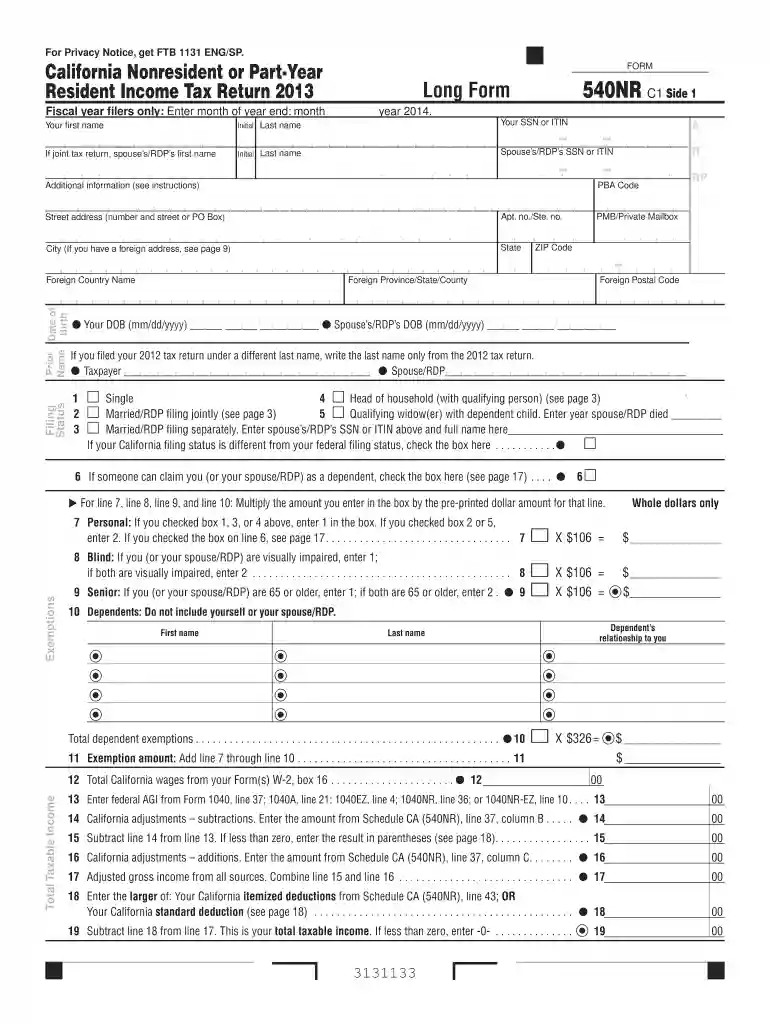
The "2013 540NR form" refers to the California Nonresident or Part-Year Resident Income Tax Return form for the year 2013. This document is designed for individuals who during 2013, either did not reside in California for the entire year or lived there for only part of the year, yet earned income sourced from within the state. The form is essential for calculating the state income tax owed or figuring out any refunds due based on California-sourced income and corresponding tax credits and deductions.
Key Components of the Form
- Personal Information: Includes fields for taxpayers to input their name, Social Security number, and filing status.
- Income Details: Requires accurate reporting of all taxable income sourced from California.
- Deductions and Credits: Allows for the inclusion of applicable tax credits and deductions to reduce tax liability.
Steps to Complete the 2013 540NR Form
Completing the 2013 540NR form involves several critical steps:
Gather Necessary Information:
- Collect all relevant income documents, such as W-2s or 1099s.
- Ensure access to personal identification details.
Complete Income Sections:
- Report all California-sourced income meticulously in applicable sections.
- Calculate total adjusted gross income attributable to California.
Claim Deductions and Credits:
- Enter all allowable deductions and tax credits.
- Calculate the total amount that lowers your taxable income.
Calculate Tax Liability:
- Utilize California tax tables to calculate the tax owed based on adjusted gross income.
- Assess the impact of credits on the final tax liability.
Finalize and Sign:
- Ensure all calculations are accurate and the form is signed.
- Double-check for any missing or incorrect information.
Important Terms Related to the 2013 540NR Form
Understanding key terminology is crucial for accurately completing the form:
- Nonresident: Someone who resided outside California but earned income from the state.
- Part-Year Resident: An individual who resided in California for only part of the year.
- California Source Income: Income that is derived from business, employment, or investments within California.
- Tax Credits: Specific reductions in tax liability due to eligible expenses or situations, such as education or energy efficiency upgrades.
State-Specific Rules for the 2013 540NR Form
California has distinct tax residency rules that affect how the 540NR form is utilized:
- Residency Status: Nonresidents are taxed only on California-sourced income, while part-year residents report both California and out-of-state income for the portion of the year they resided in California.
- Allowance for Prorated Deductions: Part-year residents can prorate certain deductions based on the proportion of the year spent in California.
- Tax Tables Specific to Nonresidents: Different tax calculation tables are used for nonresidents compared to full-year residents.
Filing Deadlines and Important Dates
Regular tax filing deadlines for the 2013 tax year apply to the 540NR form:
- Tax Filing Deadline: Typically April 15, 2014, unless extended due to holidays or other circumstances.
- Extension Requests: Taxpayers could file for a six-month extension, generally moving the deadline to October 15, 2014.
Consequences of Missing Deadlines
- Penalties and interest may accrue on any unpaid taxes after the filing deadline.
- Lost eligibility for specific deductions or credits if the filing is significantly delayed.
Form Submission Methods (Online / Mail / In-Person)
Taxpayers have multiple options for submitting the 2013 540NR form:
- Online Filing: Electronic filing through the California Franchise Tax Board (FTB) or tax preparation software ensures quicker processing.
- Mail: Forms may be mailed directly to the FTB using the address specified in the form instructions.
- In-Person: While less common, taxpayers can submit forms at FTB regional offices.
Comparing Submission Methods
- Efficiency: Online filing typically offers faster processing and confirmation.
- Verification: In-person submissions allow for immediate assistance and verification.
Penalties for Non-Compliance
Failure to comply with California tax filing requirements results in various penalties:
- Late Filing Penalty: Imposes a percentage of the owed tax for delaying submission beyond the deadline.
- Underpayment Penalty: Assessed if insufficient taxes are paid during the taxable year.
- Negligence Penalty: Penalizes substantial inaccuracies or omissions found upon audit.
Avoiding Penalties
- Ensure accurate calculations and timely submission.
- Consider filing an extension if additional time is needed to complete the form accurately.
Digital vs. Paper Version
There are dual formats for the 540NR form, each with specific advantages:
Digital Format
- Convenience: Offers ease of access and submission through digital platforms.
- Automated Calculations: Reduces human error with built-in computation tools.
Paper Version
- Tangible Record: Some taxpayers may prefer a physical copy for record-keeping.
- Accessibility: Suitable for individuals without reliable internet access or digital proficiency.
Choosing between digital and paper versions depends on personal technology comfort levels and access to electronic resources.