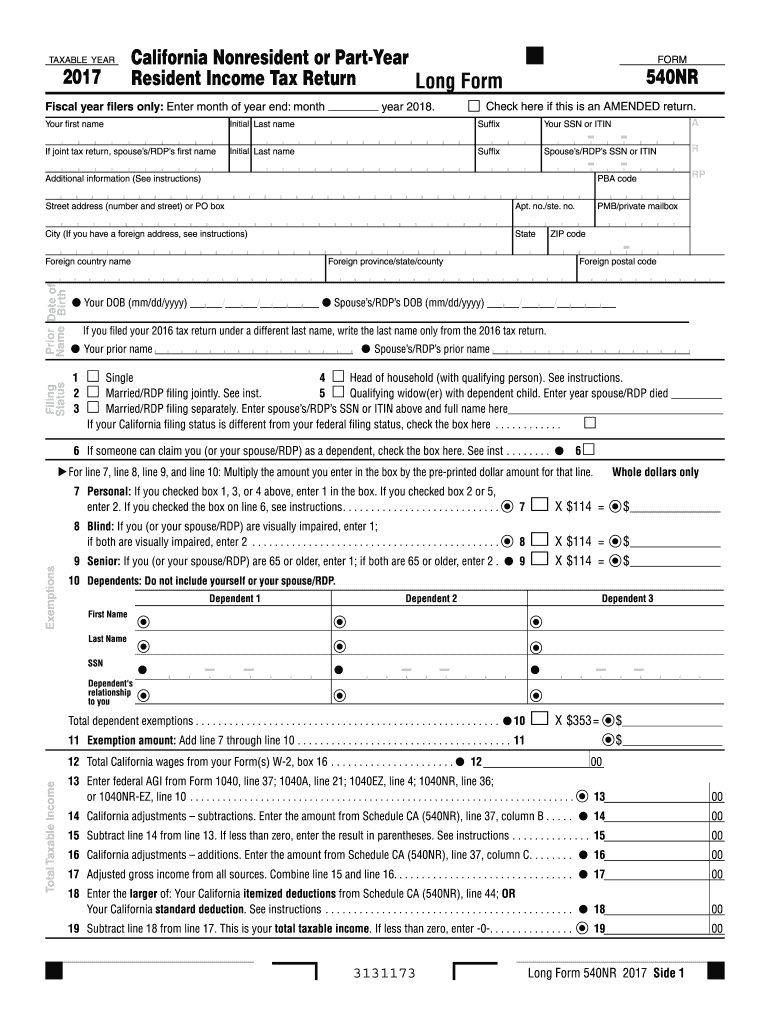







Definition and Purpose of Form 540NR
The 2017 Form 540NR is designed for individuals who were not full-year residents of California but received income from California sources. This includes individuals who lived in California for part of the year and those who reside outside the state but have financial connections, such as rental income or business earnings in California. The primary purpose of this form is to calculate the correct amount of income tax owed to California for that tax year, factoring in the nuances of non-residency or part-year residency.
Key Elements of Form 540NR
Form 540NR includes several crucial sections:
- Personal Information: Here, taxpayers provide their name, address, social security number, and filing status. This section also asks for information about dependents, which can affect deductions and credits.
- Income Adjustments and Deductions: This involves calculating federal adjusted gross income and making state-specific adjustments. Taxpayers can also itemize deductions or take the standard deduction.
- Tax Rates and Calculations: California tax rates, which may be different from federal rates, are applied to determine the taxpayer's California taxable income.
- Credits and Payments: Available tax credits and prepayments, such as estimated tax payments, are subtracted from the owed tax to determine the final balance.
Steps to Complete Form 540NR
Completing the 2017 Form 540NR involves several precise steps:
- Gather Required Documents: Collect all necessary forms, including W-2s, 1099s, or other income statements reflecting California-sourced income.
- Determine Filing Status: Select the appropriate status, such as single, head of household, or married filing jointly, as this affects tax rates and standard deductions.
- Calculate Federal Adjusted Gross Income: Start with this amount from your federal return before making state-specific adjustments.
- Compute California Adjustments: Adjust for income that varies between federal and state law, such as differing retirement income treatments or state-based tax-exempt interest.
- Apply Deductions: Decide whether to itemize deductions or take the standard deduction, noting the impact on taxable income.
- Calculate Tax Owed: Apply California tax rates to compute state taxes on your adjusted income.
- Subtract Credits and Prepayments: Reduce your tax liability using eligible credits and any estimated taxes already paid to the state.
- Submit the Form: File electronically or mail the completed form and any payment due to the California Franchise Tax Board.
Who Typically Uses Form 540NR
This form is specifically for:
- Part-Year Residents: Individuals who lived in California for only part of the year and earned income from the state.
- Nonresidents with California Income: Those who live out-of-state but have a financial interest in California, such as business owners, landlords, or employees working across states.
Important Terms Related to Form 540NR
- California Source Income: Earnings attributable to activities or investments in California.
- Nonresident: An individual who does not meet California residency requirements but has earned income from within its borders.
- Part-Year Resident: Someone who resided in California for a portion of the tax year.
- Adjusted Gross Income (AGI): Total income minus specific deductions, integral for computing state taxes.
Legal Use and Compliance
The 2017 Form 540NR is crucial for maintaining compliance with California tax laws. It ensures that nonresidents and part-year residents accurately report earnings attributed to California, thus fulfilling local tax obligations.
Penalties for Non-Compliance
Failure to correctly file or pay taxes due on Form 540NR can result in:
- Interest on Unpaid Taxes: Additional charges accruing from the unpaid tax balance.
- Late Filing Fees: Penalties for not submitting the form by the deadline.
- Audit Risks: Increased likelihood of an audit for non-compliant or incorrect submissions.
Filing Deadlines and Important Dates
The filing deadline for the 2017 Form 540NR was April 17, 2018, aligning with the federal tax deadline. Taxpayers could request an extension, typically to October 15, contingent upon fulfilling preliminary filing requirements.
Required Documents
To accurately complete Form 540NR, gather:
- Income Statements: Such as W-2s, 1099s, detailing California source income.
- Federal Tax Return: A copy of the completed federal tax return provides a basis for state filings.
- Deduction and Credit Documentation: Proof of eligibility for itemized deductions or credits claimed.
State-by-State Differences and Variations
California's approach towards part-year and nonresident taxation uniquely accounts for:
- Different Income Sources: Tax rules may vary significantly compared to federal standards, particularly regarding tax-exempt interest or differing treatment of certain retirement incomes.
- Local Tax Credits: California offers specific credits, such as renter’s credits, that may not be recognized elsewhere.
Submission Methods: Online, Mail, In-Person
Taxpayers may file the 2017 Form 540NR through several methods:
- Electronic Filing: Using platforms integrated with California's e-filing system for faster processing.
- Mail: Sending paper forms directly to the Franchise Tax Board ensures submission, albeit with longer processing times.
- In-Person: Some may choose physical submission at an authorized tax office for personal assistance.