





Spine patient questionnaire 2026

Get Form
spine patient questionnaire Preview on Page 1

Here's how it works

01. Edit your spine patient questionnaire online
Type text, add images, blackout confidential details, add comments, highlights and more.
02. Sign it in a few clicks
Draw your signature, type it, upload its image, or use your mobile device as a signature pad.
03. Share your form with others
Send it via email, link, or fax. You can also download it, export it or print it out.

How to use or fill out spine patient questionnaire with our platform

Form edit decoration
9.5
Ease of Setup
DocHub User Ratings on G2
9.0
Ease of Use
DocHub User Ratings on G2
  1. Click ‘Get Form’ to open the spine patient questionnaire in the editor.
  2. Begin by entering your personal information, including your name and MRN at the top of the form.
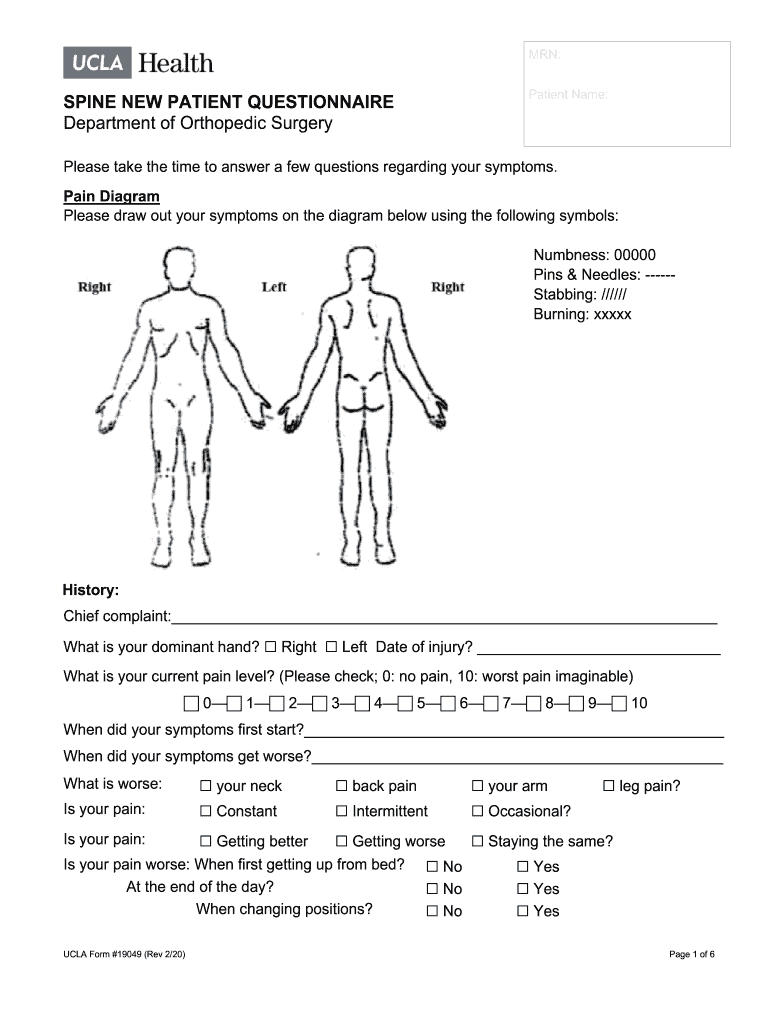
  3. In the Pain Diagram section, use the provided symbols to indicate where you experience symptoms. This visual representation is crucial for your healthcare provider.
  4. Proceed to the History section. Answer questions regarding your chief complaint, dominant hand, pain level, and symptom onset. Be as detailed as possible for accurate assessment.
  5. Continue through sections on difficulties, past medical history, medications, and allergies. Check applicable boxes and provide additional details where prompted.
  6. Complete the Social History and Family History sections by providing relevant information about your lifestyle and family medical background.
  7. Finally, review all entries for accuracy before signing at the bottom of the form. If needed, an interpreter can assist with this process.

Start filling out your spine patient questionnaire online for free today!

See more spine patient questionnaire versions

We've got more versions of the spine patient questionnaire form. Select the right spine patient questionnaire version from the list and start editing it straight away!
Versions Form popularity Fillable & printable
2020 4.9 Satisfied (32 Votes)
be ready to get more

Complete this form in 5 minutes or less

Get form

Got questions?

We have answers to the most popular questions from our customers. If you can't find an answer to your question, please contact us.
Contact us

With DocHub, you can rapidly sign your spine patient questionnaire or any other document on iOS, even without setting up additional programs. You can access your DocHub account from any web-connected browser and complete and sign your form in any preferred method with just a few clicks.

You can easily edit and complete your spine patient questionnaire on any iOS device. Open an internet browser of your choice, go to the DocHub website, authorize or create a new account, upload your file for editing, and make your required changes. Our service is mobile-friendly, so using its functions on your phone will be a no-brainer, even on the first try.

Palpation Palpate each spinous process for tenderness. Start with the atlanto-occipital joint and finishing at the sacroiliac joint. Palpate the trapezius and paraspinal muscles, assessing for muscle bulk, spasm and tenderness. Gently percuss down the spine for pain or tenderness. Feel for temperature down the spine.
The Cervical Spine Outcomes Questionnaire is a comprehensive, disease-specific instrument for assessing complaints of neck pain and evaluating the outcomes of treatments for these complaints.
The Neck Disability Index (NDI) [1] is designed to measure neck-specific disability. The questionnaire has 10 items concerning pain and activities of daily living including personal care, lifting, reading, headaches, concentration, work status, driving, sleeping and recreation.

Security and compliance

At DocHub, your data security is our priority. We follow HIPAA, SOC2, GDPR, and other standards, so you can work on your documents with confidence.

Learn more
ccpa2
pci-dss
gdpr-compliance
hipaa
soc-compliance

People also ask

The patient is positioned in prone. Cervical and thoracic spine segmental mobility and pain response are assessed. The examiner contacts each cervical spinous process with the thumbs. The examiner applies an oscillatory posterior to anterior force.
Some questions your doctor may ask: Can you describe your pain? (e.g. sharp, aching, burning) Where is the exact location of your back pain? When did the pain start and how long have you had the pain? What were you doing when you first noticed the pain? How severe or bad is the pain? What makes the pain worse or better?
Red flags are features from a patients subjective and objective assessment which are thought to put them at a higher risk of serious pathology and warrant referral for further diagnostic testing.
One or more of these tests might help pinpoint the cause of the back pain: X-ray. These images show arthritis or broken bones. MRI or CT scans. These scans generate images that can reveal herniated disks or problems with bones, muscles, tissue, tendons, nerves, ligaments and blood vessels. Blood tests. Nerve studies.
The CSOQ is a multi-item, self-report questionnaire designed to assess a number of factors considered relevant in evaluating treatment outcomes for spinal disorders, namely demographics, pain severity, functional disability, psychological distress, physical symptoms, health care utilization, and participants

Related links