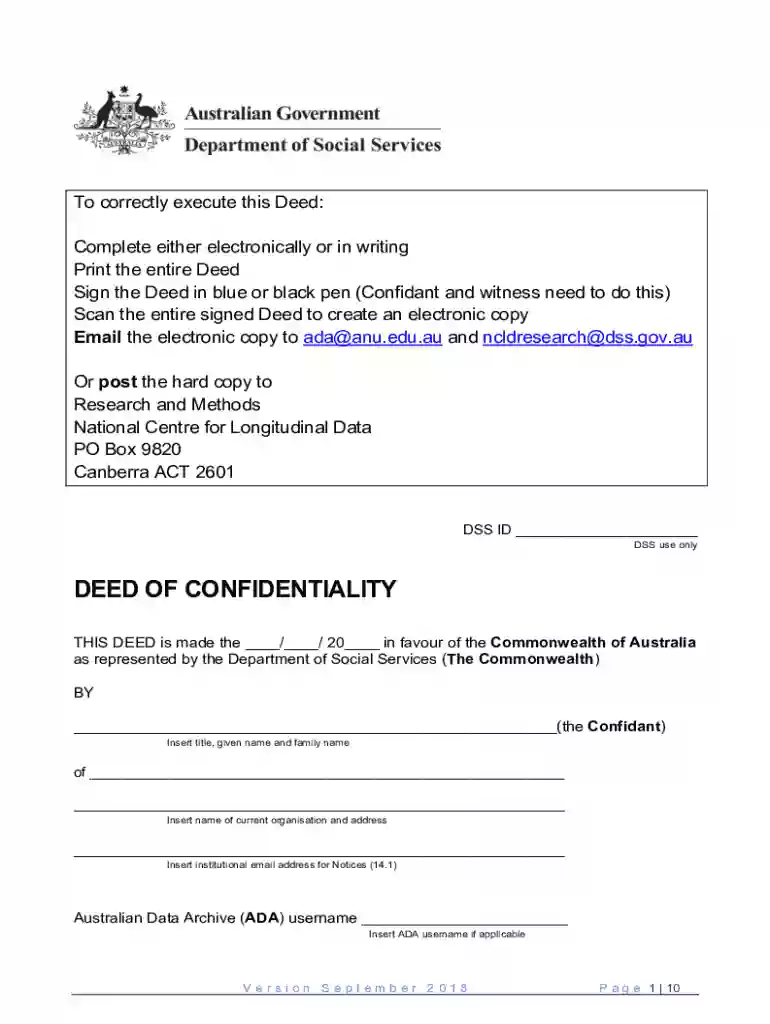
Australia deed confidentiality 2026

Get Form
australia deed confidentiality Preview on Page 1

Here's how it works

01. Edit your australia deed confidentiality online
Type text, add images, blackout confidential details, add comments, highlights and more.

02. Sign it in a few clicks
Draw your signature, type it, upload its image, or use your mobile device as a signature pad.

03. Share your form with others
Send it via email, link, or fax. You can also download it, export it or print it out.

How to use or fill out Australia Deed Confidentiality with our platform

Form edit decoration
9.5
Ease of Setup
DocHub User Ratings on G2
9.0
Ease of Use
DocHub User Ratings on G2
  1. Click ‘Get Form’ to open the Australia Deed of Confidentiality in the editor.
  2. Begin by filling in the date at the top of the form. This should be the date you are executing the deed.
  3. In the section for 'Confidant', enter your title, given name, and family name. Ensure accuracy as this identifies you legally.
  4. Provide your current organization’s name and address in the designated fields to establish your affiliation.
  5. Insert your institutional email address for notices, ensuring it is one you regularly check for communications regarding this deed.
  6. If applicable, include your Australian Data Archive (ADA) username in the specified field.
  7. Review all filled sections for accuracy before printing. Once confirmed, print the entire deed.
  8. Sign the deed using a blue or black pen. Ensure both you and a witness sign where required.
  9. Scan the signed document to create an electronic copy and either email it to the provided addresses or post a hard copy as instructed.

Start using our platform today to streamline your document editing and signing process for free!

See more australia deed confidentiality versions

We've got more versions of the australia deed confidentiality form. Select the right australia deed confidentiality version from the list and start editing it straight away!
Versions Form popularity Fillable & printable
2018 4.8 Satisfied (137 Votes)
be ready to get more

Complete this form in 5 minutes or less

Get form

Got questions?

We have answers to the most popular questions from our customers. If you can't find an answer to your question, please contact us.
Contact us
by Practical Law Corporate. MaintainedStandard documentsFederal. A mutual confidentiality deed (or non-disclosure agreement) for use where both parties will be disclosing confidential information to each other for commercial or transactional purposes.
The Privacy Act 1988 (Privacy Act) is the principal piece of Australian legislation protecting the handling of personal information about individuals. This includes the collection, use, storage and disclosure of personal information in the federal public sector and in the private sector.
Exceptions include: the individual consented to a secondary use or disclosure (APP 6.1(a)) the individual would reasonably expect the secondary use or disclosure, and that is related to the primary purpose of collection or, in the case of sensitive information, directly related to the primary purpose (APP 6.2(a))
Deeds have extra legal requirements compared to standard contracts get the signing, witnessing, and wording right for enforceability. Individuals must have their signature witnessed; companies signing under section 127 of the Corporations Act generally dont require witnesses.
Disclosure where there is express or implied consent. Disclosure that is permitted or compelled by law. Disclosure to seek advice on legal or ethical obligations. Disclosure to avoid the probable commission of a serious criminal offence. Disclosure to prevent imminent serious physical harm.

Security and compliance

At DocHub, your data security is our priority. We follow HIPAA, SOC2, GDPR, and other standards, so you can work on your documents with confidence.

Learn more
ccpa2
pci-dss
gdpr-compliance
hipaa
soc-compliance

People also ask

Exceptions to the Duty of Confidentiality Waiver. In case of danger. Committing a crime. Infectious diseases. Inspection and investigation by professional orders. Search for the truth. Protection of children. People not criminally responsible due to mental illness.
Are there any exceptions to confidentiality? Yes, there are some circumstances where confidentiality cannot be maintained. For example, a therapist must report suspected child abuse, neglect, or imminent harm to self or others. Therapists may also have to release records if subpoenaed by a court of law.

Related links