




01. Edit your schedule 1 2023 online
Type text, add images, blackout confidential details, add comments, highlights and more.

Type text, add images, blackout confidential details, add comments, highlights and more.

Draw your signature, type it, upload its image, or use your mobile device as a signature pad.

Send irs schedule i form 1041 via email, link, or fax. You can also download it, export it or print it out.
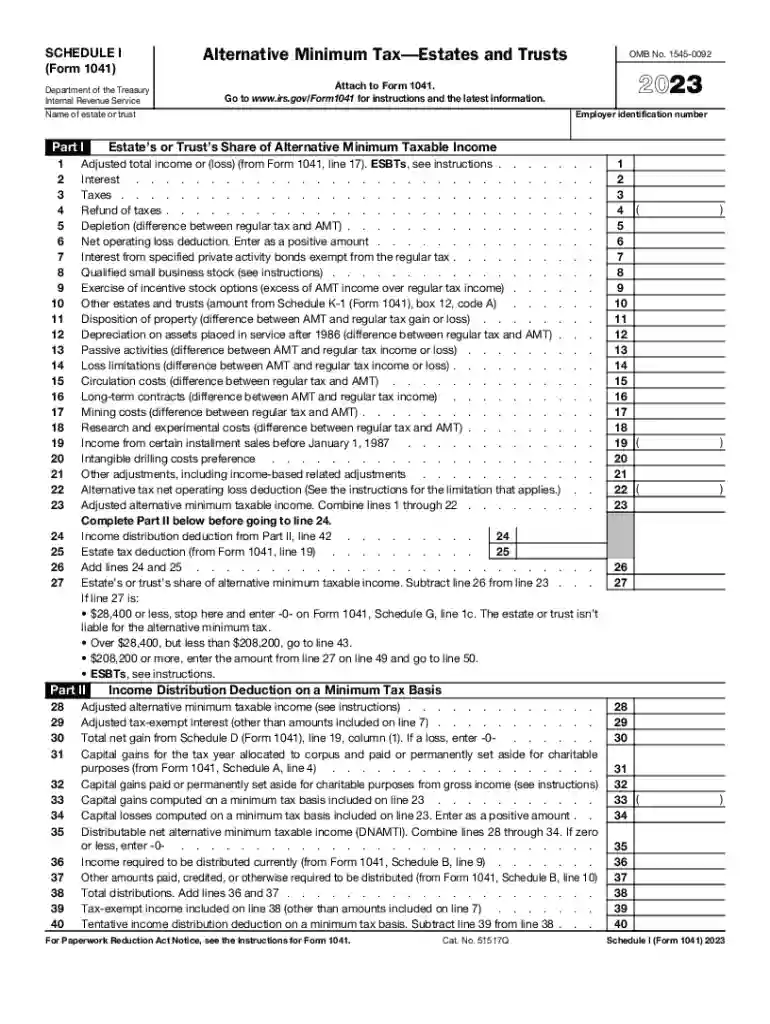
The Schedule I (Form 1041) for Alternative Minimum Tax (AMT) Estates is a tax form used by estates and trusts in the U.S. to calculate their share of alternative minimum taxable income. This form ensures that estates or trusts pay the appropriate amount of AMT by properly accounting for adjustments and preferences that differ from the regular tax system. By filling out this form, fiduciaries can determine whether their estate or trust is subject to AMT and compute the amount owed.
Schedule I is crucial for ensuring estates and trusts meet their federal tax obligations, particularly in cases with significant differences between ordinary income and AMT due to specific tax deductions or credits. By filing this form, fiduciaries not only comply with tax regulations but also minimize potential penalties for underpayment.
Typically, executors or trustees of estates and trusts that receive significant income or possess assets triggering AMT use Schedule I. This group often includes large estates, trusts with substantial investment portfolios, or entities with complex deductions.
The IRS provides comprehensive instructions for completing Schedule I to ensure accurate reporting and compliance. The guidelines delineate mandatory fields, explain computation subtleties, and provide examples to help fiduciaries navigate complex tax scenarios.
Schedule I must be submitted along with Form 1041 by the 15th day of the fourth month following the close of the estate’s or trust’s tax year. Late submissions can result in penalties, interest, and increased scrutiny from the IRS.
Failing to submit Schedule I accurately or on time can result in severe penalties. The IRS may impose fines, demand back taxes with interest, or even pursue legal action for significant omissions or errors.
Fiduciaries often use tax preparation software like TurboTax and QuickBooks to facilitate accurate and timely completion of Schedule I. These platforms offer automated calculations, guided entries, and filing assistance to streamline the process.
Schedule I is particularly relevant for estates with substantial capital gains or business owners transitioning assets into trusts. For example, an estate with a large rental property portfolio might see different depreciation calculations impacting its AMT liabilities.


While Schedule I is a federal form, some states may have additional requirements or variations. It’s important for fiduciaries to verify whether a state-specific form or additional filing is needed to comply with local tax laws.
These blocks provide an in-depth understanding and guidance on the use and importance of Schedule I (Form 1041) for estates and trusts subject to the Alternative Minimum Tax.
We've got more versions of the schedule 1 2023 form. Select the right schedule 1 2023 version from the list and start editing it straight away!
| Versions | Form popularity | Fillable & printable |
|---|---|---|
| 2025 | 4.2 Satisfied (59 Votes) | |
| 2024 | 4.8 Satisfied (46 Votes) | |
| 2023 | 4.5 Satisfied (39 Votes) | |
| 2022 | 4.6 Satisfied (24 Votes) | |
| 2021 | 4.8 Satisfied (63 Votes) | |
| 2020 | 4.4 Satisfied (182 Votes) | |
| 2019 | 4.2 Satisfied (142 Votes) | |
| 2018 | 4.2 Satisfied (74 Votes) | |
| 2017 | 4.4 Satisfied (129 Votes) | |
| 2016 | 4.4 Satisfied (183 Votes) | |
| 2015 | 4.4 Satisfied (114 Votes) | |
| 2014 | 4 Satisfied (28 Votes) |
At DocHub, your data security is our priority. We follow HIPAA, SOC2, GDPR, and other standards, so you can work on your documents with confidence.
Complete Schedule I if the estates or trusts share of alternative minimum taxable income (Part I, line 27) exceeds $30,700.
Instructions for Schedule I (Form 1041), alternative minimum tax, estates and trusts Alternative minimum tax Trusts and trustees Inheritance and transfer taxRead more


