




01. Edit your schedule 1 2022 online
Type text, add images, blackout confidential details, add comments, highlights and more.

Type text, add images, blackout confidential details, add comments, highlights and more.

Draw your signature, type it, upload its image, or use your mobile device as a signature pad.

Send alternative tax trusts via email, link, or fax. You can also download it, export it or print it out.
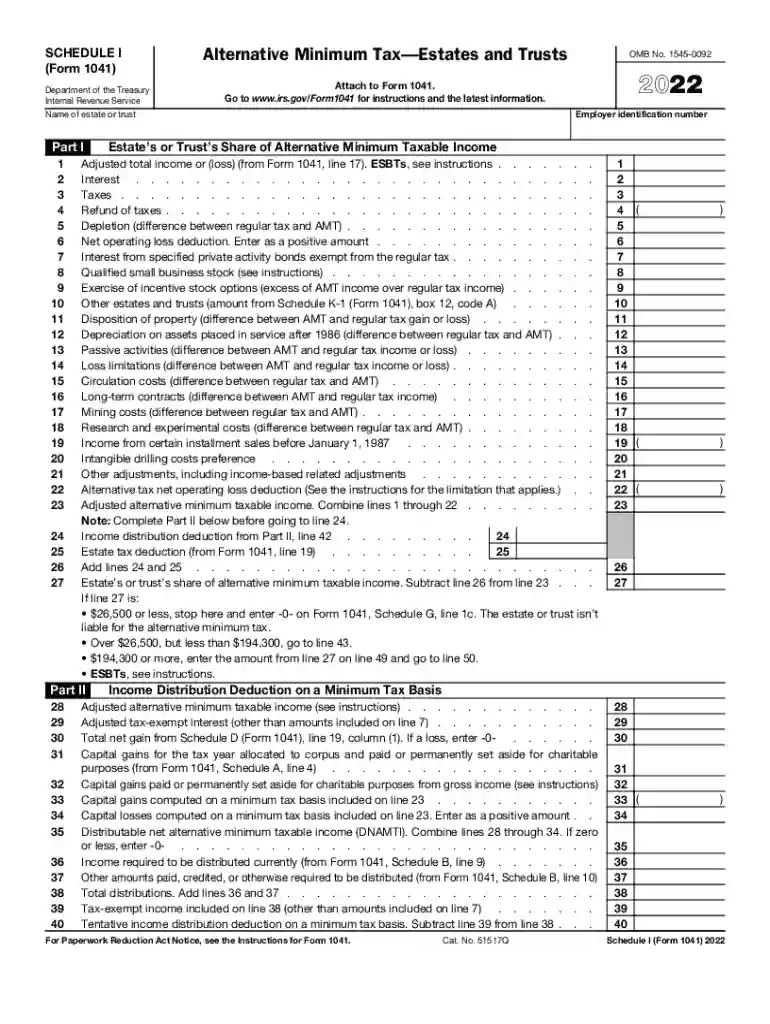
Schedule I (Form 1041) from the IRS is designed to calculate the Alternative Minimum Tax (AMT) for estates and trusts. For these tax entities, this form outlines the computation of their share of alternative minimum taxable income. It provides detailed instructions to account for various adjustments and deductions, enabling taxpayers to understand if AMT liabilities exist. This form is critical in ensuring that estates and trusts comply with federal tax obligations and manage any AMT liabilities that may arise due to particular income or deduction characteristics.
Completing Schedule I requires careful adherence to IRS instructions to ensure accuracy. Here are the key steps involved:
Collect Necessary Documents: Gather all relevant financial documents, including past tax returns and documentation of income, deductions, and credits.
Review AMT Adjustments: Adjustments may include depreciation differences, depletion, or amortization, among others. Thoroughly review these on the IRS website or in taxation literature to understand the specifics applicable to your situation.
Calculate AMT: Follow IRS guidelines to calculate the AMT using identified adjustments and preferences that differ from regular tax calculations.
Complete the Form: Input calculated figures into the relevant fields of Schedule I, ensuring that all amounts reflect accurate and lawful adjustments.
Double-Check Entries: Before submission, verify each entry for compliance with tax laws and regulations to avoid potential errors and penalties.
Understanding terminology is crucial for accuracy when completing Schedule I. Here are key terms and concepts:
Filing deadlines for Schedule I correspond with due dates for Form 1041:
When dealing with IRS forms such as Schedule I, adhering to legal guidelines is essential:
Both digital and paper submissions are viable for Schedule I, offering flexibility based on user preference and technological capability:
Adhering to the latest IRS guidelines is crucial for accurate completion and submission:
Several scenarios illustrate common use cases for Schedule I:
Understanding these core topics empowers users to navigate Schedule I confidently, ensuring both compliance with federal requirements and optimal financial management for diverse estates and trusts.
We've got more versions of the schedule 1 2022 form. Select the right schedule 1 2022 version from the list and start editing it straight away!
| Versions | Form popularity | Fillable & printable |
|---|---|---|
| 2025 | 4.2 Satisfied (59 Votes) | |
| 2024 | 4.8 Satisfied (46 Votes) | |
| 2023 | 4.5 Satisfied (39 Votes) | |
| 2022 | 4.6 Satisfied (24 Votes) | |
| 2021 | 4.8 Satisfied (63 Votes) | |
| 2020 | 4.4 Satisfied (182 Votes) | |
| 2019 | 4.2 Satisfied (142 Votes) | |
| 2018 | 4.2 Satisfied (74 Votes) | |
| 2017 | 4.4 Satisfied (129 Votes) | |
| 2016 | 4.4 Satisfied (183 Votes) | |
| 2015 | 4.4 Satisfied (114 Votes) | |
| 2014 | 4 Satisfied (28 Votes) |
At DocHub, your data security is our priority. We follow HIPAA, SOC2, GDPR, and other standards, so you can work on your documents with confidence.


