




01. Edit your schedule 1 2021 online
Type text, add images, blackout confidential details, add comments, highlights and more.

Type text, add images, blackout confidential details, add comments, highlights and more.

Draw your signature, type it, upload its image, or use your mobile device as a signature pad.

Send 2021 shedule i via email, link, or fax. You can also download it, export it or print it out.
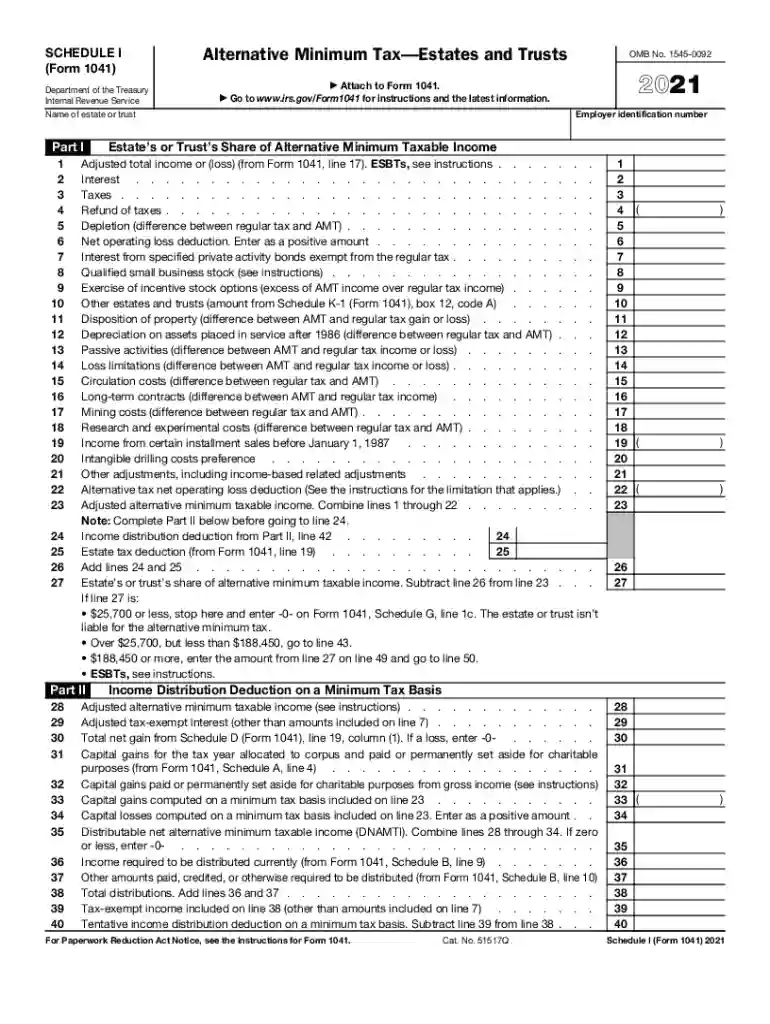
Schedule I (Form 1041) is utilized by estates and trusts when calculating the Alternative Minimum Tax (AMT). This form is essential for ensuring that estates and trusts accurately determine their share of alternative minimum taxable income, complying with federal tax regulations. It includes a range of adjustments and deductions, which are crucial elements in the comprehensive calculation of AMT obligations.
To effectively use Schedule I, begin by gathering all pertinent financial information related to the trust or estate, including income and allowable deductions. The form requires you to detail these figures precisely to ensure accurate calculation of AMT. Follow specific IRS instructions to address various adjustments and preferences unique to the AMT computation.
Schedules and forms from the IRS, including Schedule I, can be accessed through multiple channels. The easiest method is downloading the form directly from the IRS website. For those who prefer paper versions, requesting a mailed copy from the IRS or acquiring it through tax preparation software can be effective alternatives. Additionally, professional tax preparers often have access to the latest forms.
Completing Schedule I requires attention to detail to ensure compliance and accuracy. Here are the primary steps involved:
Schedule I includes several critical components that demand careful attention:
Estates and trusts are the primary users of Schedule I, given its role in calculating the AMT. These entities often require detailed income and expense tracking to comply with tax laws, and Schedule I aids in this specific area. Different examples include:
The IRS provides detailed instructions for completing Schedule I, ensuring estates and trusts meet their AMT obligations. These guidelines address:
Familiarity with specific terminology is crucial for accurately completing Schedule I:
Understanding real-world scenarios can help elucidate the application of Schedule I:
We've got more versions of the schedule 1 2021 form. Select the right schedule 1 2021 version from the list and start editing it straight away!
| Versions | Form popularity | Fillable & printable |
|---|---|---|
| 2025 | 4.2 Satisfied (59 Votes) | |
| 2024 | 4.8 Satisfied (46 Votes) | |
| 2023 | 4.5 Satisfied (39 Votes) | |
| 2022 | 4.6 Satisfied (24 Votes) | |
| 2021 | 4.8 Satisfied (63 Votes) | |
| 2020 | 4.4 Satisfied (182 Votes) | |
| 2019 | 4.2 Satisfied (142 Votes) | |
| 2018 | 4.2 Satisfied (74 Votes) | |
| 2017 | 4.4 Satisfied (129 Votes) | |
| 2016 | 4.4 Satisfied (183 Votes) | |
| 2015 | 4.4 Satisfied (114 Votes) | |
| 2014 | 4 Satisfied (28 Votes) |
At DocHub, your data security is our priority. We follow HIPAA, SOC2, GDPR, and other standards, so you can work on your documents with confidence.
Jul 25, 2025 For 2025, enter the amount reported to you on Form(s) 1099-K that was included in error or for personal items sold at a loss .Read more
Schedule 1 is used to report types of income that arent listed on the 1040, such as capital gains, alimony, unemployment payments, and gambling winnings.Read more


