




01. Edit your schedule 1 2020 online
Type text, add images, blackout confidential details, add comments, highlights and more.

Type text, add images, blackout confidential details, add comments, highlights and more.

Draw your signature, type it, upload its image, or use your mobile device as a signature pad.

Send it via email, link, or fax. You can also download it, export it or print it out.
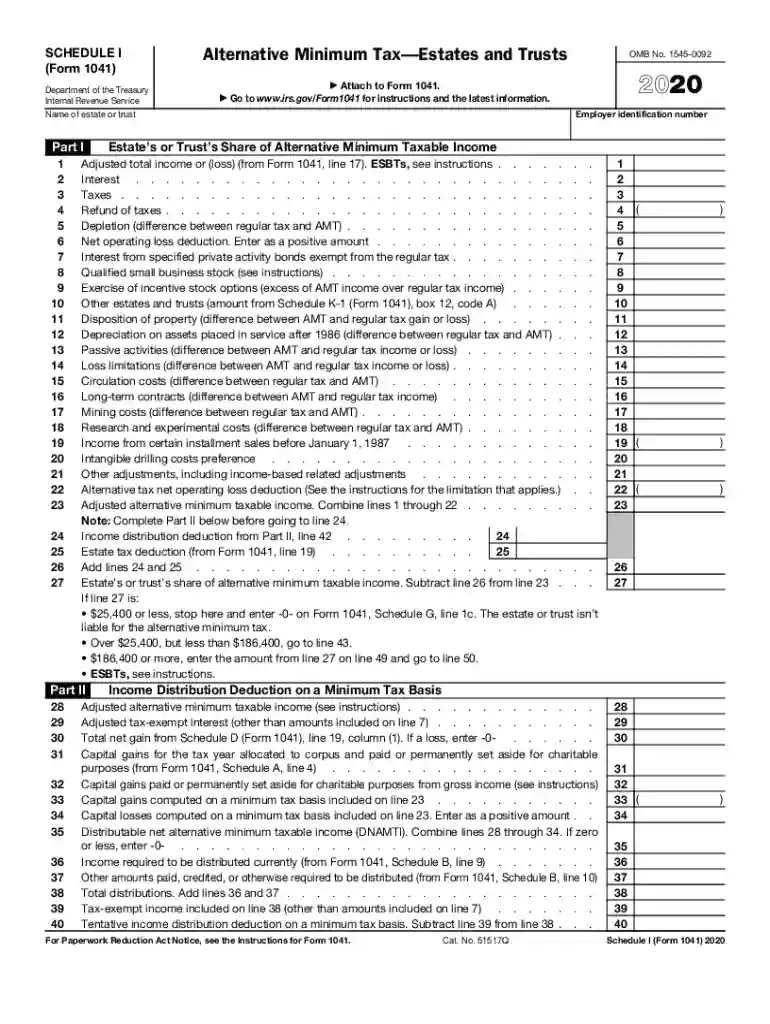
The IRS Schedule I (Form 1041) is a tax document used by estates and trusts to determine their share of the Alternative Minimum Tax (AMT). It involves calculations that account for various adjustments and deductions, ultimately affecting whether an estate or trust must pay the AMT. The form outlines instructions for accurately reporting income, deductions, and available tax credits pivotal for computing the AMT liability.
Review the AMT Instructions: Understand AMT rules and how they apply to estates and trusts. The IRS provides detailed instructions to guide taxpayers through these calculations.
Determine Adjustments and Preferences: Calculate any adjustments and tax preference items the estate or trust has. These prove essential in determining the Alternative Minimum Taxable Income (AMTI).
Compute Alternative Minimum Taxable Income (AMTI): After accounting for adjustments and preferences, calculate the AMTI. This figure is crucial for determining the applicable AMT rate.
Determine the AMT Exemption: Use the IRS guidelines to assess if the estate or trust qualifies for any AMT exemptions, which can reduce the total taxable amount.
Calculate AMT Liability: Based on the AMTI and exemptions, compute the potential AMT liability by applying the proper tax rate.
Record Results on Form 1041: Enter the final AMT liability result on Form 1041, completing the financial reporting requirements for the estate or trust.
To accurately complete IRS Schedule I, several documents are necessary:
Schedule I is legally binding and must be completed as part of the Form 1041 submission for trusts and estates. It ensures compliance with federal tax regulations regarding the AMT for these entities, providing legal documentation of the financial activities subject to the AMT. Properly filing helps prevent legal issues and aligns with the IRS's compliance standards.
Estates and trusts that may be subject to the AMT use IRS Schedule I. It allows fiduciaries and tax preparers to assess whether their financial circumstances necessitate paying the AMT. This is common among estates with complex asset mixes or multiple income streams when these might trigger AMT liabilities.


The IRS provides extensive guidelines for completing Schedule I. These guidelines include:
The form, as part of Form 1041, shares the same deadline, typically April 15. However, if that date falls on a weekend or holiday, the deadline shifts to the next business day. Extensions may be filed for additional time, providing an extended deadline, usually around six months from the original deadline.
Failing to file Schedule I when required can result in penalties, including fines and increased scrutiny from the IRS. Estate and trust managers have a fiscal and legal responsibility to ensure all pertinent forms are submitted correctly. Non-compliance could significantly increase financial liabilities and oversight burdens.
Modern tax preparation software such as TurboTax or QuickBooks often includes support for Schedule I. These tools facilitate its integration into broader tax preparation activities for estates and trusts, ensuring accuracy and efficiency in reporting.
Each of these sections collectively provides comprehensive coverage of IRS Schedule I, focusing on its critical role in estate and trust taxation related to the AMT. This structured approach seeks to furnish readers with clear, valuable, and precise guidance to navigate the complexities of this tax form seamlessly.
We've got more versions of the schedule 1 2020 form. Select the right schedule 1 2020 version from the list and start editing it straight away!
| Versions | Form popularity | Fillable & printable |
|---|---|---|
| 2025 | 4.2 Satisfied (59 Votes) | |
| 2024 | 4.8 Satisfied (46 Votes) | |
| 2023 | 4.5 Satisfied (39 Votes) | |
| 2022 | 4.6 Satisfied (24 Votes) | |
| 2021 | 4.8 Satisfied (63 Votes) | |
| 2020 | 4.4 Satisfied (182 Votes) | |
| 2019 | 4.2 Satisfied (142 Votes) | |
| 2018 | 4.2 Satisfied (74 Votes) | |
| 2017 | 4.4 Satisfied (129 Votes) | |
| 2016 | 4.4 Satisfied (183 Votes) | |
| 2015 | 4.4 Satisfied (114 Votes) | |
| 2014 | 4 Satisfied (28 Votes) |
At DocHub, your data security is our priority. We follow HIPAA, SOC2, GDPR, and other standards, so you can work on your documents with confidence.
Dont file Form 2210. You arent required to figure your penalty because the IRS will figure it and send you a bill for any unpaid amount.Read more
Schedule 1 is used to report types of income that arent listed on the 1040, such as capital gains, alimony, unemployment payments, and gambling winnings.Read more
Jul 25, 2025 For 2025, enter the amount reported to you on Form(s) 1099-K that was included in error or for personal items sold at a loss .Read more


