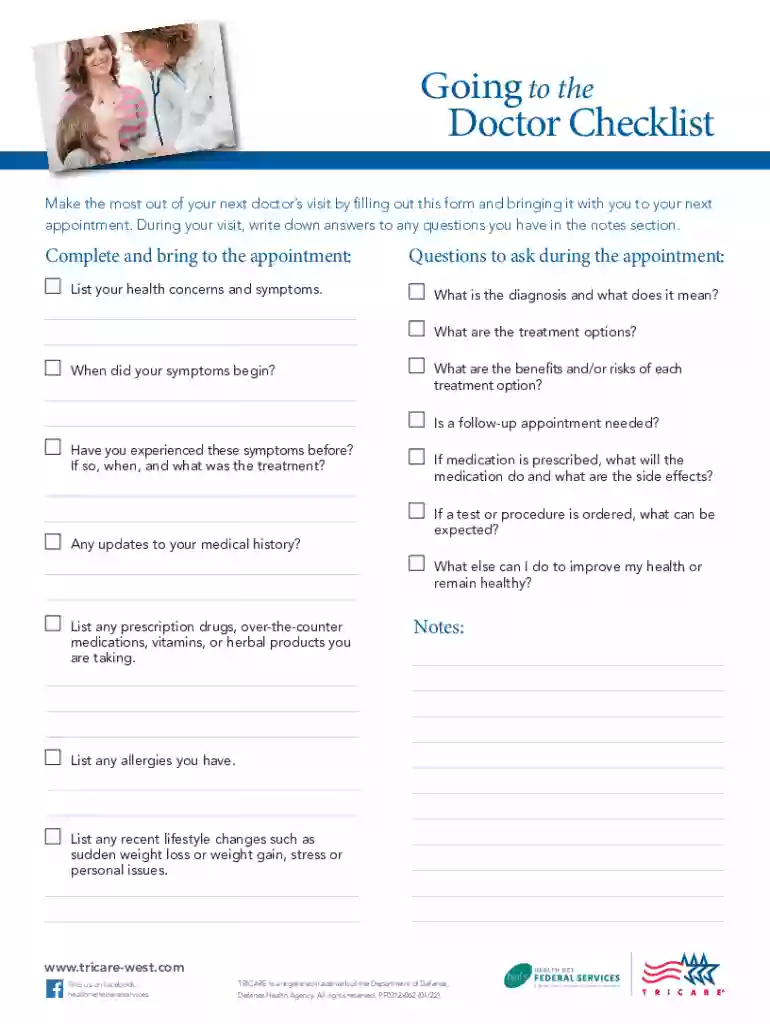
Going to the Doctor Checklist 2026

Get Form
Going to the Doctor Checklist Preview on Page 1

Here's how it works

01. Edit your form online
Type text, add images, blackout confidential details, add comments, highlights and more.

02. Sign it in a few clicks
Draw your signature, type it, upload its image, or use your mobile device as a signature pad.

03. Share your form with others
Send it via email, link, or fax. You can also download it, export it or print it out.

How to use or fill out Going to the Doctor Checklist with our platform

Form edit decoration
9.5
Ease of Setup
DocHub User Ratings on G2
9.0
Ease of Use
DocHub User Ratings on G2
  1. Click ‘Get Form’ to open the Going to the Doctor Checklist in the editor.
  2. Begin by listing your health concerns and symptoms in the designated field. This will help you communicate effectively with your doctor.
  3. In the 'Questions to Ask' section, fill in any queries you have regarding your diagnosis, treatment options, and follow-up appointments. This ensures you leave no stone unturned during your visit.
  4. Document any updates to your medical history and list all medications you are currently taking, including prescriptions and over-the-counter drugs.
  5. Utilize the notes section to jot down any allergies or recent lifestyle changes that may be relevant for your doctor.

Start using our platform today for free to streamline your document editing and ensure a productive doctor's visit!

See more Going to the Doctor Checklist versions

We've got more versions of the Going to the Doctor Checklist form. Select the right Going to the Doctor Checklist version from the list and start editing it straight away!
Versions Form popularity Fillable & printable
2022 4.1 Satisfied (53 Votes)
2015 3.5 Satisfied (34 Votes)
be ready to get more

Complete this form in 5 minutes or less

Get form

Got questions?

We have answers to the most popular questions from our customers. If you can't find an answer to your question, please contact us.
Contact us
In general, the standard physical exam typically includes: Vital signs: blood pressure, breathing rate, pulse rate, temperature, height, and weight. Vision acuity: testing the sharpness or clarity of vision from a distance. Head, eyes, ears, nose and throat exam: inspection, palpation, and testing, as appropriate.
Common Questions Doctors Ask Patients What brings you in today? What are your symptoms? When did your symptoms start? Have your symptoms gotten better or worse? Do you have a family history of this? Have you had any procedures or major illnesses in the past 12 months?
For most adults, depending on age, doctors will recommend a screening schedule that includes regular physical exams, body mass index (BMI), skin checks, cholesterol and blood pressure screening, eye exams, immunizations and screening for sexually transmitted diseases.
During a physical exam, your doctor will collect basic health information such as weight, height and vital signs, including blood pressure, heart rate and temperature. This helps us watch for trends over time, and also investigate vitals that are outside of normal range, Post said.
The purpose of routine appointments is for general health queries, diagnoses, and monitoring of conditions. Routine appointments last for 15 minutes. When you contact the surgery you will be offered the next available appointment.

Security and compliance

At DocHub, your data security is our priority. We follow HIPAA, SOC2, GDPR, and other standards, so you can work on your documents with confidence.

Learn more
ccpa2
pci-dss
gdpr-compliance
hipaa
soc-compliance

People also ask

What not to do before a physical exam Consuming alcohol. Drinking caffeine within an hour of your visit. Eating a high- meal before bloodwork. Eating or drinking anything for eight to 12 hours, or as directed by your provider, before bloodwork that requires a fast. Taking cold medicine if youre feeling under the weather.

Related links