BEGINNINGS GROUP #1 Activity: Treatment work and 2026

Get Form
BEGINNINGS GROUP #1 Activity: Treatment work and Preview on Page 1

Here's how it works

01. Edit your form online
Type text, add images, blackout confidential details, add comments, highlights and more.

02. Sign it in a few clicks
Draw your signature, type it, upload its image, or use your mobile device as a signature pad.

03. Share your form with others
Send it via email, link, or fax. You can also download it, export it or print it out.

How to use or fill out BEGINNINGS GROUP #1 Activity: Treatment work and

Form edit decoration
9.5
Ease of Setup
DocHub User Ratings on G2
9.0
Ease of Use
DocHub User Ratings on G2
  1. Click ‘Get Form’ to open it in the editor.
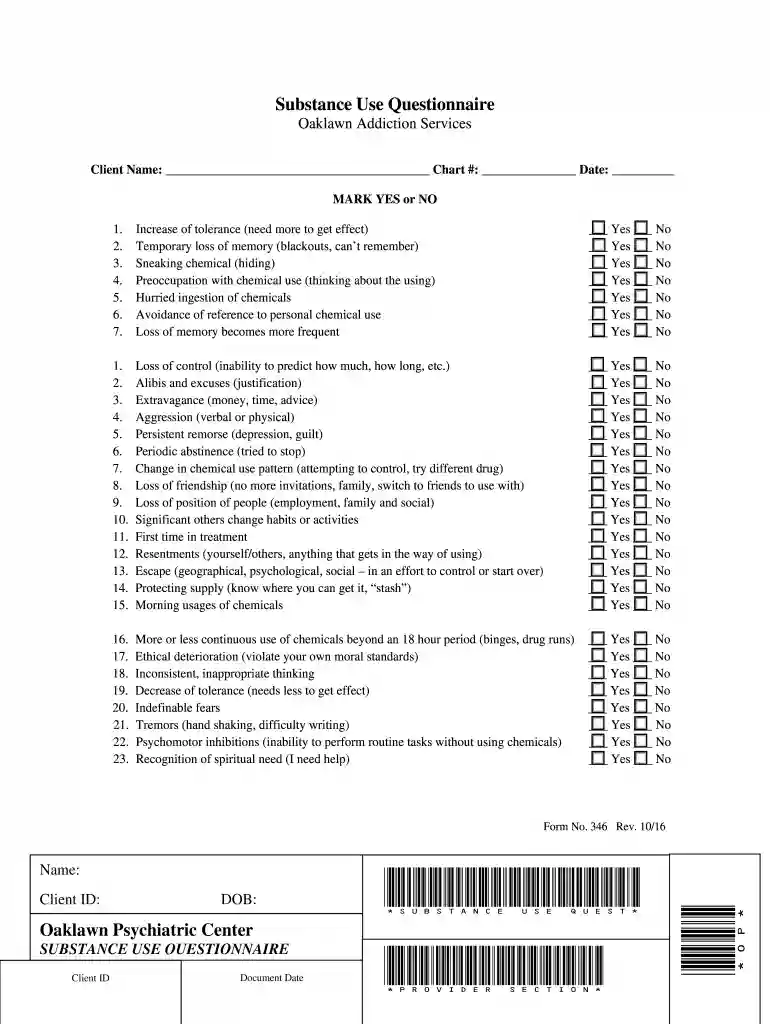
  2. Begin by entering your Client Name, Chart Number, and Date at the top of the form. This information is essential for identifying your submission.
  3. Proceed to the first section where you will mark 'Yes' or 'No' for each statement regarding substance use behaviors. Carefully read each item before making your selection.
  4. Continue through the subsequent sections, repeating the process of marking 'Yes' or 'No' for each statement. Take your time to reflect on each question as they are designed to assess various aspects of substance use.
  5. Once all sections are completed, review your responses for accuracy. Make any necessary adjustments directly in the editor.
  6. Finally, save your document and share it with your treatment provider or relevant parties using our platform’s sharing features.

Start filling out your Substance Use Questionnaire today for free and streamline your treatment process!

See more BEGINNINGS GROUP #1 Activity: Treatment work and versions

We've got more versions of the BEGINNINGS GROUP #1 Activity: Treatment work and form. Select the right BEGINNINGS GROUP #1 Activity: Treatment work and version from the list and start editing it straight away!
Versions Form popularity Fillable & printable
2016 4.9 Satisfied (46 Votes)
be ready to get more

Complete this form in 5 minutes or less

Get form

Got questions?

We have answers to the most popular questions from our customers. If you can't find an answer to your question, please contact us.
Contact us
Well-supported scientific evidence shows that addiction to alcohol or drugs is a chronic brain disease that has potential for recurrence and recovery. Well-supported evidence suggests that the addiction process involves a three-stage cycle: binge/intoxication, withdrawal/negative affect, and preoccupation/anticipation.
During the beginning phase of the group, all members should feel that they have a part to play in the group and have something in common with other members. This cohesion, both among clients and between the clients and the group leader, will affect the productivity of work throughout the therapeutic process.
The first step in therapy is the intake process. During this process, your therapist gathers essential information about you, your family history, your past, your needs, and your therapy goals. This initial session is an opportunity to share your reasons for going to therapy and discuss any pressing concerns.
The stages of addiction include: Initial use. Misuse. Tolerance. Dependence. Addiction. Relapse.
Forming. The initial forming stage is the process of putting the structure of the team together. Team members feel ambiguous and conflict is avoided at all costs due to the need to be accepted into the group.

Security and compliance

At DocHub, your data security is our priority. We follow HIPAA, SOC2, GDPR, and other standards, so you can work on your documents with confidence.

Learn more
ccpa2
pci-dss
gdpr-compliance
hipaa
soc-compliance

People also ask

The first session is the opportunity for the two people to introduce themselves, for the client to say why he/she is there and what he/she wants from therapy, and for the therapist to explain their way of working, what they expect, and any other ``rules they have. They set the scene for what the future will be like.
The four stages of development in group counselling are: the formative stage, the transition stage, the working stage, and the termination stage. In the formation stage, the therapist screens group members, develops a rationale for the group, advertises the group, and establishes the rules.
Forming: This initial stage involves the establishment of group norms and relationships. Members get to know each other, and the leader sets the tone for the group. There is often a mix of excitement and anxiety as members begin to express themselves and share their goals.

Related links