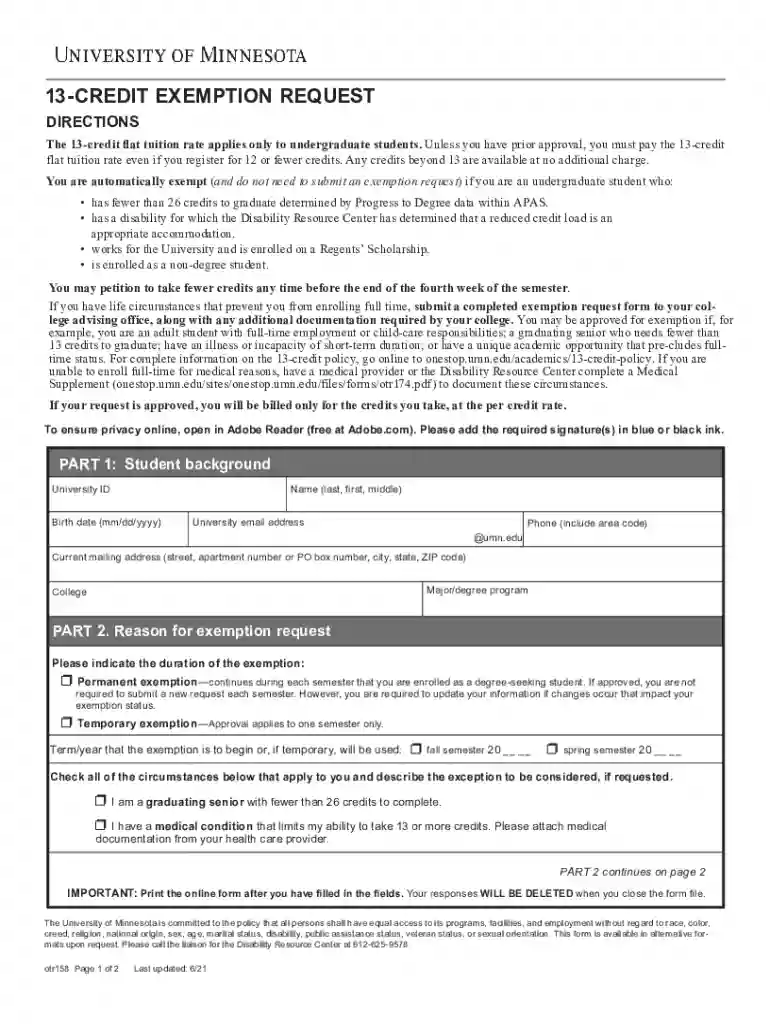
Umn 13 credit exemption 2026

Get Form
umn 13 credit exemption Preview on Page 1

Here's how it works

01. Edit your umn 13 credit exemption online
Type text, add images, blackout confidential details, add comments, highlights and more.

02. Sign it in a few clicks
Draw your signature, type it, upload its image, or use your mobile device as a signature pad.

03. Share your form with others
Send it via email, link, or fax. You can also download it, export it or print it out.

How to use or fill out umn 13 credit exemption with our platform

Form edit decoration
9.5
Ease of Setup
DocHub User Ratings on G2
9.0
Ease of Use
DocHub User Ratings on G2
  1. Click ‘Get Form’ to open the umn 13 credit exemption request in the editor.
  2. Begin with Part 1: Student Background. Fill in your University ID, name, birth date, university email address, and phone number. Ensure all details are accurate for proper identification.
  3. Continue to your current mailing address and major/degree program. This information is crucial for processing your request.
  4. Move to Part 2: Reason for Exemption Request. Indicate whether you are seeking a permanent or temporary exemption and specify the term/year it applies to.
  5. Check all applicable circumstances that justify your exemption request. Provide detailed descriptions where necessary, especially if medical documentation is required.
  6. In Part 3: Student Certification, sign and date the form to certify that all provided information is true and accurate.
  7. Finally, print the completed form directly from our platform before closing it, as responses will be deleted upon closure.

Start filling out your umn 13 credit exemption request today using our platform for free!

See more umn 13 credit exemption versions

We've got more versions of the umn 13 credit exemption form. Select the right umn 13 credit exemption version from the list and start editing it straight away!
Versions Form popularity Fillable & printable
2021 4.8 Satisfied (110 Votes)
2013 4.2 Satisfied (33 Votes)
be ready to get more

Complete this form in 5 minutes or less

Get form

Got questions?

We have answers to the most popular questions from our customers. If you can't find an answer to your question, please contact us.
Contact us
Tax exemptions help reduce the taxable income you owe taxes on, lowering your overall tax liability. Whether youre claiming the standard deduction, applying for property tax exemptions, or supporting a tax-exempt organization, understanding how these exemptions work can help you maximize your tax savings.
Credit exemptions allow students to be exempted from specific course modules or requirements based on their previous academic achievements or professional experience.
Each exemption reduces the income subject to tax. The exemption amount is a set amount that generally changes annually. Amount taxpayers can claim for themselves, their spouses, and eligible dependents. There are two types of exemptions-personal and dependency.
An exemption is a dollar amount that can be deducted from an individuals total income, thereby reducing. the taxable income. Taxpayers may be able to claim two kinds of exemptions: Personal exemptions generally allow taxpayers to claim themselves (and possibly their spouse)
The 210-credit rule The Universitys satisfactory progress policy requires students to complete their undergraduate degree programs within 30 credits beyond the minimum required for the degree. Because most degrees require 180 credits, students generally must complete their programs by the time they earn 210 credits.

Security and compliance

At DocHub, your data security is our priority. We follow HIPAA, SOC2, GDPR, and other standards, so you can work on your documents with confidence.

Learn more
ccpa2
pci-dss
gdpr-compliance
hipaa
soc-compliance
be ready to get more

Complete this form in 5 minutes or less

Get form

People also ask

The full-time student status at many colleges is usually defined as taking 12 or more credits in a semester. So technically, taking 13 credits per semester would still classify you as a full-time student. However, the typical class load for many colleges is 15 credits per semester.

Related links