Agreement between carrier and shipper 2026

Get Form
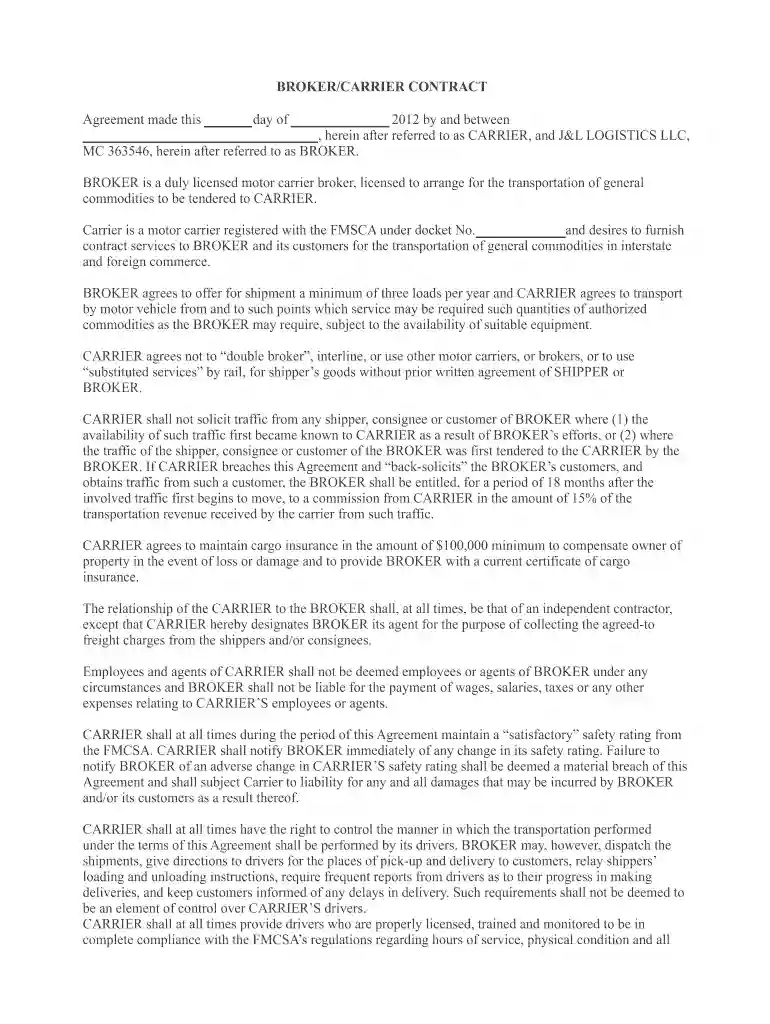
agreement between carrier and shipper Preview on Page 1

Here's how it works

01. Edit your agreement between carrier and shipper online
Type text, add images, blackout confidential details, add comments, highlights and more.

02. Sign it in a few clicks
Draw your signature, type it, upload its image, or use your mobile device as a signature pad.

03. Share your form with others
Send it via email, link, or fax. You can also download it, export it or print it out.

How to use or fill out agreement between carrier and shipper

Form edit decoration
9.5
Ease of Setup
DocHub User Ratings on G2
9.0
Ease of Use
DocHub User Ratings on G2
  1. Click ‘Get Form’ to open the agreement between carrier and shipper in our editor.
  2. Begin by entering the date at the top of the document. This establishes when the agreement is effective.
  3. Fill in the names of both parties: CARRIER and BROKER, ensuring accurate legal names are used for clarity.
  4. In the section regarding services, specify the minimum number of loads per year that BROKER will offer and ensure CARRIER agrees to transport them as required.
  5. Complete the insurance details by entering the cargo insurance amount and providing a current certificate of insurance if available.
  6. Review sections on liability, indemnity, and payment terms carefully, filling in any necessary details specific to your arrangement.
  7. Finally, both parties should sign and date at the bottom of the document to finalize the agreement.

Start using our platform today to streamline your document editing and signing process for free!

See more agreement between carrier and shipper versions

We've got more versions of the agreement between carrier and shipper form. Select the right agreement between carrier and shipper version from the list and start editing it straight away!
Versions Form popularity Fillable & printable
2012 4.8 Satisfied (61 Votes)
be ready to get more

Complete this form in 5 minutes or less

Get form

Got questions?

We have answers to the most popular questions from our customers. If you can't find an answer to your question, please contact us.
Contact us
Bill of lading. The bill of lading is a legally enforceable document summarizing the terms and conditions for a specific shipment. It is an agreement between the shipping customer, or a third party, and the carrier.
What is a bill of lading in ocean shipping? The bill of lading (B/L or BoL) is a crucial shipping document issued by a carrier to the shipper (owner of the goods). It serves three main functions: Contract of carriage between shipper and carrier, establishing the terms of transportation.
A shipper might prep and package items before theyre shipped. This role is important in protecting the items and ensuring theyre ready for transport. Carriers take possession of your goods and manage them until theyre delivered.
The shipper/carrier relationship is unique. The carrier acts as a conduit, fundamentally an intermediary, responsible for handling the shippers goods with care and delivering them on time and without exception. Those goods might be going to the shippers own locations or to a third party.
A carrier agreement is a documented promise between a shipper and a carrier that the shipper will use the carriers services in exchange for a discount on those services. A shipper of any size will typically have an agreement with at least one carrier to reduce their shipping costs.

Security and compliance

At DocHub, your data security is our priority. We follow HIPAA, SOC2, GDPR, and other standards, so you can work on your documents with confidence.

Learn more
ccpa2
pci-dss
gdpr-compliance
hipaa
soc-compliance

People also ask

Are UPS and FedEx carriers or senders? They are always carriers when handling your packages. The company sending the packagewhether thats you, your supplier, or your 3PLis the sender.
A contract of carriage is a binding agreement between a freight carrier and a shipper. It serves as a legal document where the carrier commits to transporting specified goods from one location to another.

Related links