Release, waiver, assumption of risk and hold harmless 2026

Get Form
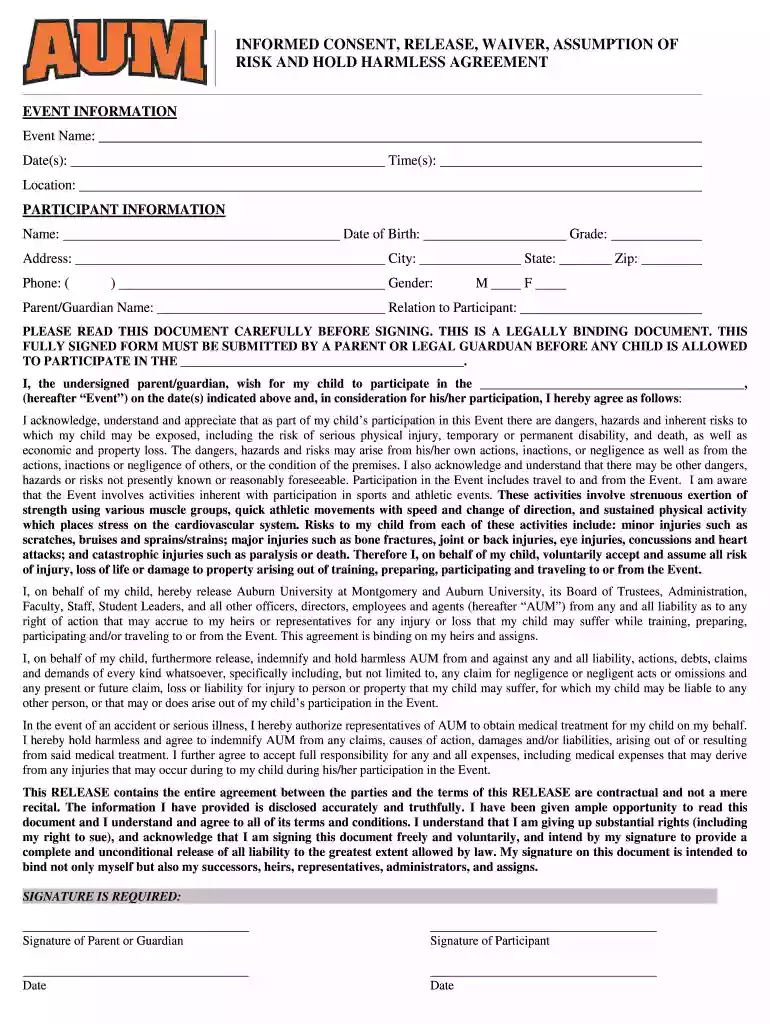
release, waiver, assumption of risk and hold harmless Preview on Page 1

Here's how it works

01. Edit your form online
Type text, add images, blackout confidential details, add comments, highlights and more.

02. Sign it in a few clicks
Draw your signature, type it, upload its image, or use your mobile device as a signature pad.

03. Share your form with others
Send it via email, link, or fax. You can also download it, export it or print it out.

How to use or fill out release, waiver, assumption of risk and hold harmless with our platform

Form edit decoration
9.5
Ease of Setup
DocHub User Ratings on G2
9.0
Ease of Use
DocHub User Ratings on G2
  1. Click ‘Get Form’ to open it in the editor.
  2. Begin by filling in the Event Information section. Enter the event name, date(s), time(s), and location accurately.
  3. In the Participant Information section, provide your child's full name, date of birth, address, phone number, and grade. Ensure all details are correct for identification purposes.
  4. Read through the Informed Consent and Release sections carefully. Acknowledge the risks involved by checking any required boxes or signing where indicated.
  5. Complete the signature fields for both the parent/guardian and participant. Make sure to include dates next to each signature.
  6. If applicable, fill out the Camps & Clinics Authorization for Release section with names of authorized individuals for pick-up.
  7. Finally, review all entered information for accuracy before submitting your completed form through our platform.

Start using our platform today to streamline your document editing and signing process for free!

be ready to get more

Complete this form in 5 minutes or less

Get form

Got questions?

We have answers to the most popular questions from our customers. If you can't find an answer to your question, please contact us.
Contact us
The key difference is that a hold harmless protects against direct liability, while a waiver of subrogation protects against third-party insurance claims after damages are paid, Spetsas said. In a well-structured agreement, you might use both to cover all bases.
Express assumption of risk: This occurs when an individual explicitly agrees to accept the risks, often through a written waiver or contract. Implied assumption of risk: This applies when a persons actions or behavior indicate an implicit acceptance of the risks involved.
If I choose to participate in this event, I voluntarily assume all responsibility and risk, including but not limited to all risk of loss of limb or life; physical and emotional injuries; serious illness such as infectious and non-infectious diseases and/or conditions arising from my participation in this event or
A waiver is often written, such as a disclaimer that has been accepted, but it may also be spoken between two or more parties. When the right to hold a person liable through a lawsuit is waived, the waiver may be called an exculpatory clause, liability waiver, legal release, or hold harmless clause.
The assumption of risk doctrine states that in instances where a person knows of the risk of an activity, that person accepts the risk when voluntarily engaging in the pursuit. Therefore, one cannot sue for injuries that may occur. Going to court would be unfair and result in an injustice.

Security and compliance

At DocHub, your data security is our priority. We follow HIPAA, SOC2, GDPR, and other standards, so you can work on your documents with confidence.

Learn more
ccpa2
pci-dss
gdpr-compliance
hipaa
soc-compliance
be ready to get more

Complete this form in 5 minutes or less

Get form