Chapter 3 Medical Legal and Ethical Issues Flashcards 2026

Get Form
Chapter 3 Medical Legal and Ethical Issues Flashcards Preview on Page 1

Here's how it works

01. Edit your form online
Type text, add images, blackout confidential details, add comments, highlights and more.

02. Sign it in a few clicks
Draw your signature, type it, upload its image, or use your mobile device as a signature pad.

03. Share your form with others
Send it via email, link, or fax. You can also download it, export it or print it out.

How to use or fill out Chapter 3 Medical Legal and Ethical Issues Flashcards with our platform

Form edit decoration
9.5
Ease of Setup
DocHub User Ratings on G2
9.0
Ease of Use
DocHub User Ratings on G2
  1. Click ‘Get Form’ to open the Chapter 3 Medical Legal and Ethical Issues Flashcards in the editor.
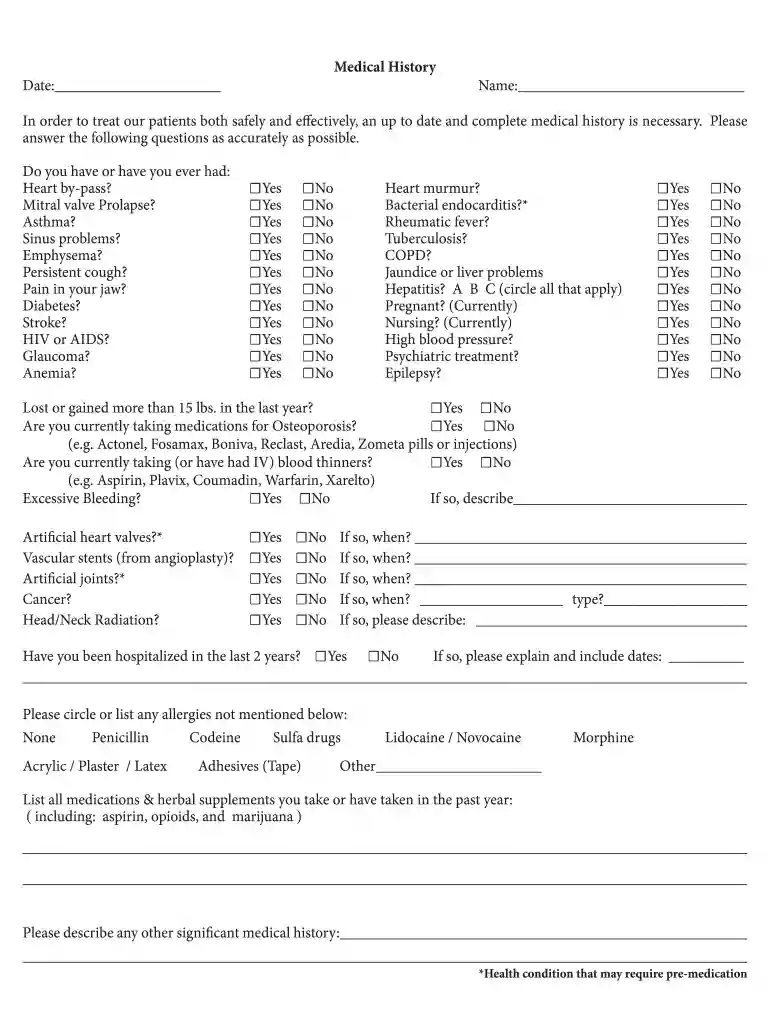
  2. Begin by entering your name and date at the top of the form. This personal information is essential for accurate record-keeping.
  3. Proceed to answer each medical history question by selecting 'Yes' or 'No' for each condition listed. Ensure you read each question carefully to provide accurate responses.
  4. For any conditions marked as 'Yes', use the provided space to elaborate on your medical history, including dates and types of conditions where applicable.
  5. Complete the identification section by filling in your personal details such as address, phone number, and emergency contact information.
  6. Review all entries for accuracy before saving or submitting the form. Our platform allows you to easily edit any mistakes.

Start using our platform today for free to streamline your document editing and form completion!

See more Chapter 3 Medical Legal and Ethical Issues Flashcards versions

We've got more versions of the Chapter 3 Medical Legal and Ethical Issues Flashcards form. Select the right Chapter 3 Medical Legal and Ethical Issues Flashcards version from the list and start editing it straight away!
Versions Form popularity Fillable & printable
2019 4.8 Satisfied (113 Votes)
be ready to get more

Complete this form in 5 minutes or less

Get form

Got questions?

We have answers to the most popular questions from our customers. If you can't find an answer to your question, please contact us.
Contact us

Electronic document signing demands a software solution that complies with data security and eSignature standards. DocHub is a perfect tool for that, because it fulfills all the aforementioned requirements. Whatever method you prefer to sign your Chapter 3 Medical Legal and Ethical Issues Flashcards in DocHub, your eSignature will be legally binding and court-admissible.

You can quickly complete, edit, and even eSign your Chapter 3 Medical Legal and Ethical Issues Flashcards utilizing DocHub. Create a new account and start your free trial. After that, you can upload the file with the form and easily make all the necessary edits. No need to print on paper or use a third-party application to sign it, as you can place your electronic signature on your document faster through DocHub.

Legal and ethical issues refer to the challenges clinicians face when balancing patient care with considerations of privacy, confidentiality, liability, and the interests of family members, particularly in situations involving docHub risks to an individuals safety.
Three basic principles, among those generally accepted in our cultural tradition, are particularly relevant to the ethics of research involving human subjects: the principles of respect of persons, beneficence and justice.
An EMT is justified in restraining a patient who is aggressive, combative, or violent, because these behaviors may pose a direct threat to the patients safety or the safety of others.

Security and compliance

At DocHub, your data security is our priority. We follow HIPAA, SOC2, GDPR, and other standards, so you can work on your documents with confidence.

Learn more
ccpa2
pci-dss
gdpr-compliance
hipaa
soc-compliance
be ready to get more

Complete this form in 5 minutes or less

Get form

People also ask

The circumstance under which an EMT can legally release confidential patient information is when the patient is competent and signs a release form. This is largely because privacy and confidentiality are fundamental rights given to all patients under the Health Insurance Portability and Accountability Act (HIPAA).
11 Health and Safety Tips for EMTs Understand the situation. Watch for dangerous conditions. Consider cultural differences. Wait for the police to secure violent scenes. Remember your safety gear and equipment. Operate the ambulance as safely as possible. Perform a pre-shift vehicle checkout. Watch your back.
Explanation. The most appropriate position to restrain a physically uncooperative patient is the Supine position. Placing a patient in the supine position (lying face up) is the safest and most commonly recommended method to restrain an uncooperative patient.

Related links