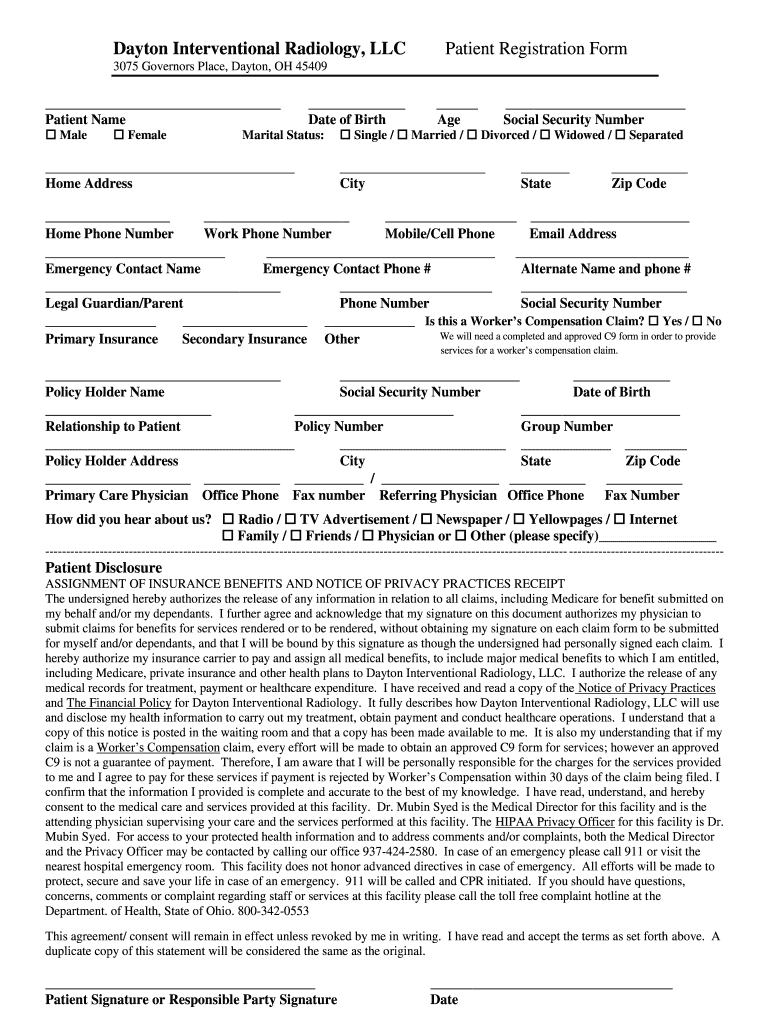
Dayton Interventional Radiology, LLCPatient Registration Form 2026

Get Form
Dayton Interventional Radiology, LLCPatient Registration Form Preview on Page 1

Here's how it works

01. Edit your form online
Type text, add images, blackout confidential details, add comments, highlights and more.
02. Sign it in a few clicks
Draw your signature, type it, upload its image, or use your mobile device as a signature pad.
03. Share your form with others
Send it via email, link, or fax. You can also download it, export it or print it out.

How to use or fill out Dayton Interventional Radiology, LLC Patient Registration Form

Form edit decoration
9.5
Ease of Setup
DocHub User Ratings on G2
9.0
Ease of Use
DocHub User Ratings on G2
  1. Click ‘Get Form’ to open it in the editor.
  2. Begin by entering your personal information in the designated fields. Fill in your name, date of birth, and select your gender.
  3. Provide your marital status and home address. Ensure that all contact numbers and email addresses are accurate for effective communication.
  4. Complete the insurance information section. Include details about your primary and secondary insurance policies, ensuring you provide the policy holder's name and relationship to you.
  5. Fill out the medical history section thoroughly. Check any relevant conditions and list past surgeries with dates for comprehensive health records.
  6. Review the patient disclosure section carefully. Sign and date where indicated to authorize the release of necessary information.

Start filling out your form online for free today!

See more Dayton Interventional Radiology, LLCPatient Registration Form versions

We've got more versions of the Dayton Interventional Radiology, LLCPatient Registration Form form. Select the right Dayton Interventional Radiology, LLCPatient Registration Form version from the list and start editing it straight away!
Versions Form popularity Fillable & printable
2019 4.8 Satisfied (126 Votes)
be ready to get more

Complete this form in 5 minutes or less

Get form

Got questions?

We have answers to the most popular questions from our customers. If you can't find an answer to your question, please contact us.
Contact us

Electronic document signing requires a software solution that complies with data protection and eSignature standards. DocHub is a great tool for that, because it meets all the aforementioned requirements. Whatever method you prefer to sign your Dayton Interventional Radiology, LLCPatient Registration Form in DocHub, your eSignature will be legally binding and court-admissible.

You can find the latest and most relevant version of the Dayton Interventional Radiology, LLCPatient Registration Form in our DocHub forms library. Search it by categories or utilize the search field to get the exact template that suits your case. You may open this form for editing after you find it.

Common IR Procedures Angiography and Angioplasty. Embolization. Port Catheter Placement. Biopsy. Drainage. Ablation. Vertebral Augmentation (Including Vertebroplasty and Kyphoplasty) Uterine Fibroid Embolization.
Due to the minimally invasive nature of the treatments performed by an interventional radiologist, the recovery time often ranges from just a few minutes to a few days, depending on the procedure.
Will I be put to sleep? Many Interventional Radiology procedures do not require you to be put under general anesthesia. You may be given sedatives to help you relax. Your individual reaction to the sedatives can vary but they may cause you to feel drowsy.

Security and compliance

At DocHub, your data security is our priority. We follow HIPAA, SOC2, GDPR, and other standards, so you can work on your documents with confidence.

Learn more
ccpa2
pci-dss
gdpr-compliance
hipaa
soc-compliance
be ready to get more

Complete this form in 5 minutes or less

Get form

People also ask

While a complex intervention may require general anesthesia, for many interventional radiology (IR) procedures, the patient remains semi-awake under whats called moderate sedation for the entire procedure.
After finishing a residency in diagnostic radiology, which typically lasts four years, the radiologist can then pursue a fellowship in interventional radiology, usually lasting 1-2 years.
The most commonly used local anesthetics are lidocaine, mepivacaine, ropivacaine and (Table 4).

Related links