ocad assessment Preview on Page 1

Ocad assessment 2026

Here's how it works

  • 01. Edit your ocad assessment online

    Type text, add images, blackout confidential details, add comments, highlights and more.

  • 02. Sign it in a few clicks

    Draw your signature, type it, upload its image, or use your mobile device as a signature pad.

  • 03. Share your form with others

    Send it via email, link, or fax. You can also download it, export it or print it out.

How to use or fill out ocad assessment with our platform

Form edit decoration
9.5
Ease of Setup
DocHub User Ratings on G2
9.0
Ease of Use
DocHub User Ratings on G2
  1. Click ‘Get Form’ to open the ocad assessment in the editor.
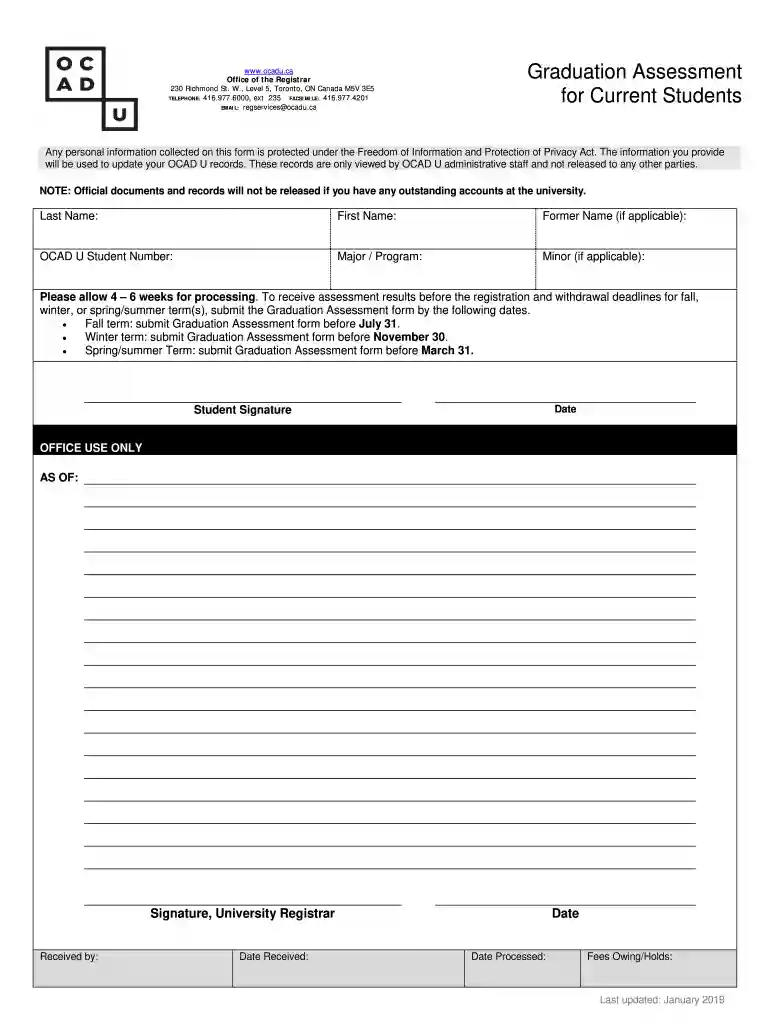
  2. Begin by entering your Last Name and First Name in the designated fields. If you have a Former Name, please include it as well.
  3. Input your OCAD U Student Number, Major/Program, and Minor (if applicable) in the respective sections to ensure accurate processing of your assessment.
  4. Review the submission deadlines for each term carefully. Ensure that you submit your form before July 31 for Fall, November 30 for Winter, or March 31 for Spring/Summer to receive timely results.
  5. Sign and date the form at the bottom. This confirms that all information provided is accurate and complete.

Start using our platform today to fill out your ocad assessment easily and for free!

See more ocad assessment versions

We've got more versions of the ocad assessment form. Select the right ocad assessment version from the list and start editing it straight away!

VersionsForm popularityFillable & printable
20194.8 Satisfied (131 Votes)

be ready to get more

Complete this form in 5 minutes or less

Security and compliance

At DocHub, your data security is our priority. We follow HIPAA, SOC2, GDPR, and other standards, so you can work on your documents with confidence.

Related links

Patient-tailored risk assessment of obstructive coronary artery

by SS Koenders 2023 Cited by 2 Our aim was to estimate the probability of obstructive CAD (oCAD) for an individual patient as a function of the myocardial flow reserve (MFR) measured withRead more

Learn more
Risk of obstructive coronary artery disease and major adverse

Conclusions: In patients undergoing coronary angiography, noncoronary atherosclerosis was associated with increased burden of oCAD and adverse events post-PCI.

Learn more
If you believe that this page should be taken down, please follow our DMCA take down process here