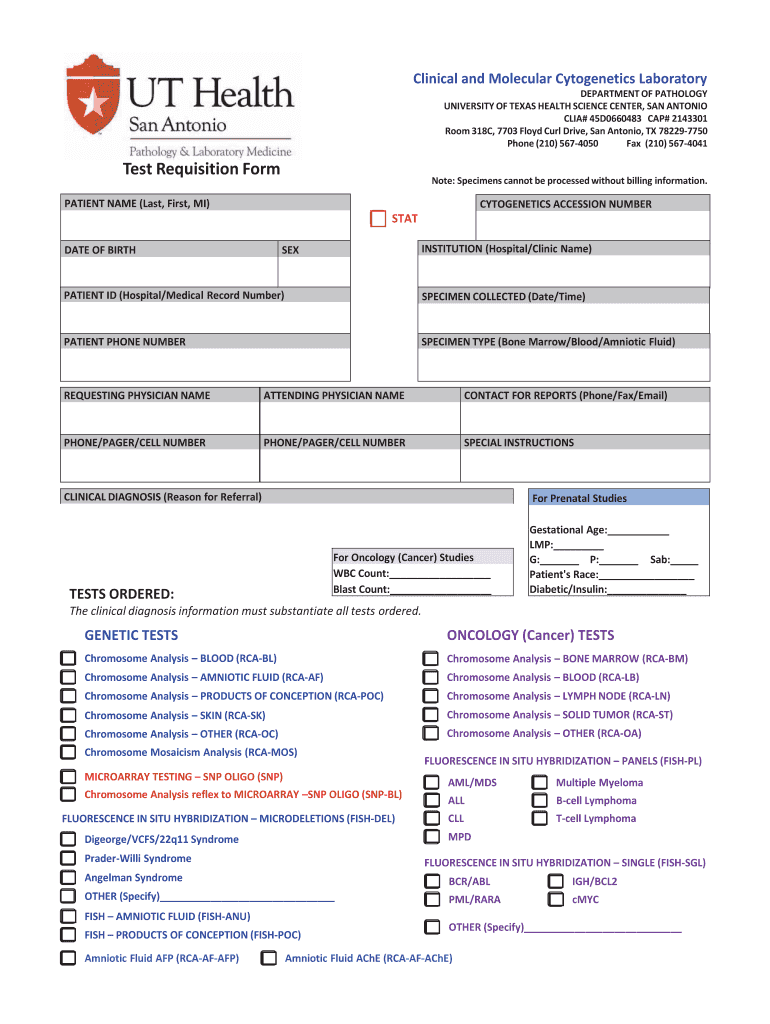
Clinical and Molecular Cytogenetics Laboratory 2026

Get Form
Clinical and Molecular Cytogenetics Laboratory Preview on Page 1

Here's how it works

01. Edit your form online
Type text, add images, blackout confidential details, add comments, highlights and more.
02. Sign it in a few clicks
Draw your signature, type it, upload its image, or use your mobile device as a signature pad.
03. Share your form with others
Send it via email, link, or fax. You can also download it, export it or print it out.

How to use or fill out Clinical and Molecular Cytogenetics Laboratory with our platform

Form edit decoration
9.5
Ease of Setup
DocHub User Ratings on G2
9.0
Ease of Use
DocHub User Ratings on G2
  1. Click ‘Get Form’ to open the Clinical and Molecular Cytogenetics Laboratory requisition form in the editor.
  2. Begin by entering the PATIENT NAME, ensuring you include Last, First, and Middle Initial. This is crucial for accurate identification.
  3. Fill in the CYTOGENETICS ACCESSION NUMBER and DATE OF BIRTH. These fields help track the specimen throughout the testing process.
  4. Provide details about the INSTITUTION, including Hospital/Clinic Name, and ensure you enter the PATIENT ID for proper record keeping.
  5. Select SPECIMEN TYPE from options like Bone Marrow or Blood. Also, indicate when the SPECIMEN was COLLECTED by entering the Date/Time.
  6. Complete sections for REQUESTING PHYSICIAN NAME and ATTENDING PHYSICIAN NAME to clarify who is responsible for the referral.
  7. In SPECIAL INSTRUCTIONS, add any specific requests or notes that may assist in processing the specimen effectively.
  8. Finally, review all entries for accuracy before submitting your form to ensure a smooth workflow.

Start using our platform today to streamline your document editing and form completion!

See more Clinical and Molecular Cytogenetics Laboratory versions

We've got more versions of the Clinical and Molecular Cytogenetics Laboratory form. Select the right Clinical and Molecular Cytogenetics Laboratory version from the list and start editing it straight away!
Versions Form popularity Fillable & printable
2018 4.8 Satisfied (121 Votes)
be ready to get more

Complete this form in 5 minutes or less

Get form

Got questions?

We have answers to the most popular questions from our customers. If you can't find an answer to your question, please contact us.
Contact us
The Cytogenetics Laboratory provides comprehensive testing services including: Chromosome analysis for prenatal samples, peripheral blood, bone marrow, lymphomas and solid tumors.
Molecular Cytogenetics primarily defines a large set of the techniques that operate either with the entire genome or with specific targeted DNA sequences. Topical areas include, but are not limited to: Structural and functional organization of chromosome and nucleus. Genome variation, expression and evolution.
See sample stability section for cytogenetic samples. Sample volumes may be reduced for children (2-4ml) and neonates (1-2ml). Turnaround time: The usual turnaround time is 2-3 weeks however the laboratory will endeavour to respond to urgent requests.
Clinical cytogenetics is the study of the structure and function of chromosomes. Cytogenetic testing aids in the diagnosis of heritable genetic abnormalities as well as detecting acquired or somatic genetic abnormalities that are relevant for the diagnosis, prognosis, therapy, and monitoring of many cancer types.
Cytogenetics involves testing samples of tissue, blood, or bone marrow in a laboratory to look for changes in chromosomes, including broken, missing, rearranged, or extra chromosomes. Changes in certain chromosomes may be a sign of a genetic disease or condition or some types of cancer.

Security and compliance

At DocHub, your data security is our priority. We follow HIPAA, SOC2, GDPR, and other standards, so you can work on your documents with confidence.

Learn more
ccpa2
pci-dss
gdpr-compliance
hipaa
soc-compliance

People also ask

Cytogenetics is a branch of biology focused on the study of chromosomes and their inheritance, especially as applied to medical genetics. Chromosomes are microscopic structures containing DNA that reside within the nucleus of a cell.

Related links