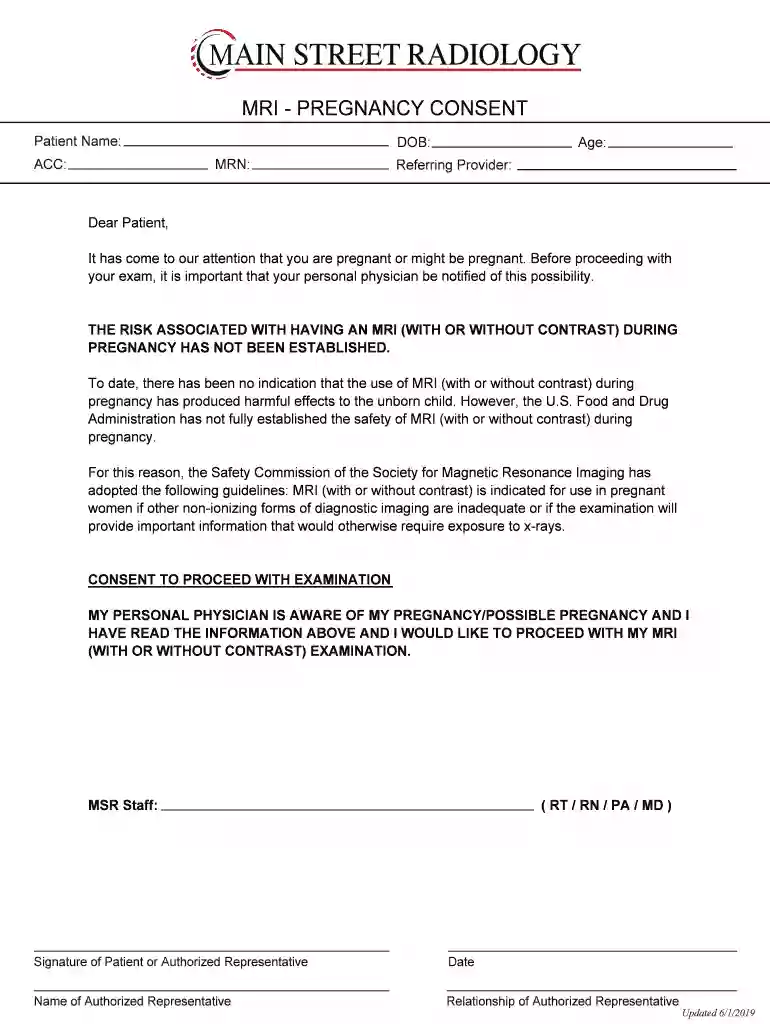
Mri pregnancy consent form 2026

Get Form
pregnancy consent form pdf Preview on Page 1

Here's how it works

01. Edit your pregnancy consent form pdf online
Type text, add images, blackout confidential details, add comments, highlights and more.

02. Sign it in a few clicks
Draw your signature, type it, upload its image, or use your mobile device as a signature pad.

03. Share your form with others
Send mri consent form sample via email, link, or fax. You can also download it, export it or print it out.

How to use or fill out MRI Pregnancy Consent Form with DocHub

Form edit decoration
9.5
Ease of Setup
DocHub User Ratings on G2
9.0
Ease of Use
DocHub User Ratings on G2
  1. Click ‘Get Form’ to open the MRI Pregnancy Consent Form in our platform's editor.
  2. Begin by entering your personal information in the designated fields, including your name, date of birth (DOB), and medical record number (MRN). This ensures that your consent is accurately linked to your medical records.
  3. Next, indicate your age and the name of your referring provider. This information helps healthcare professionals understand your context better.
  4. Read through the important safety information regarding MRI procedures during pregnancy. It’s crucial to understand the risks and guidelines provided.
  5. In the consent section, confirm that your personal physician is aware of your pregnancy status. You will need to sign and date this section, either as a patient or an authorized representative.
  6. Finally, if applicable, fill in the name and relationship of any authorized representative who is signing on your behalf. Review all entries for accuracy before submitting.

Start using our platform today to complete your MRI Pregnancy Consent Form easily and for free!

See more mri pregnancy consent form versions

We've got more versions of the mri pregnancy consent form form. Select the right mri pregnancy consent form version from the list and start editing it straight away!
Versions Form popularity Fillable & printable
2019 4.8 Satisfied (47 Votes)
be ready to get more

Complete this form in 5 minutes or less

Get form

Got questions?

We have answers to the most popular questions from our customers. If you can't find an answer to your question, please contact us.
Contact us
MRI poses no known risk to the fetus in the second and third trimester. MRI in the first trimester should only be performed after consultation with radiology faculty. feeding can be continued without interruption after administration of iodinated contrast or gadolinium to a lactating patient.
A review of current evidence supports the following indications for fetal MRI: suspected central nervous system anomalies, neck and oropharyngeal masses, diaphragmatic hernia, abdominal masses or pathology not fully characterized by ultrasonography, and suspected fetal infection.
Ultrasonography and magnetic resonance imaging (MRI) are not associated with risk and are the imaging techniques of choice for the pregnant patient, but they should be used prudently and only when use is expected to answer a relevant clinical question or otherwise provide medical benefit to the patient.
Clinical MRI requires a physician order, while research MRI typically requires an approved protocol from a local Institutional Review Board, as well as informed consent.
There are no proven risks to pregnant women or unborn babies from MRI exams. Over the last 30 years, thousands of pregnant women have had MRI exams, and no known harmful effects to the baby have been found.

Security and compliance

At DocHub, your data security is our priority. We follow HIPAA, SOC2, GDPR, and other standards, so you can work on your documents with confidence.

Learn more
ccpa2
pci-dss
gdpr-compliance
hipaa
soc-compliance
be ready to get more

Complete this form in 5 minutes or less

Get form

People also ask

Consume foods and beverages rich in folate, iron, calcium, and protein. Talk with your health care professional about prenatal supplements (vitamins you may take while pregnant). Eat breakfast every day. Eat foods high in fiber, and drink fluids (particularly water) to avoid constipation.
MRI poses no known risk to the fetus in the second and third trimester. MRI in the first trimester should only be performed after consultation with radiology faculty.
During pregnancy, informed consent can be described as the process of decision-making between a patient and the health care provider regarding the clinical management of the pregnancy.

pregnancy consent form for radiology