Fiscal Policies - General Information General Information - courts state hi 2026

Get Form
Fiscal Policies - General Information General Information - courts state hi Preview on Page 1

Here's how it works

01. Edit your form online
Type text, add images, blackout confidential details, add comments, highlights and more.

02. Sign it in a few clicks
Draw your signature, type it, upload its image, or use your mobile device as a signature pad.

03. Share your form with others
Send it via email, link, or fax. You can also download it, export it or print it out.

How to use or fill out Fiscal Policies - General Information General Information - courts state hi with our platform

Form edit decoration
9.5
Ease of Setup
DocHub User Ratings on G2
9.0
Ease of Use
DocHub User Ratings on G2
  1. Click ‘Get Form’ to open it in the editor.
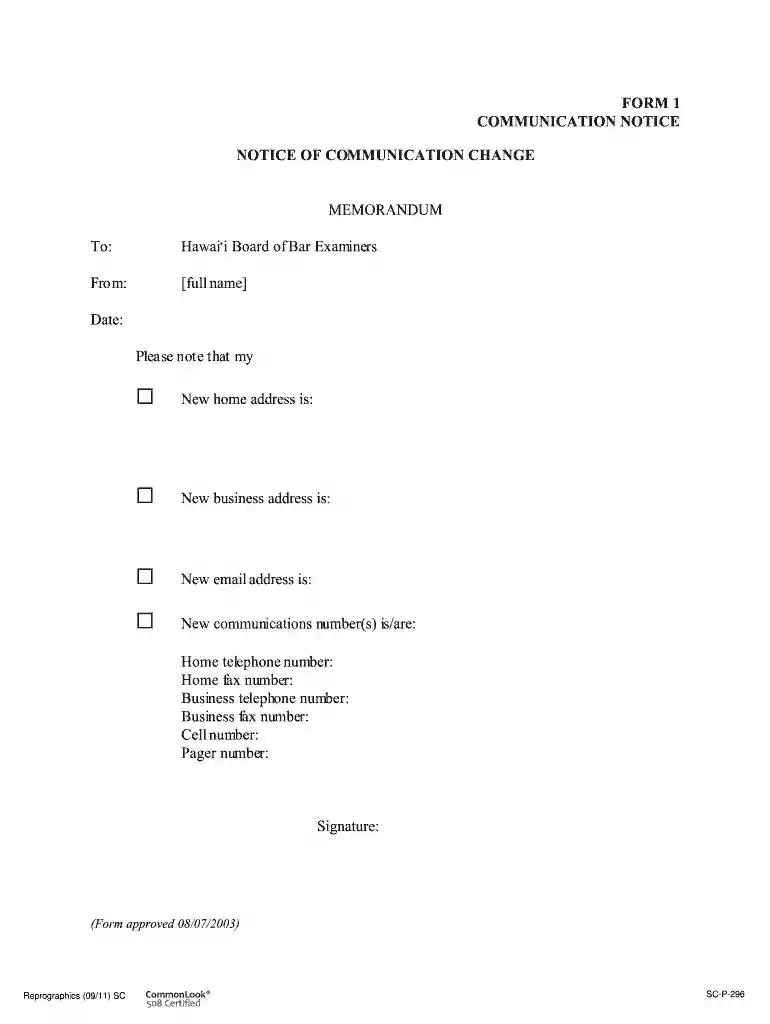
  2. Begin by entering your full name in the designated field at the top of the form. This ensures that your communication change is properly attributed.
  3. Next, indicate your new home address by checking the appropriate box and filling in the address details. Make sure to provide complete information for accurate updates.
  4. If applicable, check the box for a new business address and enter the relevant details in the provided fields.
  5. Update your email address by selecting the corresponding option and typing in your new email. This is crucial for maintaining effective communication.
  6. Fill in your new communication numbers, including home, business, cell, and pager numbers as necessary. Ensure all entries are correct to avoid any disruptions.
  7. Finally, sign the document at the bottom to validate your changes before submitting it through our platform.

Start using our platform today to effortlessly manage your document needs for free!

See more Fiscal Policies - General Information General Information - courts state hi versions

We've got more versions of the Fiscal Policies - General Information General Information - courts state hi form. Select the right Fiscal Policies - General Information General Information - courts state hi version from the list and start editing it straight away!
Versions Form popularity Fillable & printable
2011 4.8 Satisfied (102 Votes)
be ready to get more

Complete this form in 5 minutes or less

Get form

Got questions?

We have answers to the most popular questions from our customers. If you can't find an answer to your question, please contact us.
Contact us
The Regular Claims Court is a division of the District Court. The Regular Claims Division hears all civil actions in which the debt, damages or value of property claimed does not exceed $40,000.
In representing a client, a lawyer shall not communicate about the subject of the representation with a person the lawyer knows to be represented by another lawyer in the matter, unless the lawyer has the consent of the other lawyer or is authorized to do so by law or a court order.
The Code of Conduct for United States Judges includes the ethical canons that apply to federal judges and provides guidance on their performance of official duties and engagement in a variety of outside activities.
[1] The Hawai#i Revised Code of Judicial Conduct consists of four Canons, numbered Rules under each Canon, and Comments that generally follow and explain each Rule. The Scope and Terminology sections provide additional guidance in interpreting and applying the Code.
The New Code of Judicial Conduct for the Philippine Judiciary (A.M. No. 03-05-01-SC) stands as one of the foremost legal and ethical frameworks ensuring that judges in the Philippines faithfully discharge their duties with independence, integrity, impartiality, propriety, equality, competence, and diligence.

Security and compliance

At DocHub, your data security is our priority. We follow HIPAA, SOC2, GDPR, and other standards, so you can work on your documents with confidence.

Learn more
ccpa2
pci-dss
gdpr-compliance
hipaa
soc-compliance
be ready to get more

Complete this form in 5 minutes or less

Get form

People also ask

General jurisdiction in civil and criminal cases. Exclusive jurisdiction in probate [guardianship] and criminal felony cases, as well as civil cases where the contested amount exceeds $40,000. Concurrent jurisdiction with District Courts in civil non-jury cases that specify amounts between $10,000-$40,000.

Related links