Nih stroke scale 2026

Get Form
ocms maryland Preview on Page 1

Here's how it works

01. Edit your ocms maryland online
Type text, add images, blackout confidential details, add comments, highlights and more.

02. Sign it in a few clicks
Draw your signature, type it, upload its image, or use your mobile device as a signature pad.

03. Share your form with others
Send it via email, link, or fax. You can also download it, export it or print it out.

How to use or fill out NIH TRANSHARE Program Application with our platform

Form edit decoration
9.5
Ease of Setup
DocHub User Ratings on G2
9.0
Ease of Use
DocHub User Ratings on G2
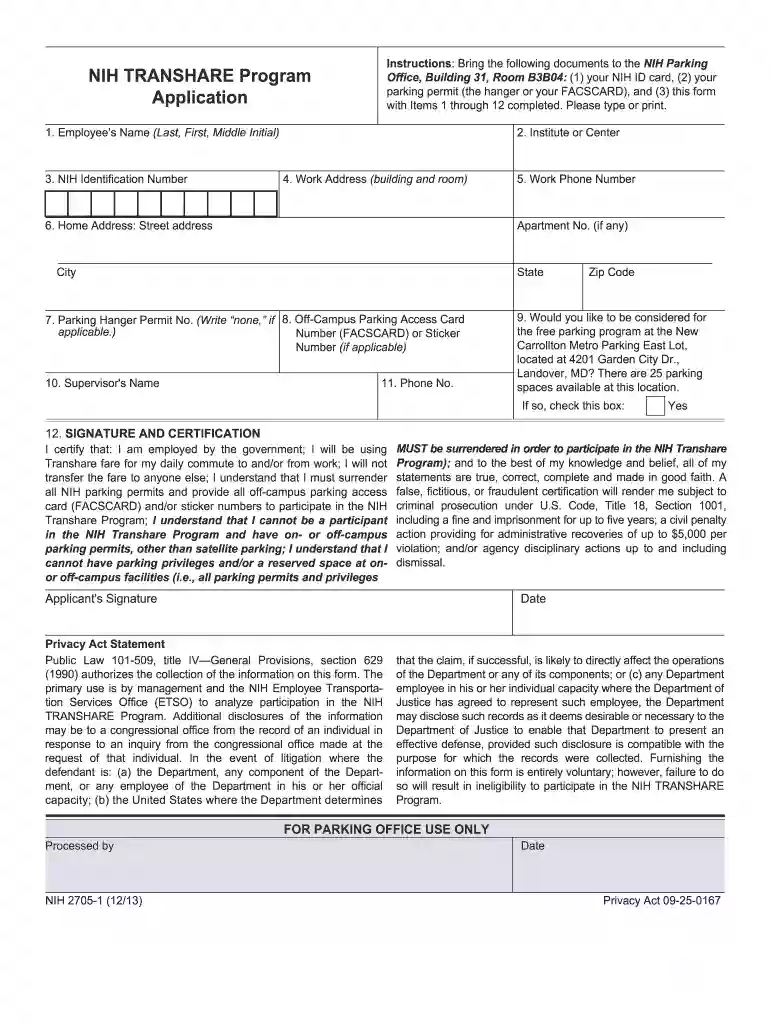
  1. Click ‘Get Form’ to open the NIH TRANSHARE Program Application in the editor.
  2. Begin by entering your Employee’s Name in the designated field, ensuring you include your last name, first name, and middle initial.
  3. Next, input your NIH Identification Number in the corresponding section to verify your employment status.
  4. Fill in your Institute or Center and Work Address, including building and room number for accurate identification.
  5. Provide your Home Address details, including street address, apartment number (if applicable), city, state, and zip code.
  6. Complete the Parking Hanger Permit No. field; if not applicable, write 'none'.
  7. If you wish to be considered for off-campus parking access, check the appropriate box and provide any necessary card numbers.
  8. Enter your Supervisor's Name and Work Phone Number for verification purposes.
  9. Finally, review all entries for accuracy before signing and dating the certification statement at the bottom of the form.

Start filling out your NIH TRANSHARE Program Application today using our platform for free!

See more nih stroke scale versions

We've got more versions of the nih stroke scale form. Select the right nih stroke scale version from the list and start editing it straight away!
Versions Form popularity Fillable & printable
2013 4.8 Satisfied (80 Votes)
2012 4.1 Satisfied (30 Votes)
be ready to get more

Complete this form in 5 minutes or less

Get form

Got questions?

We have answers to the most popular questions from our customers. If you can't find an answer to your question, please contact us.
Contact us
How to use the NIH Stroke Scale: 0 = Alert; keenly responsive. 1 = Not alert; but arousable by minor stimulation to obey, answer, or respond. 2 = Not alert; requires repeated stimulation to attend or is obtunded and requires strong or painful stimulation to make movements (not stereotyped).
The score for each ability is a number between 0 and 4, 0 being normal functioning and 4 being completely impaired. The patients NIHSS score is calculated by adding the number for each element of the scale; 42 is the highest score possible. In the NIHSS, the higher the score, the more impaired a stroke patient is.
Stroke severity may be stratified on the basis of NIHSS scores as follows (Brott et al, 1989): Very Severe: 25. Severe: 15 24. Mild to Moderately Severe: 5 14.
The National Institutes of Health Stroke Scale (NIHSS) is the most widely used deficit rating scale in modern neurology: over 500 000 healthcare professionals have been certified to administer it using a web-based platform.
The scale is made up of 11 different elements that evaluate specific ability. The score for each ability is a number between 0 and 4, 0 being normal functioning and 4 being completely impaired. The patients NIHSS score is calculated by adding the number for each element of the scale; 42 is the highest score possible. What Is The NIH Stroke Scale (NIHSS)? - Saebo saebo.com blogs clinical-article nih-str saebo.com blogs clinical-article nih-str

Security and compliance

At DocHub, your data security is our priority. We follow HIPAA, SOC2, GDPR, and other standards, so you can work on your documents with confidence.

Learn more
ccpa2
pci-dss
gdpr-compliance
hipaa
soc-compliance

People also ask

A score of 2, severe or total sensory loss, should only be given when a severe or total loss of sensation can be clearly demonstrated. Stuporous and aphasic patients will, therefore, probably score 1 or 0. The patient with brainstem stroke who has bilateral loss of sensation is scored 2.

Related links