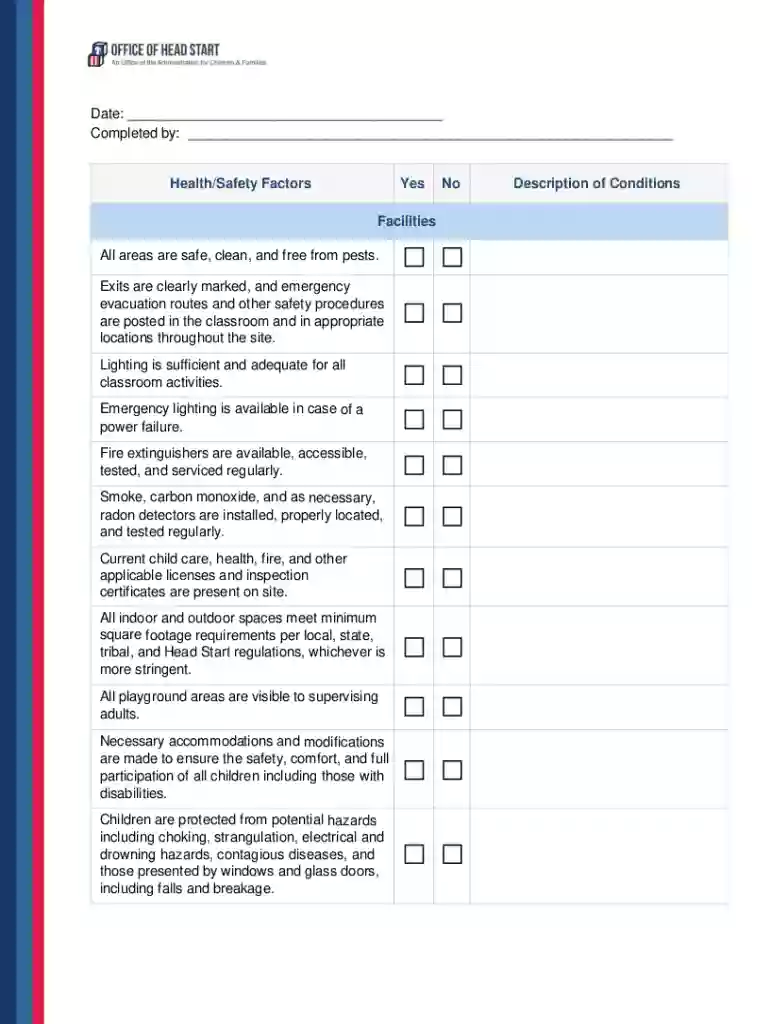
Safety screener 2026

Get Form
safety screener Preview on Page 1

Here's how it works

01. Edit your safety screener online
Type text, add images, blackout confidential details, add comments, highlights and more.

02. Sign it in a few clicks
Draw your signature, type it, upload its image, or use your mobile device as a signature pad.

03. Share your form with others
Send screener head via email, link, or fax. You can also download it, export it or print it out.

How to use or fill out the safety screener with our platform

Form edit decoration
9.5
Ease of Setup
DocHub User Ratings on G2
9.0
Ease of Use
DocHub User Ratings on G2
  1. Click ‘Get Form’ to open the safety screener in the editor.
  2. Begin by entering the date and your name in the designated fields at the top of the form.
  3. Review each health and safety factor listed. For each item, mark 'Yes' or 'No' based on your assessment of the site.
  4. If you mark 'No' for any item, provide a detailed description of the conditions in the space provided. This will help identify areas needing improvement.
  5. Once all sections are completed, review your responses to ensure accuracy. Make any necessary edits directly within the editor.
  6. Save your completed screener and share it with relevant staff members for follow-up actions and improvements.

Start using our platform today to streamline your safety screening process for free!

See more safety screener versions

We've got more versions of the safety screener form. Select the right safety screener version from the list and start editing it straight away!
Versions Form popularity Fillable & printable
2017 4.8 Satisfied (156 Votes)
be ready to get more

Complete this form in 5 minutes or less

Get form

Got questions?

We have answers to the most popular questions from our customers. If you can't find an answer to your question, please contact us.
Contact us
To develop a robust patient safety culture, organizations should focus on the following five key components. Leadership commitment. Tap to unmute. Open communication. Continuous learning and improvement. Teamwork and collaboration. Patient involvement.
In this post, we look at the 5 different types of risk assessment in health and safety. And when and why you might use each one. Including qualitative, quantitative, generic, site-specific and dynamic risk assessments. Not all risk assessments are the same.
The Patient Safety Screener (PSS-3) is a brief screening tool to detect suicide risk in all patients presenting to acute care settings.

Security and compliance

At DocHub, your data security is our priority. We follow HIPAA, SOC2, GDPR, and other standards, so you can work on your documents with confidence.

Learn more
ccpa2
pci-dss
gdpr-compliance
hipaa
soc-compliance