




01. Edit your bill of sale bc online
Type text, add images, blackout confidential details, add comments, highlights and more.

Type text, add images, blackout confidential details, add comments, highlights and more.

Draw your signature, type it, upload its image, or use your mobile device as a signature pad.

Send free printable bill of sale bc via email, link, or fax. You can also download it, export it or print it out.
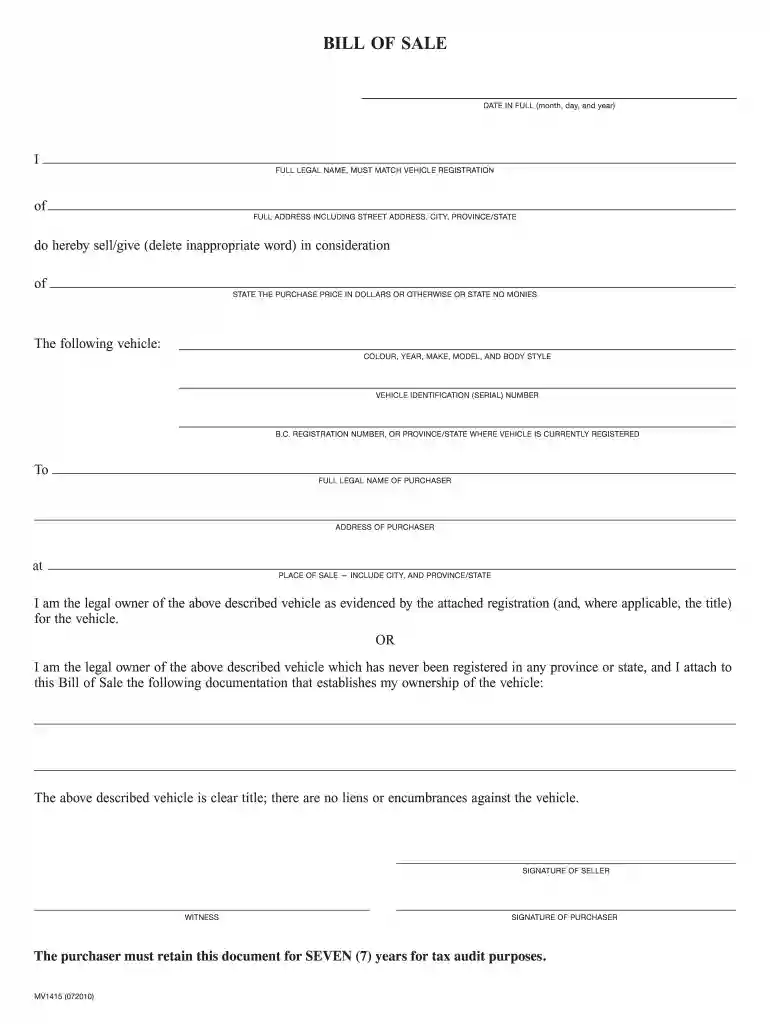
The MV1415, commonly referred to as the Bill of Sale for motor vehicles in British Columbia, acts as a formal record documenting the transfer of title from a seller to a buyer. It is crucial for legal and tax purposes, confirming that the vehicle has been sold free of debts or liens. This document serves as a protective measure for both parties involved in the transaction, ensuring that the details of the sale are clear and traceable.
Key components typically included in the MV1415 are:
The MV1415 serves as a vital tool in the buying and selling process of used vehicles in British Columbia. To effectively use the MV1415, both parties should understand the steps involved in accurately filling out the form and the implications of the information contained within it.
Steps to follow when using the MV1415:
The MV1415 also allows for additional notes or terms of sale to be included, which can clarify agreements about the vehicle's condition or any warranties, thus adding further protection for both parties involved.
Completing the MV1415 accurately is crucial for facilitating a smooth transfer of ownership of the vehicle. Here’s a detailed guide on how to fill out the MV1415:
Accurate completion of the MV1415 not only protects the seller from future claims but also ensures that the buyer has legal proof of their purchase, which is essential for registration and insurance purposes.
Understanding the terms associated with the MV1415 is essential for both buyers and sellers. Here are some key terms related to the form:
Having familiarity with these terms helps both parties navigate the sale process, ensuring that all aspects are understood and addressed before the transaction is finalized.
The MV1415 serves not only as a formal agreement between buyer and seller but also has legal ramifications under British Columbia law. Proper utilization and completion of the MV1415 have several legal implications, including:
By understanding these legal aspects, both buyers and sellers can engage in vehicle transactions with confidence, knowing that their rights and responsibilities are clearly documented.
The MV1415 can be applied in various real-world scenarios to facilitate the buying and selling of vehicles. Here are some examples that illustrate its importance:
A seller decides to sell their used vehicle to a friend. They fill out the MV1415, including the sale price and details about the vehicle. Both parties sign the document, giving the buyer legal proof of ownership during the subsequent transfer process at the motor vehicle branch.
A family member passes away, leaving a car to another relative. The inheriting family member uses the MV1415 to record the transfer of the vehicle, ensuring that there is a formal record of ownership for registration purposes.
A customer purchases a vehicle from a dealership that utilizes the MV1415 to finalize the sale. The dealership provides a completed version to the buyer, ensuring that they have legal proof of purchase necessary for registration with the provincial authorities.
These examples showcase how versatile the MV1415 is across multiple transactions, enhancing transparency and legitimacy in motor vehicle sales.
We've got more versions of the bill of sale bc form. Select the right bill of sale bc version from the list and start editing it straight away!
| Versions | Form popularity | Fillable & printable |
|---|---|---|
| 2010 | 4 Satisfied (23 Votes) |
Yes, you can utilize DocHub for signing any business and personal documentation, including your icbc bill of sale pdf. All eSignatures you create with our service are legally binding and court-admissible, as DocHub complies with criteria required by ESIGN and UETA. Save your accomplished paperwork with a detailed Audit Trail if necessary.
You can easily edit and complete your printable bill of sale bc on any iOS device. Open an internet browser of your liking, go to the DocHub website, authorize or create a new account, add your file for editing, and make your required alterations. Our service is mobile-friendly, so utilizing its functions on your phone will be a no-brainer, even on the first try.
At DocHub, your data security is our priority. We follow HIPAA, SOC2, GDPR, and other standards, so you can work on your documents with confidence.
by MDS Hossain Cited by 4 In this paper, clock-power co-design is proposed for deep sub-threshold circuits operating at 250 mV. A distributed, multi-voltage domain, and hierarchicalRead more
THE AlTACHED FILES ARE OFFICIAL. RECORDS OF THE INFORMATION . REPORTS MANAGEMENT BRANCH. THEY HAVE BEEN CHARGED TO YOU. FOR A LIMITED TIME PERIOD AND.Read more


