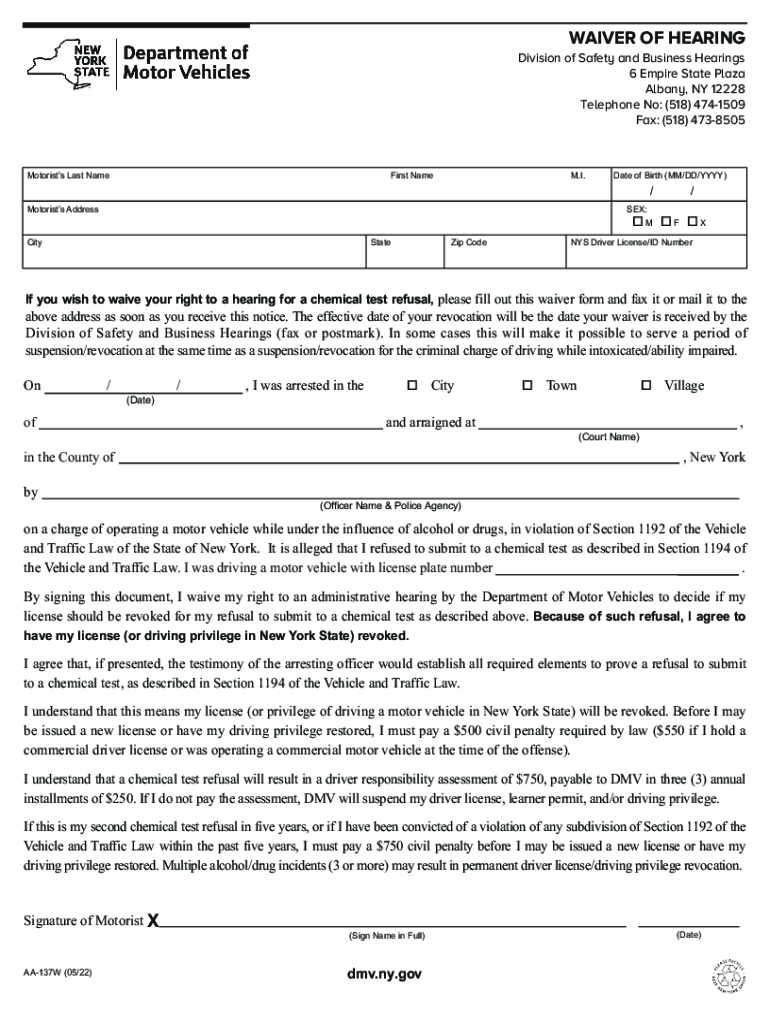
WAIVER OF HEARING 2026

Get Form
WAIVER OF HEARING Preview on Page 1

Here's how it works

01. Edit your form online
Type text, add images, blackout confidential details, add comments, highlights and more.
02. Sign it in a few clicks
Draw your signature, type it, upload its image, or use your mobile device as a signature pad.
03. Share your form with others
Send it via email, link, or fax. You can also download it, export it or print it out.

How to use or fill out WAIVER OF HEARING with our platform

Form edit decoration
9.5
Ease of Setup
DocHub User Ratings on G2
9.0
Ease of Use
DocHub User Ratings on G2
  1. Click ‘Get Form’ to open the WAIVER OF HEARING in the editor.
  2. Begin by entering your last name, first name, and middle initial in the designated fields. Ensure accuracy for identification purposes.
  3. Fill in your date of birth using the MM/DD/YYYY format. Select your sex by marking the appropriate box (M, F, or X).
  4. Provide your complete address including city, state, and zip code to ensure proper processing of your waiver.
  5. Enter your NYS Driver License/ID Number accurately as it is crucial for linking this waiver to your driving record.
  6. In the section regarding your arrest details, fill in the date of arrest and location (City/Town/Village) along with court name and county.
  7. Sign the document in the designated area to confirm that you waive your right to a hearing. Make sure to include the date of signing.

Start filling out your WAIVER OF HEARING today for free on our platform!

See more WAIVER OF HEARING versions

We've got more versions of the WAIVER OF HEARING form. Select the right WAIVER OF HEARING version from the list and start editing it straight away!
Versions Form popularity Fillable & printable
2022 4.2 Satisfied (47 Votes)
2018 4.8 Satisfied (129 Votes)
2017 4.3 Satisfied (42 Votes)
be ready to get more

Complete this form in 5 minutes or less

Get form

Got questions?

We have answers to the most popular questions from our customers. If you can't find an answer to your question, please contact us.
Contact us
Trial Waiver: When a defendant waives their right to a trial, they typically agree to plead guilty or accept a plea deal. This can expedite case resolution but eliminates the possibility of a trial.
The Procedure for Waiving a Preliminary Hearing In either case, you must: be represented by an attorney at the time of the waiver or. waive the right to counsel in open court (except capital cases).
Requesting a waiver hearing provides the opportunity to either seek reduced penalties or seek probation in lieu of a conviction. Requesting a trial provides the opportunity to challenge your traffic ticket outright.
A waiver of preliminary examination is a legal document that allows a defendant to forgo their right to a preliminary hearing. This means the defendant agrees to be bound over to court without the need for this initial court appearance.
0:21 3:39 So what exactly happens after you wave this hearing. When you wave a preliminary hearing your caseMoreSo what exactly happens after you wave this hearing. When you wave a preliminary hearing your case will proceed to the next stage more quickly. But this comes with some docHub implications.

Security and compliance

At DocHub, your data security is our priority. We follow HIPAA, SOC2, GDPR, and other standards, so you can work on your documents with confidence.

Learn more
ccpa2
pci-dss
gdpr-compliance
hipaa
soc-compliance

People also ask

A waiver hearing is a type of court hearing where a person decides to give up their right to a trial and instead plead guilty to a crime. This hearing is also called a transfer hearing. A hearing is when people go to court to talk about a problem and a judge listens to both sides and makes a decision.
If the case is waived, this simply means that the defendant agrees that the Commonwealth would be able to prove their basic case and that they will allow the case to proceed to the Court of Common Pleas without having a hearing to make that determination.
If the case is waived, this simply means that the defendant agrees that the Commonwealth would be able to prove their basic case and that they will allow the case to proceed to the Court of Common Pleas without having a hearing to make that determination. 10. What if I do not feel safe entering/exiting the Courthouse?

Related links