




01. Edit your navmc 11622 online
Type text, add images, blackout confidential details, add comments, highlights and more.

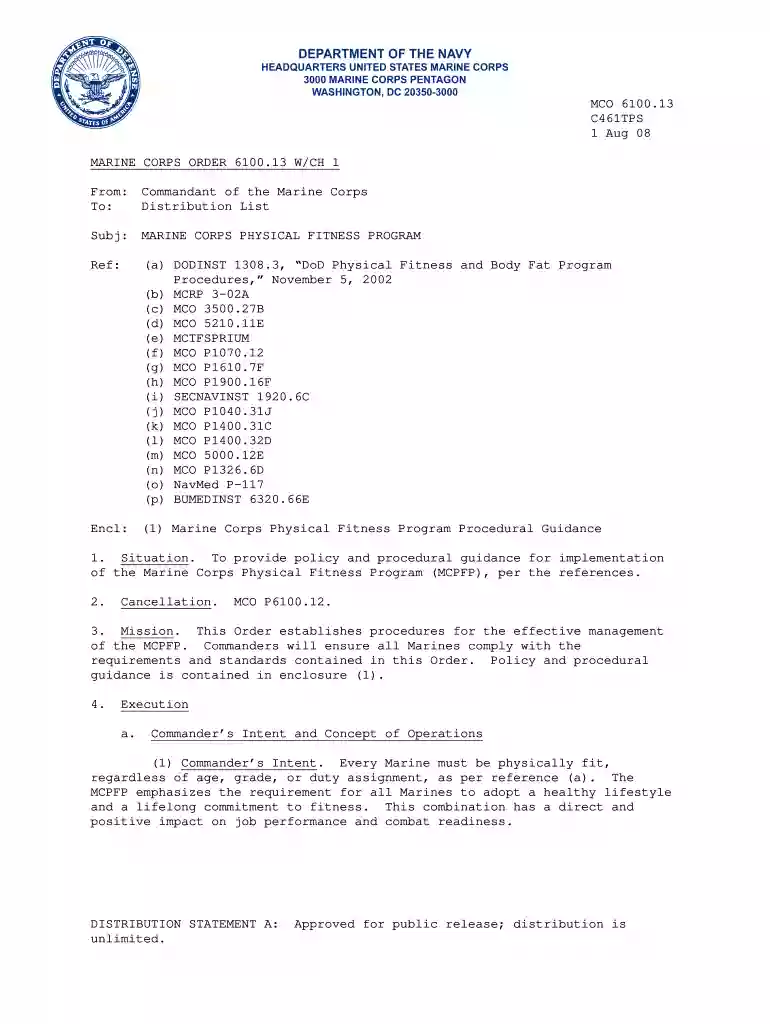
Type text, add images, blackout confidential details, add comments, highlights and more.

Draw your signature, type it, upload its image, or use your mobile device as a signature pad.

Send pft navmc via email, link, or fax. You can also download it, export it or print it out.
NAVMC 11622, also known as the USMC PFT order, is a critical document that outlines the parameters and details surrounding the Marine Corps Physical Fitness Test (PFT). This form is essential for Marines to understand the standards they need to meet for physical fitness, ensuring combat readiness. Below is a comprehensive dive into the key elements and procedural aspects related to NAVMC 11622.
NAVMC 11622 serves as the official guideline for conducting the PFT within the United States Marine Corps. It is paramount for all Marines, as this standardized order establishes:
Understanding this document is crucial for Marines to maintain their physical readiness and fulfill their operational obligations effectively.
NAVMC 11622 details the structure of the PFT, which consists of several pivotal components:
Running: The PFT includes a three-mile run that assesses cardiovascular endurance. Marines must complete this run within established time limits that vary by age and gender.
Pull-Ups: This segment measures upper body strength, with alternating options for males and females, including the option for flexed-arm hangs for females.
Crunches: For core strength, Marines perform crunches within a two-minute timeframe, with the number completed determining their score.
These components together provide a comprehensive assessment of a Marine's physical fitness levels.
Upon completion of the PFT according to NAVMC 11622, several steps must be followed for accurate reporting:
Document Results: Each Marine must record their results on the PFT performance worksheet as indicated in the order. This form ensures accountability and tracks performance trends over time.
Submit to Command: Results should be submitted to the appropriate commanding officer, adhering to deadlines specified within the NAVMC 11622 guidelines.
Understanding key terms associated with NAVMC 11622 enhances clarity and compliance:
Combat Fitness Test (CFT): In addition to the PFT, the CFT is outlined in the guidelines and assesses a Marine's combat readiness through various physical tasks.
Performance Standards: Specific criteria set forth in the order that Marines must meet to demonstrate adequate physical conditioning.
Age and Gender Adjustments: Time constraints and scoring criteria may differ based on the age and gender of the Marine.
While NAVMC 11622 focuses on the PFT, alternative physical assessments can apply in special scenarios:
Remote or Non-Traditional Evaluations: In some cases, when traditional PFT settings are not possible, alternative testing procedures may be allowed with prior approval.
Injury Protocols: For Marines temporarily unable to perform standard assessments due to injuries, medical evaluations may provide alternative pathways to demonstrate fitness.
Before partaking in the PFT, Marines must meet specific eligibility criteria as stipulated in NAVMC 11622:
Medical Clearance: A medical evaluation is necessary to ensure that Marines are fit to participate in the PFT, especially those with previous injuries or health concerns.
Operational Tempo Considerations: Active duty Marines' schedules may influence their eligibility and preparation for the PFT, necessitating advance planning and instructor guidance.
By adhering to NAVMC 11622, the Marine Corps aims to ensure that all service members maintain high physical standards, reinforcing the foundational role of fitness in military readiness. Understanding this order empowers Marines to take proactive measures in their training, assessment, and overall health.


We've got more versions of the navmc 11622 form. Select the right navmc 11622 version from the list and start editing it straight away!
| Versions | Form popularity | Fillable & printable |
|---|---|---|
| 2008 | 4.8 Satisfied (285 Votes) |
At DocHub, your data security is our priority. We follow HIPAA, SOC2, GDPR, and other standards, so you can work on your documents with confidence.
Time Pass/Fail. NAVMC 11622 (Rev. 11-16) (EF). *Note: Risk Factor Worksheet required for Marines age 46 and over. DocHub Designer 11.0. PHA. Date. Push. Ups. 5KRead more
Mar 22, 2016 Source documentation validating training item (i.e. NAVMC. 11622 PFT/CFT Worksheet, NAVMC 11432 MCMAP Course Record etc.) 2. Upon receipt ofRead more


