Vermont equivalency foreign law 2026

Get Form
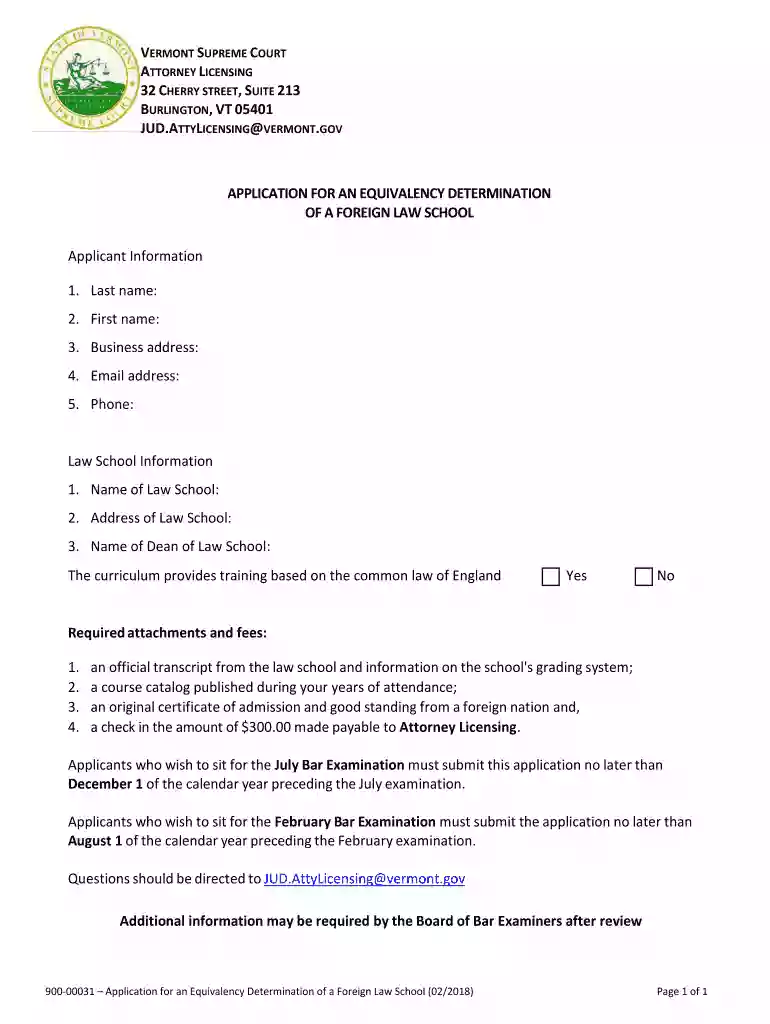
vermont equivalency foreign Preview on Page 1

Here's how it works

01. Edit your vermont equivalency foreign online
Type text, add images, blackout confidential details, add comments, highlights and more.

02. Sign it in a few clicks
Draw your signature, type it, upload its image, or use your mobile device as a signature pad.

03. Share your form with others
Send vermont equivalency foreign law via email, link, or fax. You can also download it, export it or print it out.

How to use or fill out Vermont Equivalency Foreign Law with our platform

Form edit decoration
9.5
Ease of Setup
DocHub User Ratings on G2
9.0
Ease of Use
DocHub User Ratings on G2
  1. Click ‘Get Form’ to open the Vermont Equivalency Foreign Law application in the editor.
  2. Begin by filling out the Applicant Information section. Enter your last name, first name, business address, email address, and phone number accurately.
  3. Next, move to the Law School Information section. Provide the name and address of your law school, along with the name of the Dean.
  4. Indicate whether your curriculum provides training based on the common law of England by selecting 'Yes' or 'No'.
  5. In the Required Attachments and Fees section, ensure you have included all necessary documents: an official transcript, a course catalog from your attendance years, an original certificate of admission and good standing from a foreign nation, and a check for $300 made payable to Attorney Licensing.
  6. Review all entered information for accuracy before submitting. Ensure that you meet submission deadlines for either the July or February Bar Examination.

Start using our platform today to complete your Vermont Equivalency Foreign Law application easily and for free!

See more vermont equivalency foreign law versions

We've got more versions of the vermont equivalency foreign law form. Select the right vermont equivalency foreign law version from the list and start editing it straight away!
Versions Form popularity Fillable & printable
2018 4.8 Satisfied (74 Votes)
be ready to get more

Complete this form in 5 minutes or less

Get form

Got questions?

We have answers to the most popular questions from our customers. If you can't find an answer to your question, please contact us.
Contact us
Are foreign law degrees recognized in the United States? Yes. Many states recognize foreign law degrees. However, these degrees are subject to review by state bar regulators.
In Vermont, an applicant can participate in a law office study program, an alternative to attending law school. An applicant must have a bachelors degree and study law for 25 hours a week for four years. This program must be administered with the supervision of a lawyer or judge.
In four states, you can still take this non-law-school route to becoming a lawyer. Vermont, Washington, California, and Virginia all allow people to become lawyers by reading the law, which, simply put, means studying and apprenticing in the office of a practicing attorney or judge.
The Vermont Bar Exam is as hard as the bar exam of the 40 other jurisdictions that have adopted the UBE. However, states with non-UBE components may be considered more difficult.
Vermont is famous for being one of the few states where people can still study for the bar exam under an apprenticeship model. Vermonts law office study (LOS) program allows participants to study 25 hours a week for four years with a Vermont attorney or a judge instead of going to law school.

Security and compliance

At DocHub, your data security is our priority. We follow HIPAA, SOC2, GDPR, and other standards, so you can work on your documents with confidence.

Learn more
ccpa2
pci-dss
gdpr-compliance
hipaa
soc-compliance

People also ask

In the United States, there are four states that allow a person to qualify to take the bar exam without attending any law school: California, Vermont, Virginia, and Washington. Instead, the student studies between three and four years in a law office.
Is Vermont Law and Graduate School ABA-accredited? Vermont Law and Graduate School is approved by the Council of the Section of Legal Education and Admissions to the Bar of the American Bar Association.
To become a lawyer in Vermont, one must hold a degree from an accredited four-year university, make a passing score on the LSAT exam and complete an accredited law school program, and finally, complete the bar exam with a UBE total of 270 or greater.

Related links