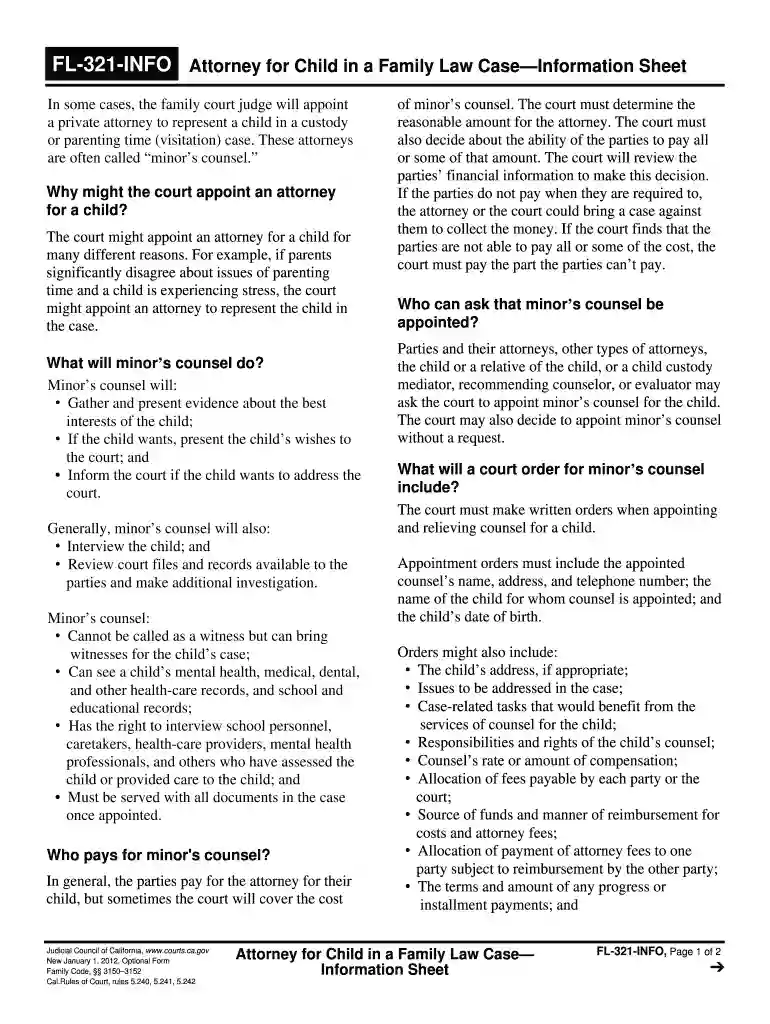
family child law Preview on Page 1

Attorney child family law 2026

Here's how it works

  • 01. Edit your family child law online

    Type text, add images, blackout confidential details, add comments, highlights and more.

  • 02. Sign it in a few clicks

    Draw your signature, type it, upload its image, or use your mobile device as a signature pad.

  • 03. Share your form with others

    Send it via email, link, or fax. You can also download it, export it or print it out.

How to use or fill out attorney child family law with our platform

Form edit decoration
9.5
Ease of Setup
DocHub User Ratings on G2
9.0
Ease of Use
DocHub User Ratings on G2
  1. Click ‘Get Form’ to open the attorney child family law document in the editor.
  2. Begin by entering the child's name and date of birth in the designated fields. This information is crucial for identifying the minor involved in the case.
  3. Fill out the section regarding the appointment of minor’s counsel. Include details such as the name, address, and contact number of the appointed attorney.
  4. In the next section, outline any specific issues that need to be addressed in relation to custody or visitation. Be clear and concise to ensure all relevant matters are covered.
  5. Review financial responsibility sections carefully. Indicate how fees will be allocated between parties and whether any costs will be covered by the court.
  6. Finally, ensure all signatures are completed where required before saving or sharing your document for further processing.

Start using our platform today for free to streamline your document editing and signing process!

See more family child law versions

We've got more versions of the family child law form. Select the right family child law version from the list and start editing it straight away!

VersionsForm popularityFillable & printable
20124.8 Satisfied (80 Votes)

be ready to get more

Complete this form in 5 minutes or less

Got questions?

We have answers to the most popular questions from our customers. If you can't find an answer to your question, please contact us.

Custody Battle Blunders: Top 10 Mistakes To Avoid Negative Speech About The Other Parent. Seeking Sympathy From The Child. Poor Communication With The Other Parent. Unjustifiably Withholding Access With The Other Parent. Misrepresenting Substance Abuse. Separating Siblings In Blended Families.
In most custody battles, the winner is the parent who can best demonstrate that they serve the childs best interests. While mothers still win more cases overall, the gap has narrowed as fathers play a greater role in raising their children.
Conclusion. In most custody battles, the winner is the parent who can best demonstrate that they serve the childs best interests. While mothers still win more cases overall, the gap has narrowed as fathers play a greater role in raising their children.
The evaluator will typically examine each parents emotional functioning, parenting history, and relationship with the child. An unstable parent may demonstrate frequent emotional outbursts, poor decision-making, or an inability to set boundariesall of which could put a child at risk.
Here are 10 tips to give you an edge in your case: Demonstrate that You Provide a Safe Environment. Be Stable. Dont Alienate the Other Parent. Keep Your Children Out of the Litigation (if possible) Pay Your Child Support on Time. Try to Co-Parent Act in the Best Interest of the Child Show The Court Your Best Self.

Security and compliance

At DocHub, your data security is our priority. We follow HIPAA, SOC2, GDPR, and other standards, so you can work on your documents with confidence.

People also ask

Disrespectful Language: Avoid insults, sarcasm, or any derogatory remarks. Personal Attacks: Never make personal comments about the judges character or past decisions, such as ``You always rule against people like me. Interrupting: Speaking over the judge or interrupting them can be seen as disrespectful.

Related links

Constructing a Legal Education for a Career in Family Law

The seminar examines the role of a lawyer for child clients (including issues of professional responsibility) and the various models of representation providedRead more

Learn more
Foster Youth Handbook.pdf

You are entitled to your own attorney/ lawyer. Your family and the LDSS have their own attorneys/ lawyers. Your attorney will meet with you before each court.Read more

Learn more
If you believe that this page should be taken down, please follow our DMCA take down process here